

A Closer Look: De Bethune DB25 Monopusher Chronograph
Reviews
A Closer Look: De Bethune DB25 Monopusher Chronograph

De Bethune may be best known today for its ultra-futuristic designs and advanced materials, but the brand’s founding collection (from the DB1 to DB5) was rooted in a more traditional design language, something closer to Breguet with features like Breguet-style hands, guilloché dials, and chemin-de-fer minute tracks. They were simple, streamlined, and elegant in a subtly modern way, with ogival lugs. Naturally, not many remember that the very first collection included a monopusher chronograph — the DB1 — followed by the DB8 in 2003.
Fortunately, the brand hasn’t forgotten its own best ideas. From time to time, it revisits those early creations, subtly updating them with modern, proprietary technology. In 2023, it introduced the DB Eight which debuted a new in-house chronograph movement, the caliber DB3000, in a 42.4mm case. This year, the same movement returns in the DB25 Monopusher Chronograph. It is a hidden gem in the collection; next to the immensely complex Maxichrono, it stands as an entry-level chronograph, yet it offers far more than its placement suggests. It comes in a smaller, 40mm case, which better complements its classical styling.
How does the DB25 redefine the chronograph function?
What sets the DB25 Monopusher Chronograph apart is its radical minimalism. The dial and case are so restrained, the watch could easily be mistaken for a time-only piece with a small seconds display. Most chronographs feature two or three sub-dials typically for running seconds, elapsed minutes, and elapsed hours, but De Bethune pares this down to just one.
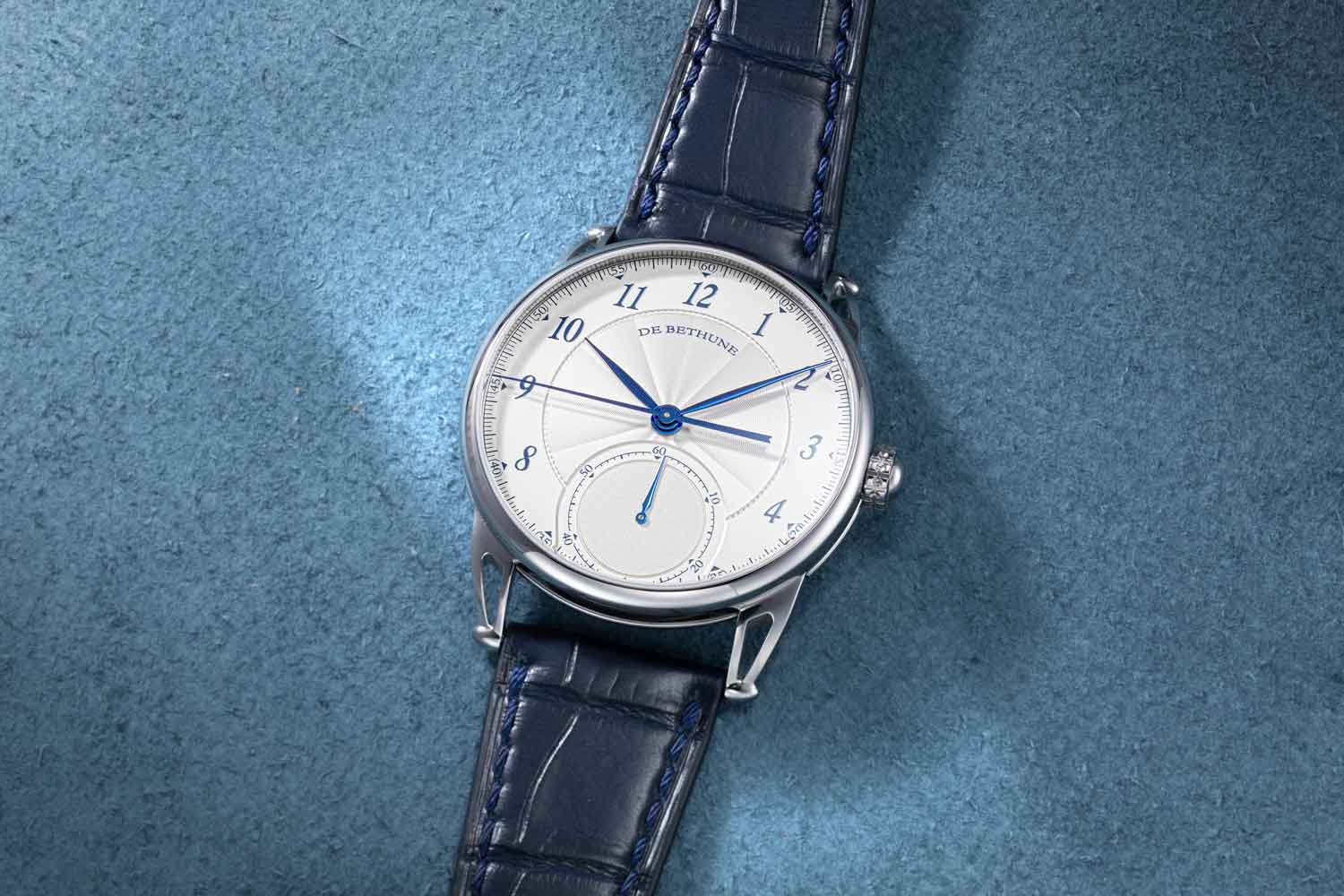
De Bethune DB25 Monopusher Chronograph is clean and compact. (Image: Revolution ©)
In terms of timekeeping, the watch displays only hours and minutes, omitting a running seconds hand altogether. For the chronograph function, it tracks only seconds and minutes, leaving out the hour counter entirely. The 60-minute totalizer sits where one would typically expect to find a running seconds sub-dial, and the result is one of the purest chronograph layouts available today. It is clean, highly legible, and free from visual clutter.
Most notably, the chronograph uses a monopusher construction. And if you’re wondering where the pusher is, it’s embedded in the crown. So what is a monopusher chronograph? It’s one that uses a single button to control the start, stop, and reset functions, always in that fixed order.

(Image: Revolution ©)
While twin pushers are common today, monopushers are typically found in high-end or design-driven chronographs. They are something of an anachronism. In fact, all early chronographs from the late 19th to early 20th century were monopushers. As a result, they could not perform start-stop-start timing, a function essential for tracking events with pauses or multiple intervals. It was not until 1933 that Breitling introduced the first chronograph with two pushers, one for start and stop, the other for reset. That more versatile layout has since become the standard.
Still, the monopusher holds a special appeal. Like many old-world solutions, it may not be the most practical — think mechanical watches compared to quartz — but it remains undeniably more charming. In this case, the hidden pusher integrated into the crown shows just how beautiful a monopusher can be.
Breguet cues, De Bethune language
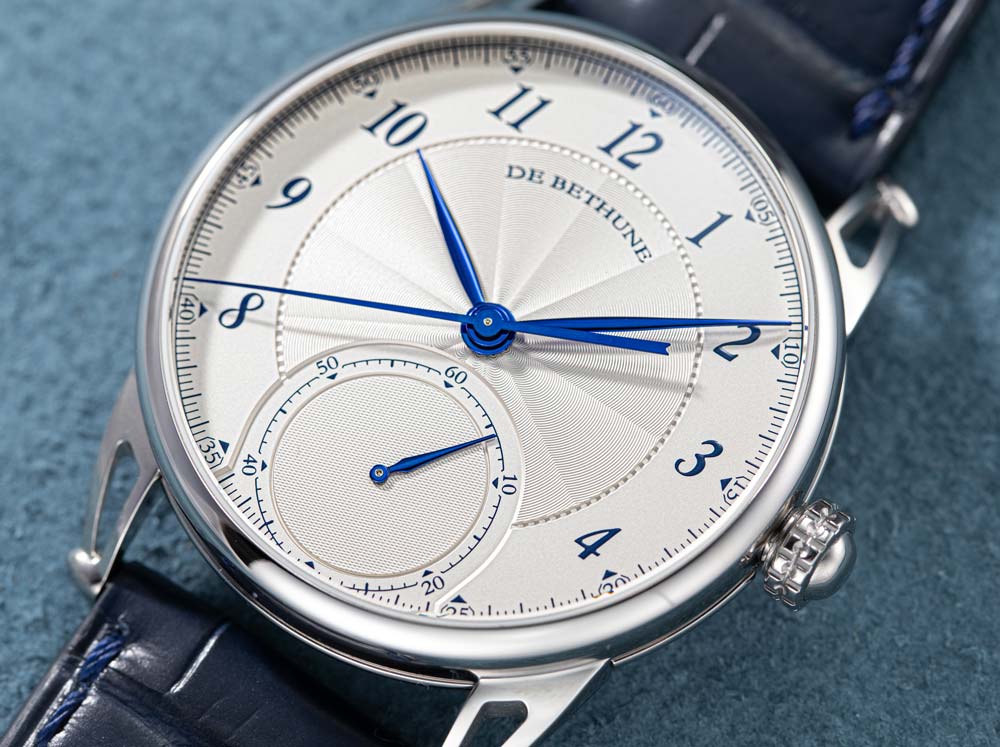
With the dial kept open and restrained, there is also space for refined decoration. This is where the Breguet influence shines through. The central portion features a radiating guilloché pattern (which somehow reminds me of the flapping wings of a butterfly) that flows outward before meeting a ring of filet sauté guilloché, which serves as both a visual boundary and a point of transition. The result is a subtly layered dial, balancing smooth and patterned surfaces to create distinct visual zones. Rather than leaving the dial as a single open expanse, this approach brings clarity and resolution to the composition.

(Image: Revolution ©)
The extra-large counter at six o’clock, on the other hand, has a barleycorn pattern. But the highlight here is not the guilloché but the shape of the cut-out. It’s a horseshoe or bell-shaped cut-out that echoes the design of the lugs, with the tip pointing outward. This shows attention to detail, with every element carefully considered to maintain coherence in design rather than defaulting to convention.
Another thing that’s worth mentioning is the execution of the Breguet numeral markers. Though printed, the numerals appear to be in light relief, with a subtle profile that sits slightly raised above the dial, and this crisp printing continues even on the smaller details, like the triangular markers at every five-minute interval.

The slim hands hovering over the shifting light on the radiating guilloché almost resemble a helicopter lifting off. (Image: Revolution ©)
Overall, the silver and blue combination gives the dial a refreshing feel, adding a touch of contemporary coolness that balances its classical elements and connects it more naturally to the distinctly futuristic case.
On the topic of the case, this is where De Bethune really shines. Its design language is so distinctive that the watch is instantly recognisable, even without the logo on the dial. And while it doesn’t feature the brand’s signature floating lugs, the case is still beautifully executed, with short, thin lugs that improve wearability. That wearability is further helped by the 40 mm size, which makes the floating lugs less necessary – since their main purpose was to reduce the lug-to-lug span on larger watches to better suit smaller wrists.

Crisp and clean dial printing. (Image: Revolution ©)

The single chronograph pusher is beautifully integrated into the crown. (Image: Revolution ©)
The DB3000 movement redefines chronograph aesthetics
It almost feels essential that a high-end chronograph should be hand-wound. That way, all the clutches, springs, and wheels can be admired in full view, without being blocked by a winding rotor. And that’s exactly the case here. But unlike most manual-winding chronograph movements, the in-house DB3000 looks a little different. The movement bridges don’t resemble anything else on the market. Rather than discrete bridge segments for individual components, it has a sweeping architecture, spanning the movement in broad, arching forms.

The manual-winding DB3000. (Image: Revolution ©)
Additionally, they are in mirror polished and chromium plated steel, which make for quite a striking composition that immediately sets it apart from the chronographs we have grown familiar with. The surfaces catch and reflect light, which reinforces the brand’s signature fusion of classical craft and futuristic aesthetics.
The real star here is the finishing, which is something De Bethune does remarkably well despite its contemporary visual identity. The first thing to notice is the mix of textures. You have polished bridges, brushed levers below, and, further down, sandblasted plates that add visual depth and nuance. More importantly, the steel levers and bridges feature rounded, polished bevels, just like those found on high-end classical dress watches. The sandblasted base plate doesn’t receive the same bevelled treatment, but that might be forgivable. The brand is after all rooted in a modern aesthetic, and the sharper edges introduce a bit of definition to the movement.

Contrasting tones and finishes create depth. (Image: Revolution ©)

Some beautiful outward angles are present, though it feels like a missed opportunity not to include one or two inward ones. (Image: Revolution ©)

(Image: Revolution ©)
And while we’re on the topic of contemporary elements, the balance assembly deserves special mention. It is entirely unique to De Bethune. This becomes obvious at a glance, because the balance wheel looks like nothing else on the market. Made from titanium with white gold inserts, the wheel is the brand’s own patented design, introduced in 2016. The combination of materials achieves a higher moment of inertia with reduced overall mass, enhancing rate stability and energy efficiency. It is attached to a balance spring with a flat terminal curve, patented even earlier in 2006. This design offers the concentric breathing of an overcoil without the added thickness of a spring that loops over itself. Rounding it all out, the escape wheel is made of silicon for its low friction and light weight.

The patented balance assembly. (Image: Revolution ©)
Oscillating pinion: good or bad?
Now there’s one fundamental aspect of this movement that deserves a closer look, and that’s the coupling system. It isn’t the typical horizontal or vertical clutch chronograph. Instead, it uses an oscillating pinion. This detail is interesting because it reveals a bit of history about the founder of De Bethune, going all the way back to his early days when he shared a workshop with none other than François-Paul Journe and Vianney Halter.
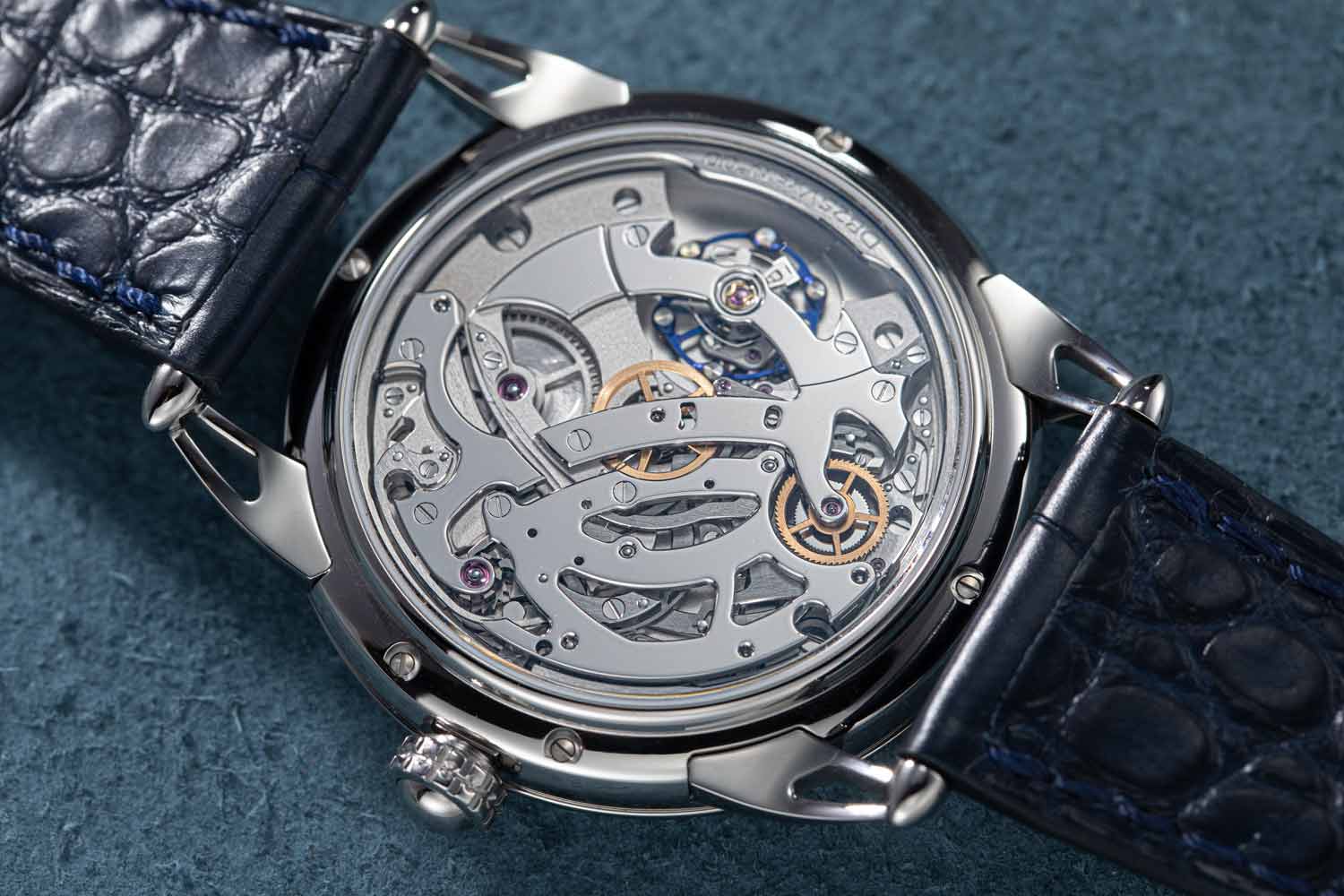
(Image: Revolution ©)
Though not widely remembered today, Techniques Horlogères Appliquées (THA) was an impressive operation, commissioned by many major brands to develop complex movements. One of the best examples is the Breguet Sympathique Clock from 1991, of which No.1 was recently auctioned for CHF 5.51 million and is now part of Journe’s personal museum. Another important example and one that more people might have heard of is the Cartier Tortue Monopoussoir CPCP. After developing a number of mystery clocks for Cartier, THA suggested reviving the monopusher chronograph. Cartier agreed, and the rest is history.
We bring up the Cartier Monopoussoir here because it was developed using an oscillating pinion. This is a detail that is often misunderstood. The oscillating pinion is rarely seen outside of the Valjoux or ETA 7750 family, so it is often dismissed as a lower-end solution compared to the horizontal or vertical clutch. But is that really the case? You can read more about the history and technical merit of the oscillating pinion, but here’s a quick summary.

(Image: Revolution ©)
In essence, the principle behind the oscillating pinion is identical to that of a horizontal clutch. The only difference lies in how it’s constructed. A horizontal clutch typically involves three key wheels to manage start and stop: a drive wheel co-axial with the fourth wheel (which drives the running seconds), the chronograph seconds wheel, and an intermediate clutch wheel between them. The clutch wheel carried by a lever pivots laterally to engage or disengage the chronograph by moving in and out of contact with the chronograph seconds wheel.
The oscillating pinion simplifies the setup. Instead of using a separate clutch wheel and a drive wheel, both functions are combined into a single component: the oscillating pinion.

Zooming in on the oscillating pinion. (Image: Revolution ©)
The oscillating pinion is a tiny component made up of a vertical shaft with two pinions at both ends. The lower pinion stays in constant contact with the fourth wheel; there’s no need for an extension wheel. When the chronograph is activated, the upper pinion swings into place to mesh with the chronograph seconds wheels. Because the pinion moves in and out of position, it’s called an oscillating pinion. This setup reduces the number of wheels that are driven off the fourth wheel, thereby lessening the load on the gear train and minimizing amplitude loss when the chronograph is activated. It’s a clever and reliable design. And because the pinion is smaller than a wheel, it reduces backlash and helps eliminate the stutter sometimes seen in horizontal clutch chronographs at the moment of start.
You might be surprised to learn that the oscillating pinion is also used in a number of high-end chronographs, including the split-seconds chronograph from F.P. Journe, as well as other complicated watches from IWC, Bulgari, and Richard Mille. It saves space (which may be why it’s less appreciated, since there’s less visual drama) but it’s unquestionably a clever piece of engineering that shouldn’t be underestimated.

The ratchet teeth of the chronograph minute wheel. (Image: Revolution ©)
And Denis at De Bethune certainly doesn’t underestimate it. In fact, he valued it so much that he acquired the rights to the chronograph movement originally developed for Cartier and used it in his DB1 and the later DB8 monopusher chronograph, which featured twin sub-dials just like the Cartier. That, along with its use in many other respected chronographs, should be enough to show that the oscillating pinion is a valuable invention and isn’t just a budget fix for the ETA 7750. The very fact that it was considered a worthy complement to one of the most robust gear trains ever developed speaks for itself.
Still, it should be mentioned that the brand also offers another, more high-end chronograph, the Maxichrono, which features a patented absolute clutch instead of an oscillating pinion. But that watch is naturally priced at several times the cost of the one in question.
Finally, since we’re on the topic of the chronograph mechanism, it’s worth mentioning that De Bethune has fitted the movement with an instantaneously jumping minutes mechanism. It consists of a lever with a pawl on one side to ratchet the minute recording wheel and a feeler on the other to act with a snail cam that is mounted on the chronograph axis. The snail cam rotates along with the chronograph wheel, and every minute when the feeler drops from the highest point of the cam to the lowest, the pawl pulls the minute wheel forward by one tooth. This means the chronograph minute hand jump instantaneously, rather than semi-instantaneous or continuously moving minute hand found on most chronographs.
Why less is more in the DB25 Monopusher’s design language
While it is hard to describe a CHF 80,000 watch as entry-level, the DB25 Monopusher Chronograph costs less than many of the time-only DB28 models. In fact, it is compelling proposition not only within De Bethune’s own catalogue but across the broader market. It brings together contemporary watchmaking and design with a clear throughline to classical principles.

(Image: Revolution ©)
At just over 40mm wide and under 10mm tall, it’s slim, elegant, and comfortable — a compact format collectors have long been waiting for. But its appeal runs deeper. Look closer and you’ll find layers of thought and history in the details. From the dial design to the chronograph coupling, the DB25 Monopusher carries echoes of De Bethune’s earliest days. That’s what gives it real character. It’s not just technically refined or beautifully finished, but a reminder that watchmaking can still feel personal, even in today’s commercialised world.
Tech Specs: De Bethune DB25 Monopusher Chronograph
Reference: DB25Vxs
Movement: Manual-winding DB3000; 60-hour power reserve
Functions: Hours and minutes; small seconds; monopusher chronograph functions
Case: 40.6mm × 9.15mm; grade 5 titanium; water-resistant to 30m
Dial: Silver
Strap: Alligator leather strap, titanium pin buckle
De Bethune

You may also like
Watch Fairs
De Bethune Introduces Two Of Its Smallest Watches
Sep 4, 2025
Watch Fairs
De Bethune Introduces Two Of Its Smallest Watches
Sep 4, 2025

How A Dinner In LA Led Me To De Bethune’s Purple Rain Masterpiece
Nov 17, 2024
How A Dinner In LA Led Me To De Bethune’s Purple Rain Masterpiece
Nov 17, 2024

News
The Best Performance Watches at the Paris Olympics 2024
Aug 5, 2024
News
The Best Performance Watches at the Paris Olympics 2024
Aug 5, 2024