

How Citizen’s unrivaled expertise with titanium has been cultivated for over half a century
Technical
How Citizen’s unrivaled expertise with titanium has been cultivated for over half a century

Without a doubt, the most instantly noticeable and consequential element of a watch is its case material. It’s the first thing that one interacts with when encountering a watch — feeling its weight, its density (or lack thereof), the texture of its finishing, whether brushed, polished, or some combination of the two. There’s also the temperature of the material, the sound of the bracelet falling between the fingers, and the way light interacts with the case — whether it’s absorbed or reflected.

Titanium Sponge — the pure, raw form of titanium which will be melted down into ingots
It’s a multisensorial experience, creating that initial moment of connection with a timepiece. Each watch owner has their own expectations and priorities for what they want a watch to feel like. Some want the watch to be dense and heavy, with the metaphorical weight of each and every dollar represented in gravity’s tug on their wrist. For others, the desire is for the exact opposite; the watch must be lightweight and strong, effortlessly gracing the wrist in such a way that it blends into the background.
For those inclined to the latter, there are few materials that check as many boxes with such efficiency and capability as titanium. It is, in a great many ways, the most superlative metal, in terms of form and function, that has lent its metallurgic properties to the art of watchmaking. Given its durability and its weight, it is superior to steel for daily wear. When utilized in its purest form, that is to say, titanium which contains no nickel in the alloy or in the finish coatings, it is also hypoallergenic.
While there are many countries that produce titanium alloys for industrial and commercial uses, with China sitting as the top producer at 30 percent, far and away the highest quality titanium in the world comes from Japan. And, of the watch manufacturers that utilize titanium today, Citizen stands out for its diverse range of alloys, advanced surface treatments and consistent material quality.

Part of a display explaining Citizen’s use of titanium, shown during the brand’s exhibition in New York City in May
Japanese Titanium Society
The production of titanium in Japan dates back to 1952 when, in the early post-war years, the use of the metal was shifting to industrial rather than military purposes. That year, a consortium of titanium smelting operations formed the Japan Titanium Society. Of those original 10 smelters, only two remain today. This consolidation, however, has not hampered the creation of the purest titanium alloys available.
Now, entire dissertations can (and have) been written on the multitudes of alloys and production methods employed for various uses. The purest varieties typically specified within the watch world are Grade 4 and Grade 5. The core functional difference between the two is their hardness, or scratch resistance. In either case, both varieties begin as a rough, jagged, miraculous material known as sponge titanium.
The Technology Behind Citizen Super Titanium
Officially, Citizen does not specify, or at least publicly disclose, the grade of titanium that it uses across its collections (likely owing to the utilization of a combination of grades, varieties and alloys, depending on the component in question). With that said, its Super Titanium is without a doubt among the most durable and finely finished titanium found in watchmaking today. This is due to its combination of innate hardness, finishing techniques and application of the proprietary Duratect surface treatment — a combination of heat treatment and DLC coating that results in an exceedingly hard, scratch-resistant finish.
From Sponge to Super Titanium: Japan’s Metallurgical Edge
In any case, we do know that this titanium begins its illustrious life as sponge titanium. To create this material, metallurgists take titanium tetrachloride and reduce it with magnesium at 800 to 850 degrees Celsius. As the metal begins to solidify, the resulting magnesium chloride is removed by a high temperature vacuum process. The final product is a large chunk of sponge titanium. From there, the sponge is melted down into solid, pure ingots. This is the material that Citizen then takes and works its magic on.
However, unlike steel, gold or other precious materials, titanium is difficult to work with. It requires high heat, specific tooling and unique techniques to manipulate, involving the navigation of a slew of industrial and material challenges along the way. But the Japanese, and by extension Citizen, are particularly well equipped for this.

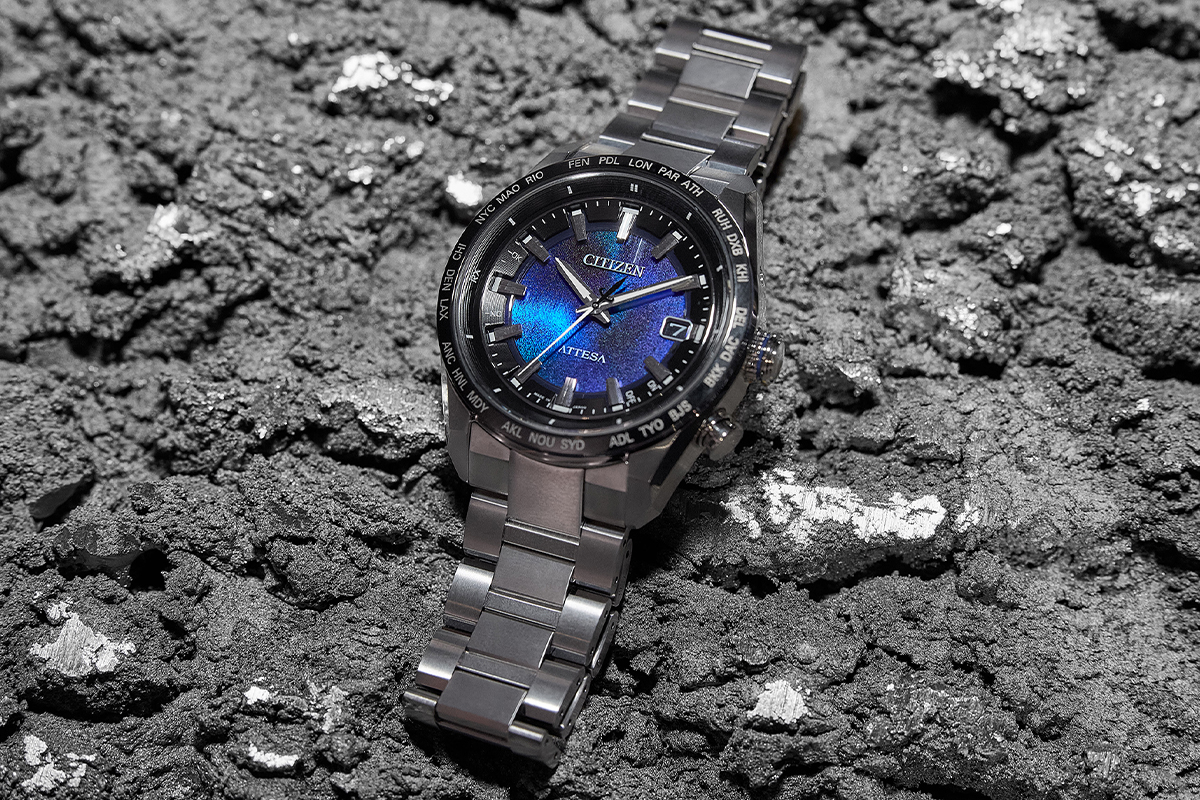
A part of the UNITE with BLUE collection, the new limited-edition World Time is set via the Atomic Clock
Citizen’s Legacy as a Pioneer in Titanium Watchmaking
Beginning in 1970, Citizen released the X-8 Chronometer, the first watch to be made of pure titanium. Over the subsequent 55 years, the brand’s knowledge and capability has evolved. In addition to the know-how, it has cultivated the machinery, the tooling and the techniques needed to create superlative results. Thus, Citizen is uniquely positioned to innovate and consistently offer watches that would be significantly more expensive if produced elsewhere.
Citizen’s Super Titanium Today
As Citizen now enters the second half-century of working with titanium, it is doubling down on and expanding the variety of watches in its offering. Earlier this year, Citizen brought the Attesa collection to North America for the first time. While the collection has existed in Japan since 1987, Attesa has remained largely unknown to wider markets until now.

The Attesa collection, which debuted in 1987, comes to the U.S. Market for the first time
The range encompasses the best of what Citizen can create — the finest finishing techniques, Super Titanium, intricate and innovative dial treatments, and the best movements currently in its catalog. Indeed, the breadth and depth of Citizen’s titanium applications stretches far beyond the normal varieties seen elsewhere. Take, for example, its recrystallized titanium — a dark, enchanting form of the metal, which is typified by a crystalline structure that can be seen sparkling in the light. By heating titanium to 400 degrees Celsius and rapidly cooling it, a unique structure is formed, resulting in its distinct appearance. Recrystallized titanium has been used for a number of special edition pieces, emphasizing the impact and importance of such celebratory watches.
But this is not to say that innovation is reserved exclusively for Attesa. On the contrary, recently Citizen announced the brand-new Citizen xC, an elegant, gold-toned dress watch with a mother-of-pearl dial. But this demure timepiece is far more sophisticated than it first appears. In order to achieve the golden color, known specifically as Amber Yellow, Citizen developed a new method for treating and finishing the titanium by combining a niobium-titanium alloy with a Duratect platinum DLC coating. This ensures the hardness of the titanium and its finish (i.e. it will not scratch off as other gold-toned watches will).

Citizen’s new Amber Yellow titanium treatment, made from a niobium titanium alloy
Those in the know, that is to say those who have spent the time to truly get to know Citizen and all of its many facets, will likely find no surprise in hearing that it is a deeply innovative company with decades of experience in advanced metallurgy. But the truth is that the broader watch buying market may not be so familiar. For while Citizen has been innovating with its use of titanium — its finishing techniques and applied treatments — for over five decades, it has done so quietly, even modestly.
This is an intrinsically Japanese trait — the craft, the artistry and the study of perfection for its own sake is the point, not the accolade. But this is perhaps the most important aspect of Citizen’s identity as a brand, and why it has been able to create the watches that it has for so long. It is a deeply rooted Japanese brand with a culture of production that is focused on a meditative level of dedication to quality in all its forms. These traits are never more present than in the Attesa collection, and indeed in all of the watches that utilize Super Titanium.
Click here to find out more!
Citizen
You may also like

Editorial
Citizen Unveils Series8 880 GMT & 890 Limited Edition Models Inspired by Japan’s Cityscape Aesthetic
Oct 31, 2025
Editorial
Citizen Unveils Series8 880 GMT & 890 Limited Edition Models Inspired by Japan’s Cityscape Aesthetic
Oct 31, 2025
News
Celebrating 40 Years Of A Dive Icon: The Citizen Aqualand 40th Anniversary Limited Edition
Jul 2, 2025
News
Celebrating 40 Years Of A Dive Icon: The Citizen Aqualand 40th Anniversary Limited Edition
Jul 2, 2025

News
Citizen Commemorates Its Centennial Anniversary With A Limited Edition Model
Nov 4, 2024
News
Citizen Commemorates Its Centennial Anniversary With A Limited Edition Model
Nov 4, 2024