





The Evolution of Audemars Piguet’s Perpetual Calendar
Technical
The Evolution of Audemars Piguet’s Perpetual Calendar

Few complications are as integral to a watchmaker’s identity as the perpetual calendar is to Audemars Piguet. That is not to say that other brands haven’t made exceptional perpetual calendars, but in terms of continuous production, influence and development in the field, Audemars Piguet stands apart.
Hidden beneath the dial, a perpetual calendar is a sophisticated mechanism with a four-year cycle encoded in its gear train. This intricate system of cams, levers and wheels automatically accounts for the varying lengths of months and leap years, requiring no manual correction until 2100, when the Gregorian calendar omits a leap year to remain accurate. The year 2100, for example, will not be a leap year because it is not divisible by 400. The complexity of encoding a nest of rules makes the gear train of a perpetual calendar movement one of the most intricate in fine watchmaking. As a result, most manufactures have stuck to tried-and-true techniques and designs.
Yet at Audemars Piguet, the perpetual calendar has been a platform for continuous development, culminating in the latest Caliber 7138, a groundbreaking movement in which all indications can be set individually from the all-in-one crown, both forwards and backwards. What’s lesser known, however, is that the perpetual calendar has been integral to the brand since the very beginning. Even before co-founding Audemars Piguet, Jules Louis Audemars demonstrated his skill in 1875 with a school watch — a timepiece that had to be completed to graduate watchmaking school — which combined a quarter repeater with a perpetual calendar and a rarely seen deadbeat second. This early work set the foundation for what would become a lineage of some of the most refined and technically accomplished perpetual calendars ever made.

Jules Louis Audemars’ school watch, which combined a perpetual calendar with a quarter repeating mechanism and a deadbeat second, was completed in its first incarnation prior to 1875, and transformed in the workshops over the following two decades
The first Perpetual Calendar with leap year indication (Ref. 5516)
Audemars Piguet was the first manufacturer to introduce a perpetual calendar with a leap year indication in 1955 with the reference 5516. Before this, perpetual calendars internally accounted for the cycle without expressing it. For more than two decades after its introduction, no other brand would offer a perpetual calendar with this feature. Only 12 examples of the 5516 were ever produced, with three early pieces — often referred to as “pre-series” — made before 1955 without leap year indicators.

Front view of Calibre 13VZSSQP, which powered the landmark Ref. 5516
The genesis of the Audemars Piguet Perpetual Calendar (Ref. 5516) began in 1947 when a watchmaker discovered a perpetual calendar mechanism that had been left unused for 60 or 70 years and paired it with Caliber 13VZSS. The perpetual calendar module relied on a 48-month program wheel with notches of varying depths that correspond to the length of months, with the deepest representing 28 days for February and its full diameter representing 31 days.

Ref. 5516, the first pre-series powered by Calibre 13VZS, produced in 1947 (Image from Audemars Piguet 20th Century Complicated Watches, p.66)
This laid the groundwork for what would become the first perpetual calendar wristwatch to feature a leap year indication — a defining advancement in the evolution of the complication.
It is something taken for granted today, but without a leap year display, the wearer has no direct way of knowing which year within the four-year cycle the mechanism is tracking. This, in turn, means that to set a perpetual calendar correctly, one must first determine the mechanism’s current position in the cycle, which often requires a watchmaker’s expertise.
The first three examples of Ref. 5516 featured a leap year indication within a subdial at 6 o’clock, displaying all 48 months fully spelled out. In contrast, the subsequent six pieces relocated the leap year subdial to 12 o’clock, adopting a more minimalistic approach. The months were removed, replaced by a concise display reading: “first year,” “second year,” “third year” and “leap year.”It is hard to overstate the revelation Ref. 5516 represented. For the first time, a watch owner could set their perpetual calendar themselves.

A leap year indication was introduced in Ref. 5516 in 1955. Prior to this, perpetual calendar watches internally accounted for leap years without visually displaying it, requiring the expertise of a watchmaker to adjust the watch
The thinnest self-winding Perpetual Calendar of its time (Ref. 5548)
It’s well known that in 1972, just as the quartz onslaught was hitting Switzerland, Audemars Piguet unveiled what would become one of the world’s most iconic timepieces — the Royal Oak.
However, what is important to understand is that it took time for the Royal Oak to catch on. It was the Audemars Piguet Perpetual Calendar (Ref. 5548) launched in 1978 that really changed the game for the brand.

Ref. 5548 debuted in 1978 as the world’s thinnest perpetual calendar, measuring just 7mm thick
1978 marked the deepest point of the Quartz crisis. Swiss watchmakers were hemorrhaging jobs, Japanese brands were innovating aggressively, and the dominance of quartz over mechanical watches seemed irreversible. However, at Audemars Piguet, a trio of watchmakers was turning the key in the opposite direction. Their motivation was not just to create a complicated wristwatch, but also to keep watchmakers employed. Amazingly, the initiative to create the world’s thinnest self-winding perpetual calendar started in secrecy. Almost like resistance fighters, the watchmakers would work on this project during their off hours and meet surreptitiously in the dark of night.
Caliber 2120, which powered the original Royal Oak, proved to be the ideal base caliber for their project, as it is a thin movement measuring a mere 2.45mm thick. In fact, it remains the thinnest full-rotor automatic movement today. The key to its slimness is that the rotor consists of a central hub set onto a 21K gold peripheral mass, which rides on ruby rollers set into the movement plate.

At 2.45mm thick, the legendeary Caliber 2120 remains the slimmest full-rotor automatic movement to this day
The perpetual calendar module was made for Audemars Piguet by complications specialist Dubois-Dépraz and represents classic complicated watchmaking at its best. It relies on a 12-month program wheel with a Maltese cross satellite to manage the month of February. The main difference between a 48-month program wheel, such as the one in Ref. 5516, and a 12-month program wheel is that the latter turns once per year. As such, the notch for 29 February cannot be encoded directly in this wheel. Instead, it features a cutout where the month of February ought to be, with a leap year cam fitted into this gap. The leap year cam appears rectangular with three sides of equal distance from its pivot that correspond to 28 February and the fourth side furthest from the pivot accounts for 29 February. The rotation of this cam is governed by a Maltese cross system. On the whole, Caliber 2120/2800 measures only 3.95mm thick.
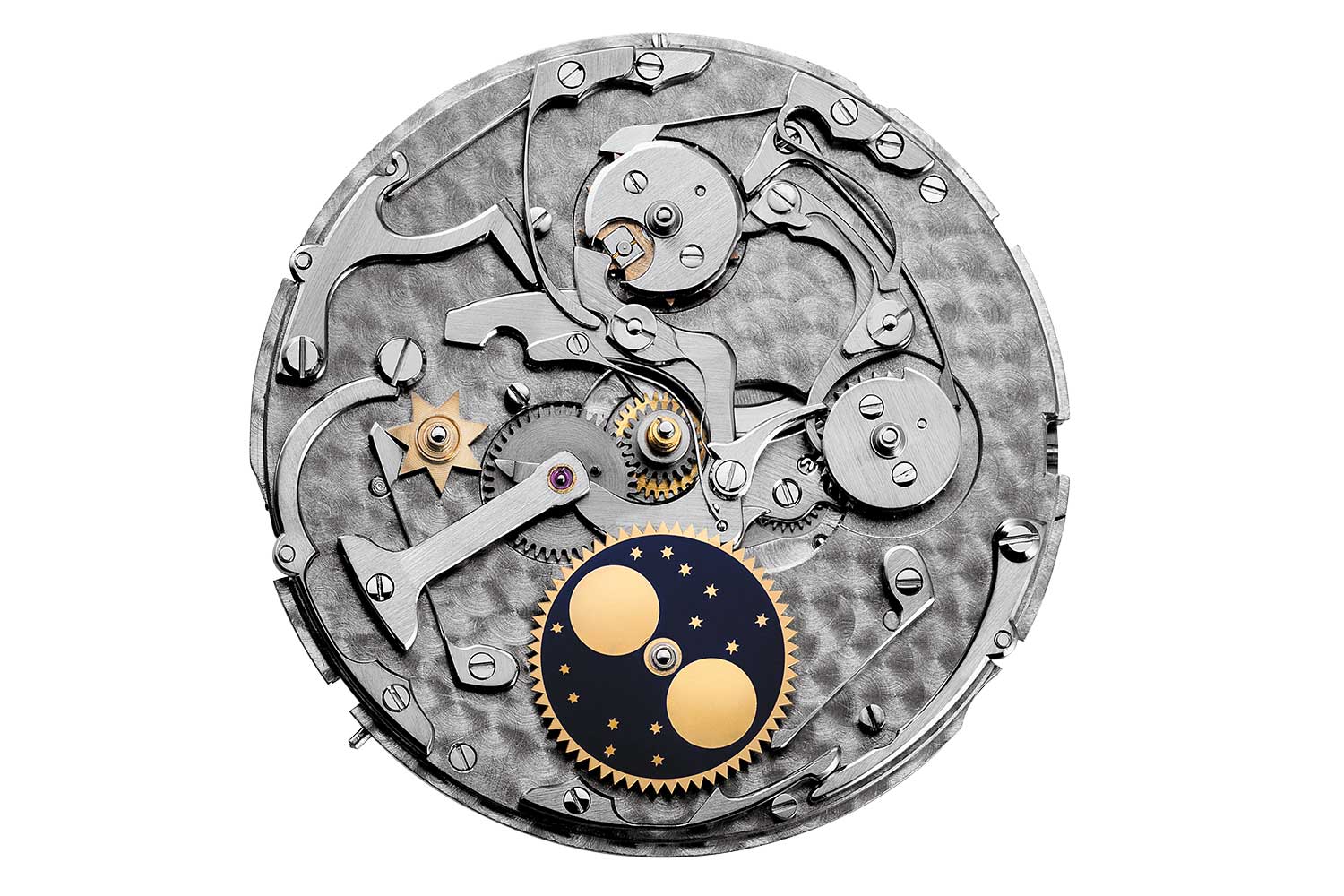
The perpetual calendar module in Caliber 2120/2800 relies on a traditional 12-month program wheel with a Maltese cross satelite to manage the month of February
In 1977, the trio surprised Audemars Piguet’s Managing Director, Georges Golay, with this extraordinary movement.
Such was Golay’s confidence in the project that, despite the inclemency of the times, he immediately commissioned 159 watches, which was almost as many as the total number of calendar watches made by AP since 1924.
As a great movement would be nothing without a great design, Golay immediately set an exceptional woman named Jacqueline Dimier to work. The brilliant Jacqueline Dimier joined AP in 1975 and was responsible for the design of the first woman’s Royal Oak in 1976 — amongst many other projects. She later designed the world’s first tourbillon wristwatch in 1986.
Launched in 1978, the Audemars Piguet Perpetual Calendar (Ref. 5548) was equipped with the world’s thinnest self-winding perpetual calendar movement. Measuring just 36mm in diameter and a remarkably slim 7mm in height, it was nearly half the thickness of its closest mechanical competitor. This unprecedented feat of miniaturization allowed it to rival the dimensions of quartz watches, a remarkable achievement that reinforced the ingenuity of mechanical watchmaking in an era dominated by electronic precision.
The dial design pared everything back to the essentials with no leap year indication, as it was perceived to be somewhat superfluous on such a minimalist watch. Additionally, as the leap year is managed by a Maltese cross satellite, additional gearing would be required to drive a leap year axle. The display would only make its return in 1995. Legibility was enhanced with the months displayed at 12, the date at 3, the moon phase at 6 and the day at 9 o’clock.
A total of 2,183 watches were crafted between 1977 and 1991. Of the materials available, yellow gold was the most popular followed by white gold, platinum, steel and pink gold. This model reached its peak in popularity in 1984 with 675 iterations produced.
The iconic Royal Oak Perpetual Calendar (Ref. 5554)
The creation of Caliber 2120/2800 allowed the manufacture to double its watchmaking team, creating precious jobs in the watchmaking sector of the Vallée de Joux. In 1984, Audemars Piguet manufactured 675 watches powered by this movement, comprising more than half of all the perpetual calendars made in Switzerland that year. At the same time, the Royal Oak had become a phenomenon, a symbol of style and modernity.
Bringing together two of the most revolutionary acts of Audemars Piguet — the iconoclastic Royal Oak and the world’s thinnest self-winding perpetual calendar movement — the Royal Oak Perpetual Calendar (Ref. 5554) was born in 1984.

The first Royal Oak Perpetual Calendar, Ref. 5554
Ref. 5554 introduced one of Audemars Piguet’s most successful models, a watch that is still as relevant today as when it was first created. From 1984 to 2014, the watch remained unchanged. It measured 39mm in diameter and was 9.3mm in thickness, which was just 2.1mm thicker than Ref. 5402’s 7.2mm case.
From 2015 to the present day, the case of the watch is enlarged to 41mm and receives a slightly thicker movement with an annular week display (an increase from 3.95 to 4.31mm) that results in a case that is just marginally thicker at 9.5mm.
At the time of the 5554’s birth, there was basically no other shaped, integrated sports chic perpetual calendar around. The Royal Oak Perpetual Calendar was something the world had never seen before — a modern case and a modern ultra-thin movement united to create one of the most groundbreaking complicated timepieces of all time.
Then in 1986, the Royal Oak Perpetual Calendar was launched with a beautiful openworked dial (Ref. 25636). As a perpetual calendar mechanism is derived from the motion works of a watch, it is fitted on a separate plate beneath the dial, and thus usually can’t be admired in action. The introduction of an openworked dial brought its complexity to light, allowing the perpetual calendar’s mechanical ballet to be admired in real time. Its normally solid dial was replaced with a sapphire unit that allows you to see the incredible levels of finishing that Audemars Piguet applies to all parts of the movement, including those normally never seen.
It marked the beginning of a lineage of openworked Royal Oak Perpetual Calendar models, which included including Ref.25688 and Ref. 25775 among others.
The return of the leap year indication, 1995–2015
In 1995, to celebrate the manufacturer’s 120th anniversary, Audemars Piguet released the Royal Oak Perpetual Calendar (Ref. 25810) equipped with Caliber 2120/2802. This pink gold Royal Oak Perpetual Calendar featured one major difference: the reappearance of the leap year indication. This took the form of a hand that was mounted coaxially with the month hand in the subdial at 12 o’clock.
Next, in 1997, Audemars Piguet introduced the Royal Oak Grande Complication (Ref. 25865). Conceived by the technical powerhouse Audemars Piguet Renaud & Papi, it combined a minute repeater, a perpetual calendar and a split seconds chronograph.

The Royal Oak Grande Complication Ref. 25865
A minute repeater, like a perpetual calendar, is a dial- side complication as the striking mechanism is connected to the base movement by having both its quarter and minute snails fixed to the cannon pinion shank. When both complications are combined, as in this case, the calendar works are located above the strike works beneath the dial.
The perpetual calendar module base on its display does, however, seem to be the Dubois-Dépraz module from the 2120/2800, flipped 180 degrees and with the hands for continuous seconds and chronograph elapsed seconds added coaxially to the horizontal subdials.
The emergence of the Royal Oak Perpetual Calendar, 2015–2020
In 2015, the Royal Oak Perpetual Calendar (Ref. 26574) featuring Caliber 5134 marked a major advancement of Audemars Piguet’s Perpetual Calendar, housed inside an all- new case that measured 41mm in diameter as opposed to the traditional 39mm. Rather than 3.95mm, the movement is now 4.31mm thick. While it is based on the ultra-thin Caliber 2120, the perpetual calendar module was developed in-house. The calendar incorporated an additional week of the year display along the periphery of the dial, indicated by a central hand. The perpetual calendar module also differs from the 2120/2800 in a fundamental way, for which a patent was granted.
While Caliber 2120/2800 uses a traditional 12-month cam with a Maltese cross satellite, Caliber 5134 relies a 12-month cam with an integrated co-planar leap year cam. The 12-month cam, which encodes months with 30 and 31 days, has a recessed hub with the leap year cam nested in it. Despite being nested, the two cams remain independent in their movement. This ingenious and compact setup does away with the usual intermediate wheels needed to traverse the distance from the program wheel to the month and leap year hands. Instead, they drive the hands directly, with the months and leap year displayed in a co-axial fashion at 12 o’clock.

Caliber 5134 debuted a co-planar 12-month and leap year program wheel, that could drive the month and leap year hands directly in a co-axial fashion
Along with an additional week of the year indication, this results in a watch that is only marginally thicker at 9.5mm as opposed to the 9.3mm of its predecessor. The remarkable perpetual calendar Caliber 5134 would go on to power everything from the all-ceramic Royal Oak Perpetual Calendar (Ref. 26579CE) launched in 2017 to the Code 11.59 by Audemars Piguet Perpetual Calendar (Ref. 26394).

From 2015 to 2024, Caliber 5134 powered all Royal Oak Perpetual Calendars including Ref. 26579CS in blue ceramic
Shortly after, in 2018, Audemars Piguet unveiled the Royal Oak RD#2, which stands for “Research & Development #2.” The watch was the brand’s take on a Royal Oak Perpetual Calendar but now ultra-thin. At 41mm in diameter and 6.3mm in thickness, the watch was almost a full millimeter thinner than the original time-and-date Royal Oak (Ref. 5402).
How did AP achieve this? In a beautiful act of homage to the original Caliber 2120/2800, at the base of the watch was the same Caliber 2120, which has been such a key part of Audemars Piguet’s horological audacity throughout the late 20th century and into the third millennium. However, the movement debuted an all-new, ultra-thin calendar mechanism with a very ingenious construction.
In a traditional perpetual calendar, the 48-month program wheel is not a gear in the conventional sense because it does not have teeth. Instead, it functions as a cam, encoding month lengths through notches and raised sections of varying depths. As such, a regular 48-month gear, along with an intermediary train, is needed to transmit information to the month hand. But in the RD#2, the 48-month program wheel is both a cam and a gear. It simultaneously interacts with the grand lever and drives the month pinion directly.
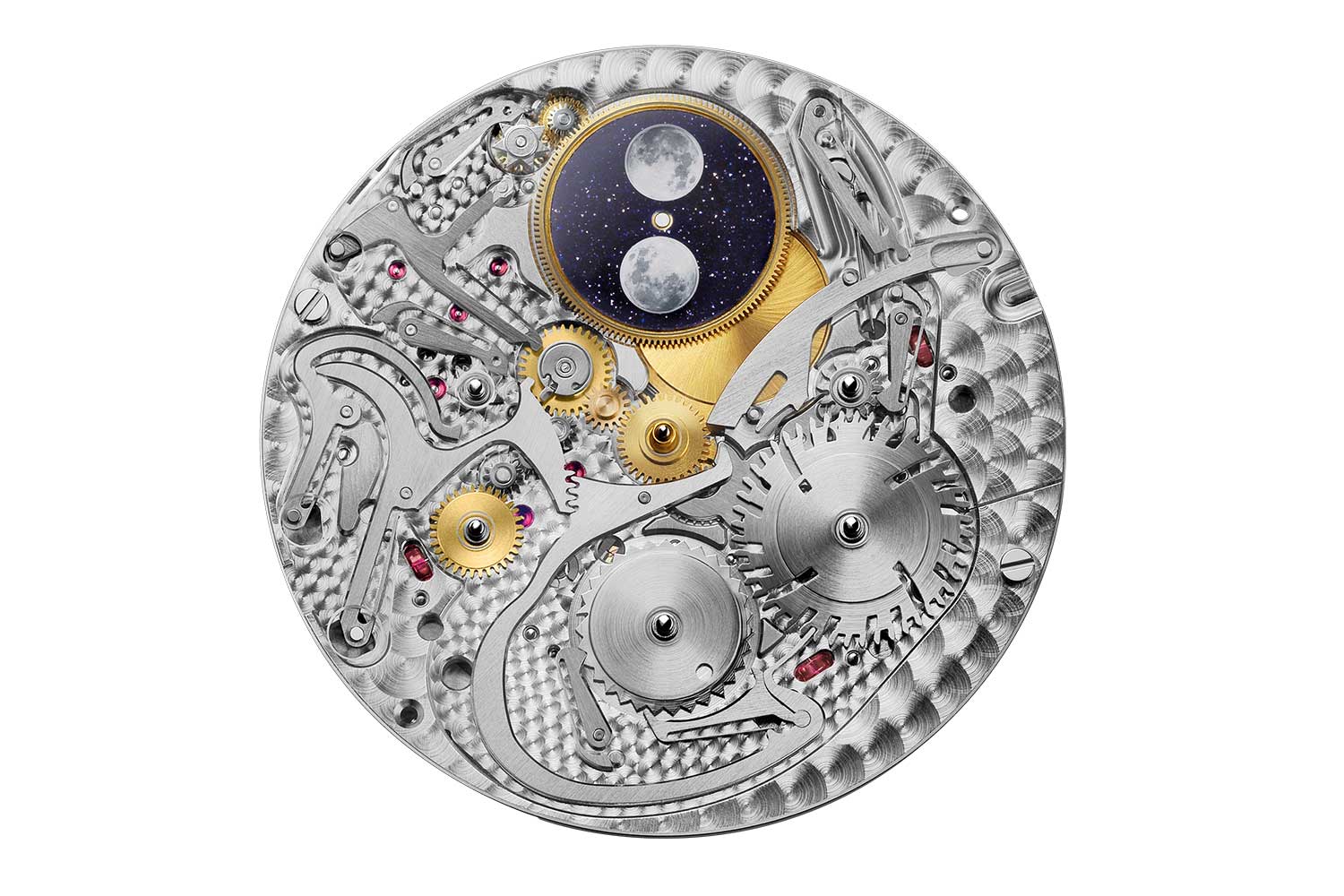
At just 2.89mm thick, Caliber 5133 in the RD#2 holds the record as the world
The date wheel, on the other hand, has an integrated end-of-month cam. It features an asymmetrical tooth that is deeper than the rest and advances the month disk by one increment at the end of the month. This design replaces both the end-of-month snail cam that interacts with the grand lever and the finger that advances the month wheel, effectively reducing three layers to one.

The latest Royal Oak Perpetual Calendar available in both stainless steel and 18-carat sand gold (ref. 26674)
The leap year is no longer coaxial with the months but appeared in a small subdial at 4 o’clock, while a similar dial for day-and-night indication (key for not setting the perpetual calendar during the changeover period) is at 8 o’clock. The result is a movement that is a mere 2.89mm thick as opposed to the 3.95mm thickness of Caliber 2120/2800 or the 4.31mm thickness of the Caliber 5134.
2019 saw the introduction of the commercial version of the RD#2 — known as the Royal Oak Perpetual Calendar Ultra-Thin (Ref. 26586) — as well as the new Royal Oak Perpetual Calendar Openworked in ceramic (Ref. 26585CE).

Royal Oak RD#2
The Code 11.59 by Audemars Piguet Ultra-Complication Universelle (RD#4)
In 2023, Audemars Piguet unveiled the RD#4. While it boasts a total of 23 complications, it is as user-friendly as it is complicated. The perpetual calendar in RD#4 is notable for going a step further than a regular perpetual calendar. It accurately accounts for a 100-year cycle, taking into consideration the century years that are common years. This is achieved with a program wheel similar to that in RD#2. However, it encodes 36 months instead of 48, meaning the leap year is not encoded in it. Instead, a separate leap year cam prevents the grand lever from reaching the full depth of the February notch in the program wheel during a leap year, while a century cam blocks the leap year correction every 100 years to ensure that century years not divisible by 400 are treated as common years.

Code 11.59 by Audemars Piguet Universelle RD#4
Any calendar that can track beyond a four-year cycle is certainly an enormous feat, as it requires auxiliary mechanisms to account for more exceptions in the Gregorian calendar. Beyond that, the month can be adjusted both backwards and forwards via a crown at 4 o’clock.
The new caliber 7138
Audemars Piguet’s 150th-anniversary celebrations this year has begun with a major technical milestone: Caliber 7138, an all-new ultra-thin perpetual calendar movement debuting in both the Royal Oak and Code 11.59 by Audemars Piguet. While it might look visually similar to its predecessors, the movement actually represents a significant leap in both engineering and user experience, introducing a fully crown- operated setting system, robust mechanical safeguards and an ultra-thin perpetual calendar mechanism.

The perpetual calendar mechanism in Caliber 7138. One neat feature is the all-in- one crown which allows for all corrections to be easily made by the wearer
While the main event is no doubt the perpetual calendar, it would be remiss to overlook the base, Caliber 7121. The movement was first introduced in 2022 to mark the 50th anniversary of the Royal Oak. While Caliber 2120 was designed with slimness in mind, Caliber 7121 is a balancing act of both slimness and performance.
The gear train in Calibre 7121 is positioned along the periphery of the base plate, creating space at the center for a more secure rotor mounting, eliminating the support ring found in its predecessor. This, in turn, allowed for a significantly larger barrel, spanning nearly half the movement’s diameter to maximize energy storage. The automatic winding mechanism is now a bi-directional system, with reverser wheels strategically arranged to preserve space for manual winding components. The balance assembly was optimized for stability, incorporating a free-sprung design with a broad, flat rim and recessed weights to reduce air resistance, while a higher 4 Hz beat rate improved shock resistance, all of which is supported by a full balance bridge.
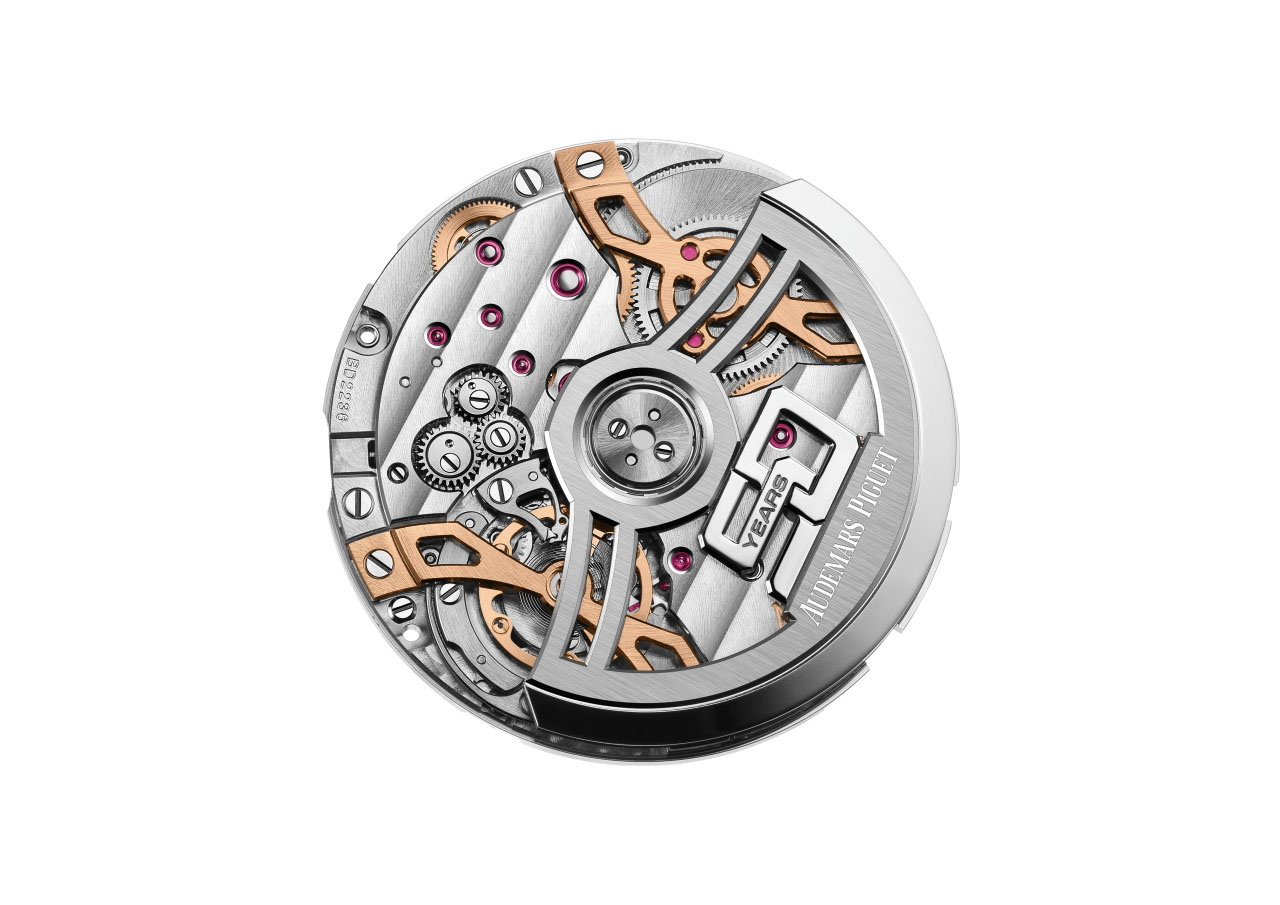
A look at the all new Calibre 7121 on its own with the special 50th anniversary rotor
Precision was further refined with an offset stud holder mounted separately from the balance bridge, ensuring reliable beat adjustments while maintaining the bridge’s structural integrity. Every component – the barrel, balance, winding gears, and gear train – was carefully arranged to optimize performance within the constraints of an ultra-thin construction, making Caliber 7121 a thoroughly modernized movement that prioritizes efficiency, robustness and chronometric precision.
The perpetual calendar mechanism was developed over a period of five years and five patents were filed. It relies on the ultra-thin solutions presented in RD#2 such as a 48-month program wheel that is designed as both a cam and a gear along with a date wheel with an integrated end-of- month cam and finger. Notably, the date wheel also features irregular tooth spacing, a thoughtful design that ensures precise and consistent hand movement across the entire date display. Instead of uniform steps, the wheel advances in smaller increments for single-digit dates and as the display transitions into double-digit dates, the spacing increases slightly, allowing the hand to cover a wider distance in a single step. This intelligent gearing accounts for the varying visual spacing between single and double-digit numerals on the dial, ensuring a seamless and proportional progression of the date indication.
Most astonishingly, the all-in-one crown enables the setting of a full perpetual calendar, managing six separate indications with just a three-position crown. Traditionally, correctors are set into the case flanks requiring tools to adjust the calendar. These correctors are generally arranged to lift the grand lever, isolating it from the program wheel to enable adjustments without risking damage to the mechanism.
Vaguely visible beneath 48-month program wheel is a four-arm month-correcting cam. When the crown is rotated counterclockwise in the second position, it engages a gear train that rotates this cam and one of its arms lifts the grand lever away from the 48-month program wheel to prevent interference or damage. As the cam continues to rotate, another arm engages a month-correcting pinion, which in turn rotates the month-indicating mechanism and updates the display. Isolation and correction therefore occur in a single continuous motion.
The date is corrected in a similar manner, using a date- correcting cam, while a clutch mechanism links the crown to the moon phase disc and day hand. By consolidating all corrections into a single, rotationally controlled system, this invention delivers a streamlined and highly efficient approach to adjusting the perpetual calendar. It is a notable achievement, both technically and philosophically. In an industry where mechanical complexity is often a badge of honor, this movement eschews complexity for its own sake and instead offers solutions that are genuinely intuitive and practical for the wearer.
Today, Audemars Piguet is known for its iconic designs — the Royal Oak, Royal Oak Offshore and the Code 11.59 by Audemars Piguet — but its perpetual calendar watches are a reminder that grand complications continue to sit at the heart of this beautiful haute horlogerie manufacture.
Audemars Piguet

You may also like

News
Audemars Piguet Concludes RD Series With Royal Oak “Jumbo” Extra-Thin Flying Tourbillon Chronograph RD#5
Oct 30, 2025
News
Audemars Piguet Concludes RD Series With Royal Oak “Jumbo” Extra-Thin Flying Tourbillon Chronograph RD#5
Oct 30, 2025

Reference
Five Chapters of Innovation in Complications: The Audemars Piguet RD Series
Oct 22, 2025
Reference
Five Chapters of Innovation in Complications: The Audemars Piguet RD Series
Oct 22, 2025
News
Audemars Piguet Brings The Perpetual Calendar To 38mm For The First Time And Introduces A Trio Of Vibrant Stone Dials
Sep 10, 2025
News
Audemars Piguet Brings The Perpetual Calendar To 38mm For The First Time And Introduces A Trio Of Vibrant Stone Dials
Sep 10, 2025

