


TAG Heuer Formula 1: Back On Track
Reference
TAG Heuer Formula 1: Back On Track

Throughout the watch industry, there is only one company that has all but dedicated its entire history, its entire existence, to the world of motor racing, and that spent its formative years nurturing a lifelong passion for motorsport. That company is TAG Heuer — or Heuer, as it was known during its early years making precision timekeepers that were designed to aid in the recording of distance, speed and time onboard automobiles and aircraft, as well as pocket watches and, later on, wristwatches. From the mid-19th century through the 20th century and now well into the 21st century, TAG Heuer has poured its heart and soul into the quest for timekeeping precision. A perpetual quest it is indeed, but nonetheless one that the company relishes with every new timepiece it creates.
Looking back at the road traveled by TAG Heuer over the past 165 years, one can easily see why motor racing has had such a natural and profound influence on its present-day identity. How could it not, when the company’s origins are so inextricably steeped in chronometric precision? Key inventions associated with TAG Heuer include the oscillating pinion chronograph introduced in 1887, and from the 1910s onwards, the Mikrograph stopwatch accurate to 1/100th of a second, and the much-vaunted Mikrosplit which was a rattrapante version of the Mikrograph. There were also 1/50th-of-a-second variations of these timepieces known as the Semikrograph and Semikrosplit, which were half as accurate and thus slightly more affordable to a wider audience.
These high-precision instruments naturally seek out high-speed events to put their eminence to the test, and as such, the burgeoning auto and aviation industries became the ultimate wonderland for TAG Heuer. From here on, the histories of TAG Heuer and many of the most important motor racing events have been forever intertwined. The Mexican Carrera Panamericana, the 24 Hours of Le Mans, the 12 Hours of Sebring, the Indy 500, and the most glamorous motorsport event of them all, the Formula 1 Grand Prix.

Former CEO and Honorary Chairman of TAG Heuer, Jack Heuer is a legendary marketing genius like no other
The Link to Formula 1
TAG Heuer’s involvement with Formula 1 Grand Prix racing constitutes an important chapter in its brand history. The company first set foot in this high-octane world in 1969, its famous Heuer logo appearing prominently on Formula 1 cars and drivers’ attire, and with some of its most iconic timepieces dedicated to important F1 circuits such as Monaco, Monza and Silverstone. Up until this point, the main business driving the Heuer watch company had been timekeeping devices for sporting events, including a collaboration with Scuderia Ferrari as official timing partner in 1971. But, ever the visionary marketer, Jack Heuer saw immense potential for his wristwatches in the auto-racing world.

In 1969, Jack Heuer inked a deal with Jo Siffert as the first brand ambassador of Heuer chronographs
Before long, the name Heuer was seen everywhere, from Formula 1 cars and race suits to event banners all over the circuit, and most notably on the wrists of the drivers. Some of the most illustrious individuals ever photographed wearing Heuer chronographs during that era include legendary drivers like Niki Lauda, Clay Regazzoni, James Hunt, Ronnie Peterson, Jochen Rindt, Derek Bell, Emerson Fittipaldi, Jody Scheckter, Carlos Reutemann, Denis Hulme, Rolf Stommelen, Jo Siffert, Jacques Villeneuve, Jacky Ickx, Mike Hailwood, Mario Andretti, Bruce McLaren and Graham Hill — not forgetting the King of Cool himself, Steve McQueen in the 1971 movie Le Mans. The company was completely in sync with the world of motorsports and this thus provided the perfect setting to usher in the next big milestone, which was the moment Heuer became TAG Heuer.
In 1985, the Heuer watch company was acquired by TAG Group whose subsidiaries include a state-of-the-art aviation and aeronautical manufacturer. Those who have been in the watch collecting community long enough would be well aware that TAG stands for Techniques d’Avant Garde and that the early TAG Heuer logo had a very dynamic style with arrowheads at both ends of the letter ‘G’ suggesting speed, movement and power flow. At that time TAG Group was manufacturing high-tech components such as ceramic turbochargers for Formula 1 cars. In addition, the company was a sponsor of the Formula 1 Williams Team in the early 1980s, when drivers Alan Jones and Keke Rosberg dominated the championships in ’80 and ’82. Thereafter in 1983, TAG Group took up partial ownership of the McLaren Team, a relationship that continues to this day.


The prominent shield-shaped Heuer logo is a familiar sight at race tracks all over the world


Eye on the Future
Very quickly, TAG Heuer began to incorporate a modern vision for its product lineup. Where before it was a brand associated with mechanical chronographs and dashboard timekeepers, now it was a company focused on designing watches for the 21st century — watches that resonated with the contemporary consumer looking to the future rather than the past. Electronic and quartz-driven timepieces were the cutting-edge technologies of the time, and the company embraced them with enthusiasm, applying them to a wide range of timepieces such as the Series 2000 and the bold and colorful TAG Heuer Formula 1 collection. Introduced in 1986, the TAG Heuer Formula 1 collection was especially significant in the early years of TAG Heuer, reflecting a seismic shift in consumer behavior where timepieces were acquired not merely for telling the time, but to express one’s personality.
This was the 1980s, after all. Maximalism was in the air and there was optimism everywhere, so the TAG Heuer Formula 1 collection took it and ran. Bright colors, plastic cases, simple quartz movements and fun packaging were the order of the day, and TAG Heuer was more than well equipped to deliver. Crucially, the watches were also accessibly priced and thus appealed to younger consumers who were already drawn to the exuberant and sporty designs.

The 1992 TAG Heuer Series 6000 exemplified sporty elegance
Did it matter that the motorsport-themed TAG Heuer Formula 1 had a 200-meter depth rating and oversized diving bezel with a 15-minute countdown segment? In retrospect, that was indeed one of the early curiosities of the TAG Heuer Formula 1. But here’s the thing: consumers at that time minded not one bit. Because the TAG Heuer Formula 1 was never about trying to be a performance tool watch or timekeeping instrument. It was always meant to be a fun and trendy piece designed for maximum enjoyment on the wrist.
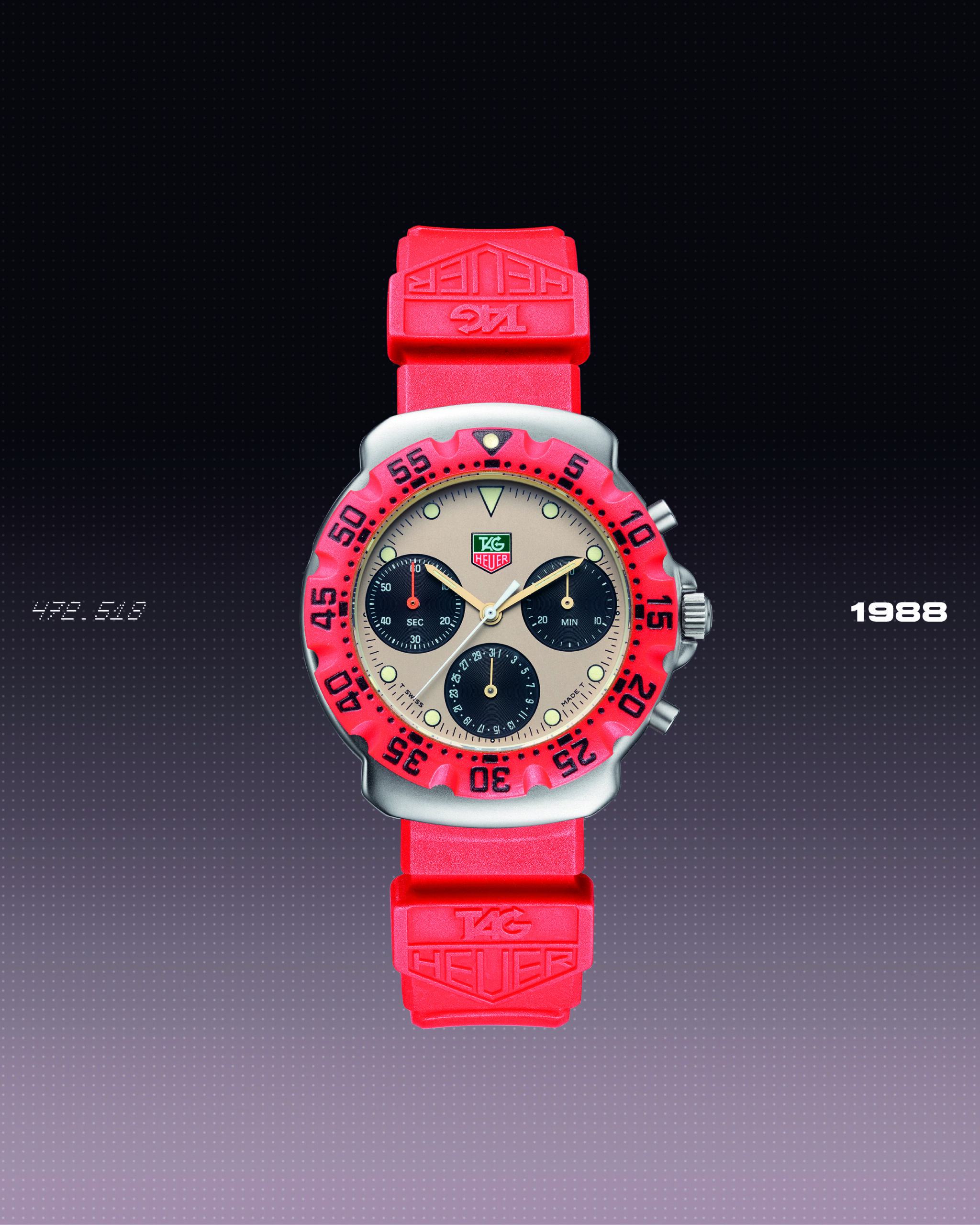


From the 80s to the new millennium, TAG Heuer's Formula 1 maintained its colorful sporty spirit
Did it work? Well, there is an entire generation of watch-loving Millennials today getting all nostalgic and goofy-smiled whenever the TAG Heuer Formula 1 comes up in conversation. In 2024, when TAG Heuer collaborated with the American fashion and lifestyle brand Kith, it was a blast from the past that triggered a deep well of emotions in all the ’80s and ’90s kids who were suddenly reminded of their TAG Heuer Formula 1 watch — or that all they had ever wanted back in the day was a TAG Heuer Formula 1 watch.
Race to the Finish
That said, TAG Heuer never gave up its close ties with the Formula 1 Grand Prix. Since 2025, it has once again become the Formula 1 official timekeeper. When the brand was first named official timekeeper for the race in 1992, a partnership that lasted till 2003, one of the most collectible timepieces from the era was the TAG Heuer S/el. The watch was “designed to be worn with a diving suit as well as a dinner jacket” — or in the case of Ayrton Senna, a racing suit. The legendary racer famously wore an ana-digi model reference S25.706C, distinguished by its eggshell-colored dial and two additional digital displays located at four and eigh o’clock. Known as the S/el Digital Quartz Chronograph, it offered 1/100th-of-a-second precision — exactly like the early Heuer Mikrograph did. In fact, this watch united everything that defined TAG Heuer: chronograph, motor-racing, timekeeping precision and stylish elegance.

The TAG Heuer S/el worn by Ayrton Senna with a multifunction quartz movement
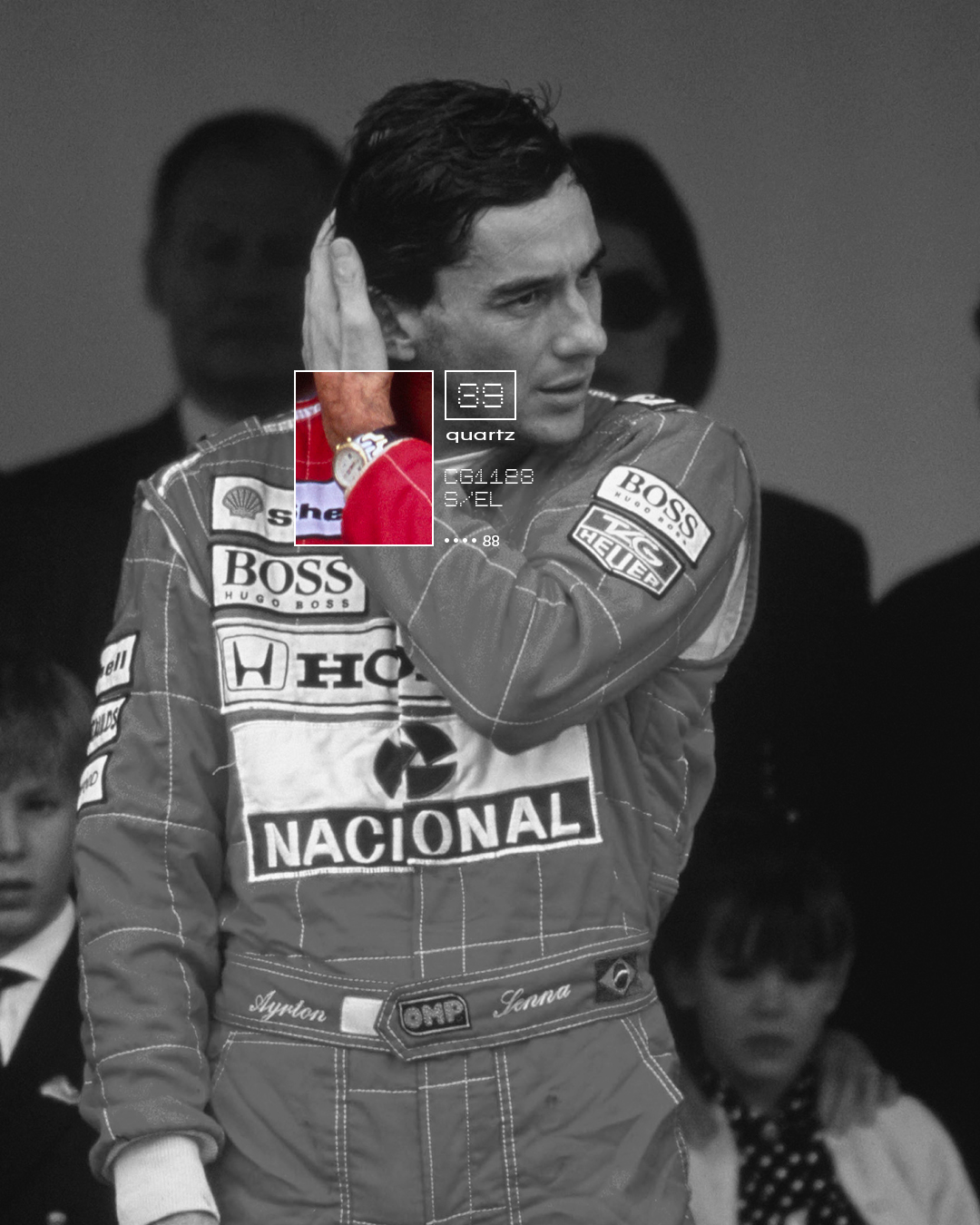
Spot the unmistakable S links of the S/el Chronograph Reference S25.706C/CG1123
TAG Heuer’s renewed partnership with the Formula 1 Grand Prix brings it back full circle to the starting line of its long and winding history with motorsports; and not just the racing aspect of F1, but everything that surrounds it: the glamor, the power, the emotions, the cultural impact, and of course, the avant-garde technical side which is perfectly synchronized with TAG Heuer as a modern, forward-looking watch brand.
Over the years, TAG Heuer has been associated with 239 race victories, 613 podium finishes, an impressive tally of 11 World Constructors’ Championships and 15 World Drivers’ Championships. TAG Heuer CEO Antoine Pin says, “With decades of history in F1 connecting us to the most successful drivers and teams of all time, we are honored and privileged to be the name connected to the very thing that defines the winner: time,” adding, “we are excited to be part of the journey and create new stories to enrich TAG Heuer.”
As it reprises its duties as official timekeeper, TAG Heuer is certainly well positioned to bring a dose of exuberance to the circuit, potentially even reinventing Grand Prix racing and making it fun and enjoyable for everyone, not just the petrolheads.
TAG Heuer
You may also like
News
TAG Heuer’s New Connected Calibre E5 × New Balance Edition Brings Performance Into The Digital Age
Oct 8, 2025
News
TAG Heuer’s New Connected Calibre E5 × New Balance Edition Brings Performance Into The Digital Age
Oct 8, 2025
Watch Fairs
TAG Heuer Presents The TH-Carbonspring And The Carrera Astronomer At Geneva Watch Days 2025
Sep 4, 2025
Watch Fairs
TAG Heuer Presents The TH-Carbonspring And The Carrera Astronomer At Geneva Watch Days 2025
Sep 4, 2025
Editorial
Fore Of The Greatest Golf Watches Ever To Hit The Green, Inspired By Happy Gilmore 2
Aug 15, 2025
Editorial
Fore Of The Greatest Golf Watches Ever To Hit The Green, Inspired By Happy Gilmore 2
Aug 15, 2025