


A Quick Guide: 3 Of The Most Important Patek Philippe Grand Complications You Need To Know
Reference
A Quick Guide: 3 Of The Most Important Patek Philippe Grand Complications You Need To Know

While numerous brands today produce varying forms of chiming watches, Patek Phillippe chiming watches, in both minute repeater and grande sonnerie incarnations, express what is irrefutably the highest level of musicality in watchmaking because of their uniquely exquisite voice, otherwise known amongst collectors as the legendary “Patek sound.” More than that, because of their unique ability to engage us in sight, feel and sound, to dazzle and arouse us through this multiplicity of the senses, the chiming watches are the ultimate goal of every collector of Patek Philippe complications.
To create a serially produced minute repeating wristwatch was considered to be impossible, until Philippe Stern, Patek Philippe’s honorary president, arrived at the decision to do precisely that. His introduction of the in-house developed manufacture R 27 automatic micro-rotor driven minute repeater movement and the resulting two timepieces — Reference 3979, the first automatic minute repeater to be produced by Patek Philippe, and Reference 3974, the world’s first automatic minute repeater with small seconds — are as significant an achievement as the introduction of the 1518 and 1526 in 1941 by his grandfather and grand-uncle, Charles and Jean Stern. What followed was an uninterrupted era of Patek Philippe’s dominance over chiming wristwatches, culminating in 1992 with the Reference 3939, the world’s first serially produced tourbillon minute repeater; in 2001 with the Ref. 5002 Sky Moon Tourbillon, which introduced the world to Patek’s famous cathedral gongs; and in 2014 with the creation of the Grandmaster Chime, the maison’s first serially produced grande sonnerie.

Philippe Stern (left) with Thierry Stern (right) pictured together commemorating Patek Philippe’s 175th Anniversary milestone
Today, there is no brand on the planet that is more synonymous with the minute repeater than Patek Philippe. From 1989 to the present day, Patek Philippe has almost single-handedly shaped the modern history of the minute repeater and chiming watch through three and a half decades of unrelenting technical innovation and design brilliance.
Reference 3939 (1993–2009): Self-Winding Minute Repeater Tourbillon
Unveiled in 1993, a full decade before the launch of the Reference 5101 10-day tourbillon in 2003, the Patek Philippe Ref. 3939 was a truly extraordinary timepiece. It combined the minute repeater with that other most revered of complications — the tourbillon — in a watch measuring just 33mm in diameter. The significance of this watch is massive as this was the first tourbillon wristwatch made by the manufacture.


The 1980s and ’90s represented a seismic period in horology, as the industry was struggling to rebuild itself from the ashes of the Quartz Crisis. The appearance of the legendary tourbillon, once believed to be only achievable in pocket watches, shook up the entire watch industry. In 1984, Franck Muller unveiled an incredible wristwatch tourbillon. In 1986, Audemars Piguet revealed an ultra slim self-winding tourbillon wristwatch, the Reference 2870, designed by the brilliant Jacqueline Dimier. In 1986, Reinhard Meis, the legendary German watchmaker, published Das Tourbillon, proclaiming the return of this complication.
But with the Ref. 3939, Patek did something truly astounding. It combined the minute repeater with a tourbillon, and then to elevate the brand’s horological game to the next level, it sent its movement for COSC certification.

A blow-up timeline of Patek Philippe Minute Repeaters. Ref. 3939 was introduced in 1992, along with Ref. 5013
Says Michael Tay of The Hour Glass, “Since it introduced its tourbillon wristwatches with the Reference 3939, Patek has insisted on certifying these movements as chronometer. The rationale was that the entire raison d’être of the tourbillon was a chronometric device. What better way to prove this to the world than through independent certification?” For many years, Patek Philippe would remain the only maison to take this rigorous step.
The movement architecture of the caliber R 27 PS is magnificent to behold. On the back of the watch, you see the automatic rotor, the hammers and gongs of the repeater, and a striking gold skeletonized third wheel with octopus-shaped arms — a design reminiscent of the 5004’s isolator wheel. This wheel is engaged to the pinion of the tourbillon, which is secured by a fully traversing balance bridge with stunning inner angles. Its design is inspired by Patek Philippe’s tourbillon pocket watches used in observatory trials, built with ébauches by Charles Piguet and tourbillons crafted by Hector Golay.

Caliber R 27 PS: A micro-rotor automatic movement with minute repeater function

Patek Philippe Ref. 3939 for Only Watch presented this version, a unique model in stainless steel. The sale closed at €1.4m
Take note that for watches which are given the designation 3939HA, with “HA” referring to “haute,” the case is slightly higher to create space for cathedral gongs for the minute repeater that coil twice around the perimeter of the movement for a truly special tone.
The Reference 3939 was produced in yellow, white and rose gold, as well as platinum, from 1993 to 2009. One particularly magnificent example of the 3939P is a “possibly unique” version with Donzé Cadrans black grand feu enamel dial and applied Breguet numerals.
Tech Specs: Patek Philippe Reference 3939
Movement: Manual winding caliber RTO 27 PS; 21,600 vibrations per hour
Functions: Hours, minutes, small seconds, minute repeater and tourbillon
Case: 33mm; 18K yellow gold, white gold, rose gold or platinum, with a unique stainless steel model for Only Watch 2011
Dial: Silvery opaline; applied Arabic numerals
Strap: Leather
Years in production: 1993–2009, with the exception of the stainless steel model made for Only Watch
Total production: Fewer than 200 examples
Reference 5002 (2001–2012): The Sky Moon Tourbillon
The Ref. 5002 Sky Moon Tourbillon was, at the time of its launch, the most complicated wristwatch in the world and the ultimate expression of Patek Philippe’s relentless leadership in the realm of grand complications. The Ref. 5002 is a 42.8mm-wide, double-sided watch paying tribute to the double-sided timepieces from Patek Philippe’s illustrious history, like the Graves Super Complication and the Caliber 89.

Patek Philippe Ref. 5002P-001 Sky Moon Tourbillon was an extremely rare platinum double-dialed wristwatch with 12 complications. Image: Christie’s
While the movement R TO 27 QR SID LU CL is similar to that found in the 5013, there are two notable differences. The first is the use of cathedral gongs, which would reappear one year later in the Reference 5074. This is, importantly, the very first implementation of cathedral gongs in a Patek Philippe wristwatch. This type of gong is twice the length of traditional wire gongs and is coiled twice. The sound transmitted through them is utterly unique with a deeper, longer and more resonant tone.
Secondly, in the case of the Sky Moon Tourbillon, the automatic winding micro-rotor assembly has been removed, because built on the back of the movement is the sky chart display, which is driven by small wheels at the perimeter of the baseplate.

The manual-winding R TO 27 QR SID LU CL is composed of 705 parts, including 24 bridges, a third wheel in gold, and a flywheel. The balance is a Gyromax® operating at a frequency of 21,600 vibrations per hour (3 Hz) with a Breguet overcoil hairspring. This exceptional level of craftsmanship is certified by the Patek Philippe Seal

A blow-up timeline of Patek Philippe Grand Sonnerie watches
The Sky Moon Tourbillon displays both mean solar time (civil time) and sidereal time (the second face of the watch located on the back). It also shows the star chart depicting the night sky over a specific location on the planet that makes a full rotation once a year. This celestial display is viewed through an elliptical window and shifts throughout the year as it is synchronized to the watch’s perpetual calendar. Finally, the Sky Moon Tourbillon shows the phases and orbit of the Moon.
Tech Specs: Patek Philippe Reference 5002
Movement: Manual winding caliber R TO 27 QR SID LU CL; 21,600 vibrations per hour
Functions: Hours, minutes, minute repeater, tourbillon, and perpetual calendar with sidereal time and sky chart
Case: 42.8mm; 18K yellow gold, white gold and platinum
Dial: Silvery opaline, black or blue
Strap: Leather
Years in production: 2001–2012
Total production: Only three to five pieces produced each year, with a total of fewer than 60 pieces
Reference 5175 (2014): The Grandmaster Chime
Taking over from the Sky Moon Tourbillon as the most complicated wristwatch ever made, this extraordinary wristwatch featured five chiming functions using its three hammers and three gongs. It featured a grande sonnerie, a petite sonnerie and a minute repeater. The repeater incidentally played a unique three-tone melody for the quarters that was inversed with each strike. It also featured a date chime connected to the watch’s perpetual calendar. It would strike a two-tone melody for each of the 10s in the date and a single strike for the single digit. And as if this was not already incendiary enough, the watch also featured an alarm function where the repeater would play out the time on its hammers and gongs as if in minute repeater mode.

In 2014, to commemorate their 175th anniversary, Patek Philippe created a collection of limited-edition commemorative timepieces. The center piece was this Grandmaster Chime Ref. 5175. Only seven examples of were made, one of which is displayed in the Patek Philippe Museum, Geneva
The Grandmaster Chime was also a double-faced watch that could actually swivel on its own lugs. On the first dial, where the crown is positioned at three o’clock, you have displays for time; a second time zone and a day/night indicator for this zone; an alarm-setting subdial at 12 o’clock formatted in 24 hours; an indicator for the alarm’s on/off; power reserve for the movement at nine o’clock and the sonnerie at three o’clock; indications for silent, grande or petite mode for the sonnerie; a hand that tells you if you are in rewinding “R” mode where winding the crown clockwise powers the movement and anticlockwise powers the sonnerie, alarm setting mode “A,” or hand setting mode “H.” The dial also features a date and moonphase display synchronized to the watch’s perpetual calendar.
-

- Caliber 300 GS AL 36-750 QIS FUS IRM showing the Grande Sonnerie
-
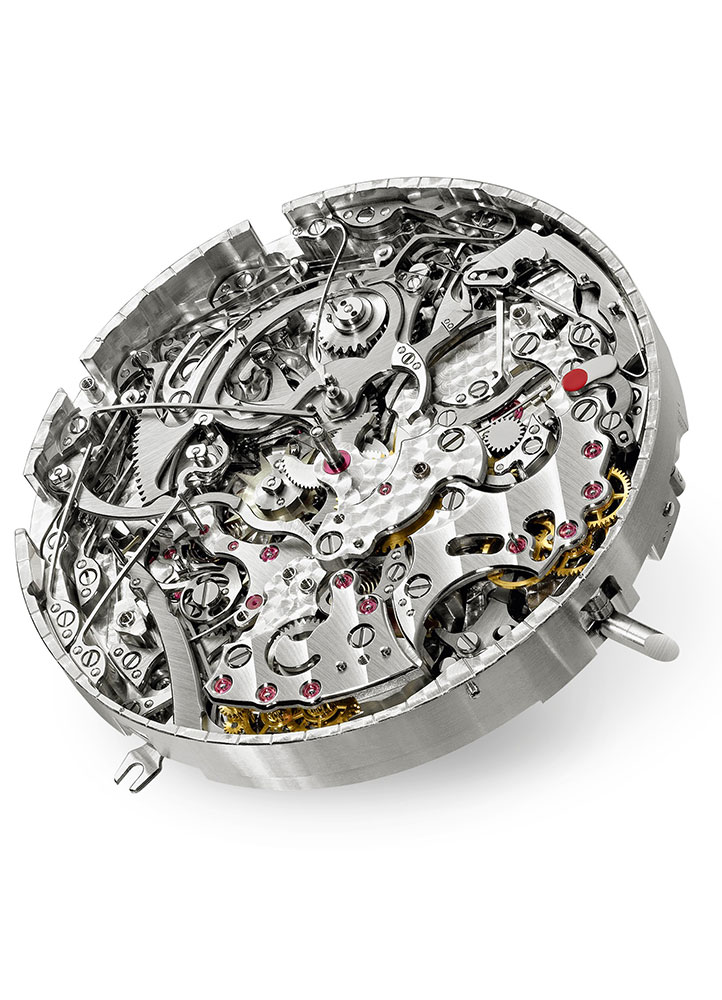
- The calendar side of the Caliber 300 GS AL 36-750 QIS FUS IRM
But how do you operate all these functions? The second time zone is advanced “Travel Time” style by the pushers on the left side of the case. This controls both the second time zone hand fitted to the cannon pinion and distinguished by its Breguet shape as well as the day/night indicator for the second time zone to the left of the sonnerie’s power reserve. At nine o’clock, there is the sonnerie slider that allows you to switch between the three modes. A red indicator at 1:30 tells you when the sonnerie is in either of the activated modes. The pusher at two o’clock turns the alarm on or off. The pusher at four o’clock activates the innovative date repeater. Just in case you forget any of these, the pushers are engraved with the words “date” and an alarm bell. The pusher fitted co-axial to the crown activates the minute repeater. Because the quarters of this watch feature a three-part note played on three gongs using three hammers, this consumes 50 percent more energy than a traditional repeater. As such, the sonnerie mechanism features its own two-barrel energy source with 30 hours of power reserve.

Now, turn the Reference 5175 around so that the crown is facing nine o’clock and you see the perpetual calendar side of the Grandmaster Chime. Here, time is in 24-hour format on the subdial at 12 o’clock; month is at three o’clock; date and leap year are located at six o’clock; and finally day-of-the-week is located at nine o’clock. In the center of all of this is the four-digit leap year.
All in, there were over 1,000 hours or eight years’ worth of research and development that went into the creation of the extraordinary caliber 300 GS AL 36-750 QIS FUS IRM, which is the penultimate expression in Patek Philippe’s legacy on chiming watches. The original Reference 5175 was also a repository for incredible handcraftsmanship in the form of the three-dimensional hand engraved “Hellenistic” themed case and lugs. It is home to 20 complications and 1,366 individual components. Only seven watches in this iteration were made with one of these pieces residing at the Patek Philippe Museum.
Tech Specs: Patek Philippe Reference 5175
Movement: Manual winding caliber 300 GS AL 36-750 QIS FUS IRM; 25,200 vibrations per hour
Functions: Hours, minutes, second time zone, minute repeater, grande and petite sonnerie, acoustic alarm time, date repeater, and instantaneous perpetual calendar
Case: 47.4mm; 18K rose gold with hand engraving
Dial: Silvery opaline with center guilloché; applied Roman numerals
Strap: Leather
Years in production: 2014
Total production: Seven examples
Patek Philippe

You may also like
News
These Are The Most Iconic Singapore-Exclusive Timepieces Over The Years, And Then Some
Aug 8, 2025
News
These Are The Most Iconic Singapore-Exclusive Timepieces Over The Years, And Then Some
Aug 8, 2025
Reviews
A Closer Look: Patek Philippe Calatrava 8-Day Ref. 5328G
Jul 21, 2025
Reviews
A Closer Look: Patek Philippe Calatrava 8-Day Ref. 5328G
Jul 21, 2025

Through the Looking Glass: Tinted Sapphires
Apr 20, 2025
Through the Looking Glass: Tinted Sapphires
Apr 20, 2025