


A Retrospective On The A. Lange & Söhne 1815 Collection
Reference
A Retrospective On The A. Lange & Söhne 1815 Collection

In many ways, the story of A. Lange & Söhne and the story of the watchmaking industry in Saxony, Germany are one and the same. Though predated by individual craftsmen of the Court, the modern story as we know it begins with the birth of Ferdinand Adolph Lange in 1815. Thus a 210 year story began, leading to the contemporary horological world in which A. Lange & Söhne sits as a pinnacle of fine watchmaking. Amongst its six distinct and largely iconic collections is the remarkable, and traditional, 1815 collection, so named for the year of Ferdinand Adolph Lange’s birth.
First conceptualized in 1995 after the rebirth of A Lange & Söhne, the collection is an aggregate of classical timekeeping aesthetics — precise, reserved, and elegant. Perfectly balanced, its beauty stems from the purity of its purpose. Arabic numerals circumnavigate the dials, framed by a railway-track minute scale. This synthesis of function and form is demonstrated through subtle, refined details, all in the service of legibility.

The evolution of the 1815 dial, 100 years apart. Image: Langepedia
Over the past 30 years, the collection has played host to some of the most lauded and desirable watches in Lange’s storied history. Running the gamut from the most simple, time-only examples to the wildly complex and fabulously complicated, the cleanly canvas of the 1815 has persisted as a horological muse for both collectors and watchmakers alike. Thus, on the auspicious occasion of its third decade, we shall look back upon some, those certainly not all, of the more notable examples.
The debut of 1815
The 1815 was first introduced in 1995 to great fanfare, unveiled at the Residenzschloss, or the Royal Palace Castle in Dresden, Germany. The principle model was, at the time (perhaps overshadowed by the accompanying Tourbillon “Pour Le Merite”, but more on that later), the 1815 was a remarkably clean yet stylish timepiece. Sitting at an ideal 35.9mm, the manually wound caliber L051.1 was equally restrained, though nevertheless featuring the distinct finishing techniques the Glashütte based watchmaker is known for.
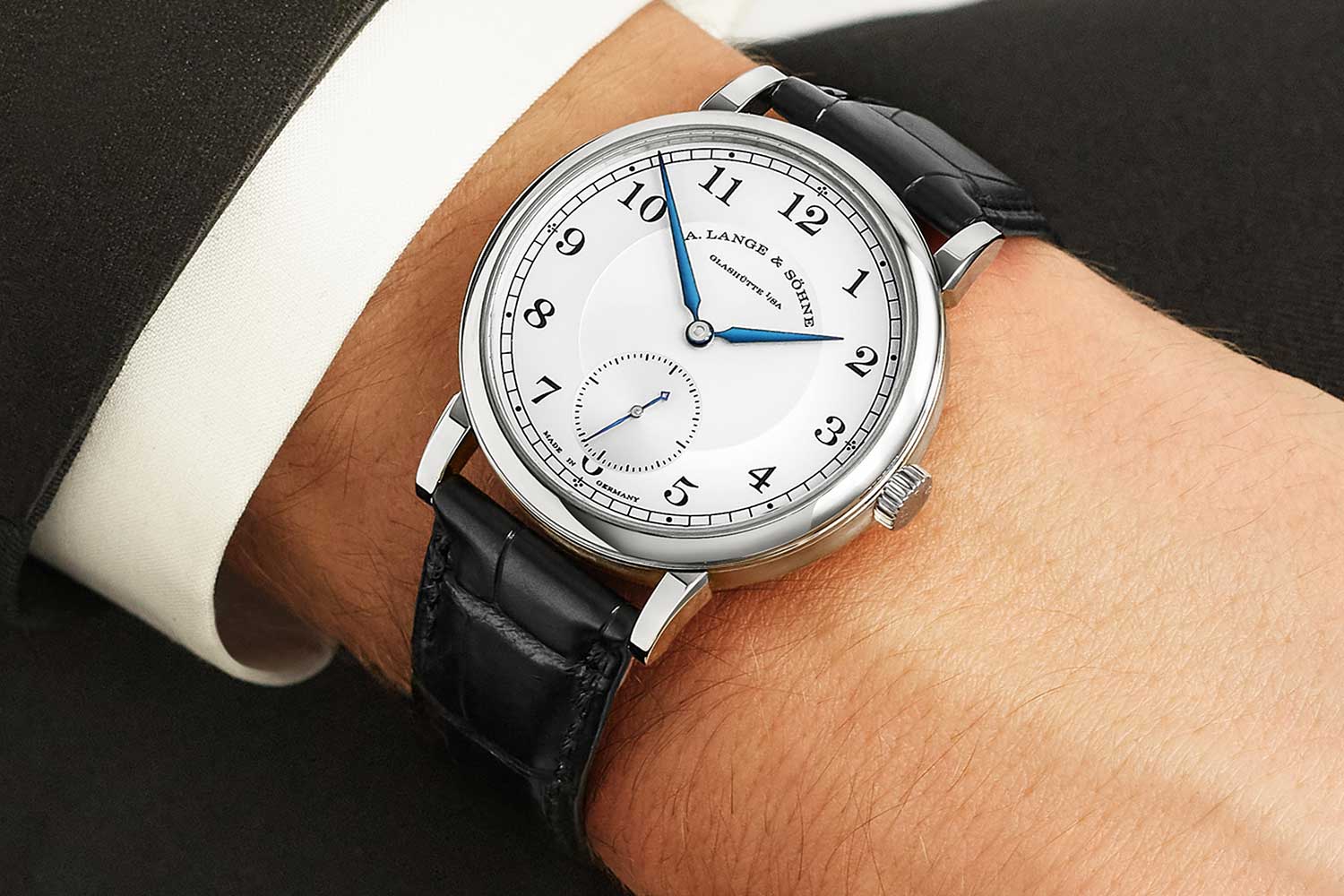
A. Lange & Söhne 1815 in 750 White Gold, Ref. 235.026

Movement L051.1
Some years later, the 1815 was reinvented in size and capability, though it maintained its austerity and legibility — hours, minutes, and small seconds subdial at 6 o’clock. The power reserve thus increased from 45 to 55 hours, and its case size increased to 40mm, in keeping with the trend of the time.

A. Lange & Söhne 1815 in 750 Pink Gold, Ref. 235.032
1815 Up/Down
Two years later, the 1815 was joined by the 1815 UP/DOWN. The subsidiary seconds dial was moved to the 4 o’clock position and, maintaining its dignified symmetry, a second subdial was positioned at 8 o’clock containing a power reserve indicator. While the 1815 soubriquet evokes history in its own right, the UP/DOWN indications are reminiscent of the pocket watches that were produced by Lange in 1879.

A. Lange & Söhne 1815 UP/DOWN in 750 White Gold, Ref. 234.026
Throughout its numerous iterations, this combination of functional, essential information harkens back to an era where utility was paramount. Even the finest examples of horological prowess were, at the end of the day, timekeeping instruments first and foremost. Thus, the 1815 UP/DOWN provides the most fundamental information necessary, and nothing more.

A. Lange & Söhne 1815 UP/DOWN in 750 Pink Gold, Ref. 234.032
1815 Automatic
In 2004, the 1815 received another monumental addition. Up until this point, the 1815 had all been manually wound. For the first time, the 1815 now utilized the SAX-0-MAT movement, with its three-quarter rotor. This allows for an unhindered view of the rest of the movement including the engraved balance cock. A secondary function of the movement, the subsidiary seconds dial provides additional accuracy via the Zero-Reset mechanism, causing the seconds hand to reset to zero as soon as the crown is pulled out to set the time.

A. Lange & Söhne 1815 Automatic in 750 Yellow Gold, Ref. 303.021
1815 Chronograph
Fresh on the heels of the Datograph in 1999, the chronograph that literally put the Swiss Watchmaking industry on notice, the 1815 Chronograph was launched. Utilizing a version of that same flyback chronograph movement with jumping minute counter, the 1815 chronograph was lacking in the large date window, creating an even more harmonious dial layout.
-

- A. Lange & Söhne 1815 Chronograph in 750 Pink Gold, Ref. 414.031
-

- A. Lange & Söhne 1815 Chronograph in 750 White Gold, Ref. 414.026
After a few iterations and small design changes, the final form of the watch would utilize an updated manually wound movement with 60 hour power reserve and a pulsations scale along the outer track of the dial. Considered by many to be one of, if not the, most beautiful and refined chronographs ever made, the 1815 Flyback Chronograph is a cornerstone of Lange’s catalogue.

Movement L951.5
1815 Rattrapante Perpetual Calendar
While there have been several variations of the 1815 with various calendar and calendar adjacent functions, such as the 1815 Calendar Week, 1815 Annual Calendar, and 1815 Moon Phase, the 1815 Rattrapante Perpetual Calendar is chief among them. Utilizing a remarkable two-column wheel transmission, one indented for the chronograph and one for the split-seconds function, this astounding achievement of horological prowess also incorporates a perpetual calendar and moonphase. The accuracy of the calendar is ensured until the year 2100.

A. Lange & Söhne 1815 Rattrapante Perpetual Calendar in 750 Pink Gold, Ref. 421.056FE
-

- With a traditional railway-track minute scale, Arabic numerals and the harmonious arrangement of the four subsidiary dials, the dial embodies the essence of the 1815 watch family
-

- The calendar indications will only need to be corrected by one day, but not until 1 March 2100; according to the rules of the Gregorian calendar, the leap year will then be skipped
Initially released in 2013 in both pink gold and platinum, another limited edition was released in 2017 utilizing the mind boggling Handwerksunst dial, which featured a blue enamelled white gold dial with relief engravings. Additionally, a white gold edition was produced in 2023 with a pink gold dial in just 100 examples.

A. Lange & Söhne 1815 Rattrapante Perpetual Calendar in 950 Platinum, Ref. 421.025FE
Tourbillon “Pour Le Merite” and Tourbograph “Pour le Merite”
When it was first unveiled alongside the 1815, the Tourbillon “Pour Le Merite” stood as a mechanical achievement. The movement utilizes a fusée-and-chain mechanism which, apart from its delicate beauty, allows for a consistent tension as the mainspring releases its energy to the movement. The result is a constant transmission of energy that equates to even accuracy throughout the watch’s 36 hour power reserve. 150 examples in gold and 50 examples in platinum were produced.

A. Lange & Söhne 1815 Tourbillon “Pour Le Merite” in Platinum, circa 1994 (Image: A Collected Man)
As though the initial example weren’t impressive enough, the Tourbograph stood as a totality of capability. One of the most dazzlingly complex timepieces ever created, the Tourbograph “Pour le Merite” utilized the L903.0 movement, which combined the fusée-and-chain mechanism, a one minute tourbillon, and a split-seconds chronograph. Both the 2005 edition in platinum and the 165 Years – Homage to F.A. Lange Edition from 2010 in Honeygold remains two of the most rare and desirable Lange timepieces ever created.

A. Lange & Söhne Tourbograph ‘Pour le Mérite’, Ref. 702.025F (Image: Sotheby’s)

View of the Movement L903.0 from the caseback (Image: Sotheby’s)
Lest the combinations of complication prove too numerous, the Tourbograph Perpetual “Pour le Merit” was subsequently released in 2017 and then again in 2020 in celebration of the 175th anniversary in Homage to F.A. Lange. Both examples were made in limited editions of just 50 pieces.
-

- A. Lange & Söhne Tourbograph Perpetual Honeygold ‘Homage to F. A. Lange’ in 750 Honeygold©, Ref. 706.050FE
-

- A. Lange & Söhne Tourbograph ‘Pour le Mérite’ in 950 Platinum, Ref. 706.025FE
1815 Grand Complication
Admittedly, one can only string together so many superlatives in close succession, in an ever escalating effort to describe the capabilities of A. Lange & Söhne’s watchmaking prowess, before things start to just sound hyperbolic. But alas, this proves necessary one more time when discussing the Grand Complication. This is the culmination, the top of the proverbial mountain. Produced in 2013 in just six examples, this timepiece is a study in horological capability.
-

- A. Lange & Söhne 1815 Grand Complication in 750 Pink Gold, Ref. 912.032F
-

- Close up on the dial
The enamel dial is constructed in five parts and belies the complexity beneath. The watch features grande and petite sonneries, minute repeater, split-seconds chronograph with minute-counter and flying seconds, a perpetual calendar, and a moon phase. The depth of complexity and skill required would almost strain credulity were it not for the sheer magnitude of Lange’s expertise. By containing what amounts to over 200 years of watchmaking knowledge into a single piece, the Grand Complication demonstrates definitively that the 1815 is a canvas on which any horological accomplishment can, and should, be demonstrated.
A. Lange & Söhne
You may also like
News
A. Lange & Söhne Launches Two New Saxonia Thin Special Editions
Oct 4, 2025
News
A. Lange & Söhne Launches Two New Saxonia Thin Special Editions
Oct 4, 2025
News
A. Lange & Söhne Unveils Richard Lange Jumping Seconds And 1815 Tourbillon At Hampton Court Palace
Sep 5, 2025
News
A. Lange & Söhne Unveils Richard Lange Jumping Seconds And 1815 Tourbillon At Hampton Court Palace
Sep 5, 2025
Reviews
A Closer Look: A. Lange & Söhne Zeitwerk Date in Pink Gold
Jul 25, 2025
Reviews
A Closer Look: A. Lange & Söhne Zeitwerk Date in Pink Gold
Jul 25, 2025