



How The Cartier Santos Became The First Pilot’s Watch
Editorial
How The Cartier Santos Became The First Pilot’s Watch

At the dawn of the 20th century, when most men still wore pocket watches and the skies remained largely unconquered, two visionaries changed the course of aviation and timekeeping history. One was Louis Cartier, Parisian jeweler and scion of a dynasty whose name was destined to become world-famous for high luxury. The other was Alberto Santos-Dumont, a Brazilian-born aristocrat and pioneering aviator, a man whose stubborn refusal to accept the limits of gravity wrote the earliest chapters of the tale of human flight.
Together, they forged a lifelong friendship that directly inspired what can arguably claim to be the first true pilot’s watch: the Santos de Cartier.
-
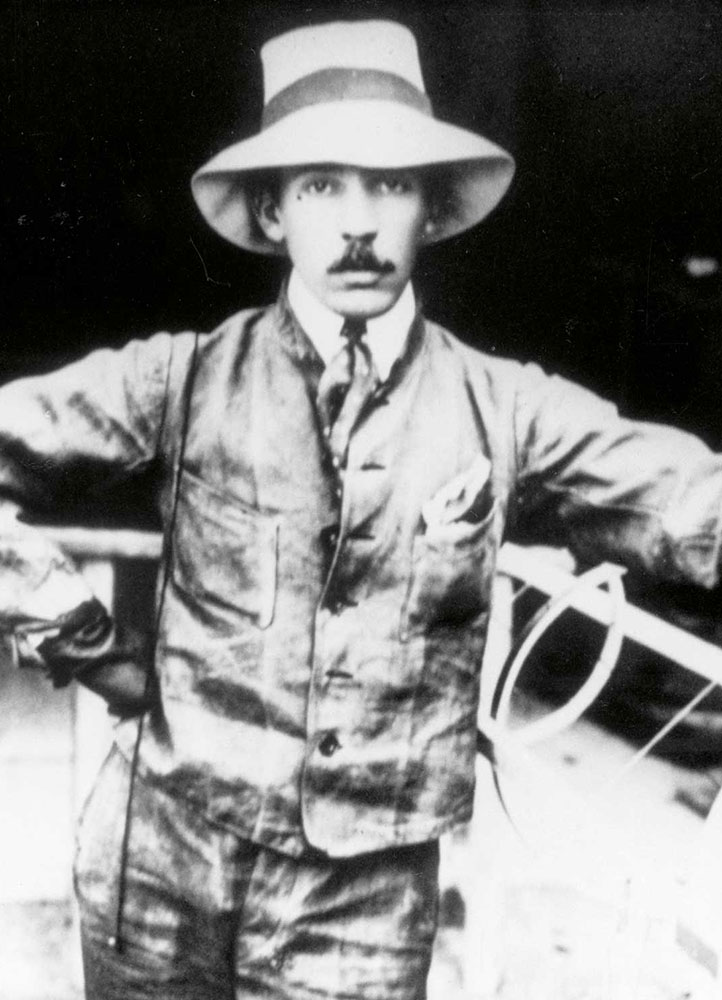
- Alberto Santos-Dumont
-
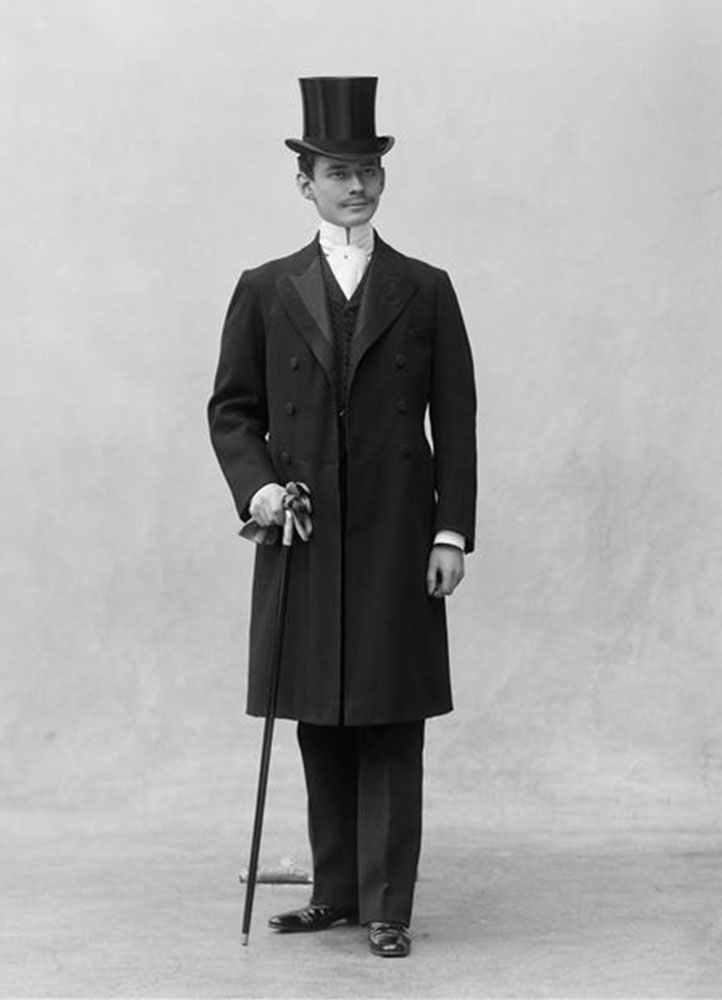
- Louis Cartier
Alberto Santos-Dumont was no run-of-the-mill man. A wealthy dandy from a Brazilian coffee-growing dynasty, he spent most of his life in Paris, where he developed a taste for mechanical experimentation, alongside an appreciation for the finest things in life. Santos-Dumont moved in aristocratic circles and cultivated a taste for adventure. He summited Mont Blanc at the age of 18, a feat that set the stage for his lifelong preoccupation with altitude, and dived into the worlds of motor racing and cycling, alongside embarking on his studies. His inner urge for adventure did not fuel a deep commitment to learning and he abandoned his early studies. However, an innate knack for mechanics — and that obsession with the skies — led him to ballooning. The fortuitous blend of almost endless wealth and a passion for flight saw him designing and building increasingly complex air balloons. He became an early advocate for aviation, encouraging both the French government and the general public to support this new and exciting industry as he buzzed precariously around Paris rooftops in his highly experimental machines.
Santos-Dumont became the first person to fly around the Eiffel Tower in an early airship: On October 19, 1901, after multiple attempts, Alberto Santos-Dumont flew his No. 6 airship from Parc de Saint-Cloud to the Eiffel Tower and back — an 11-kilometer journey — in 29 minutes and 30 seconds. Though he exceeded the official 30-minute time limit by about 40 seconds due to the time it took to land and was initially denied the Deutsch de la Meurthe Prize, public support ultimately persuaded the prize committee to rule in his favor. He donated the 100,000-franc reward to his staff and Paris’s unemployed, cementing his status as a pioneering aviator. Next, Santos-Dumont turned his focus to the development of gliders, helicopters and airplanes. In 1906, he achieved Europe’s first publicly witnessed powered flight in his 14-bis aircraft.
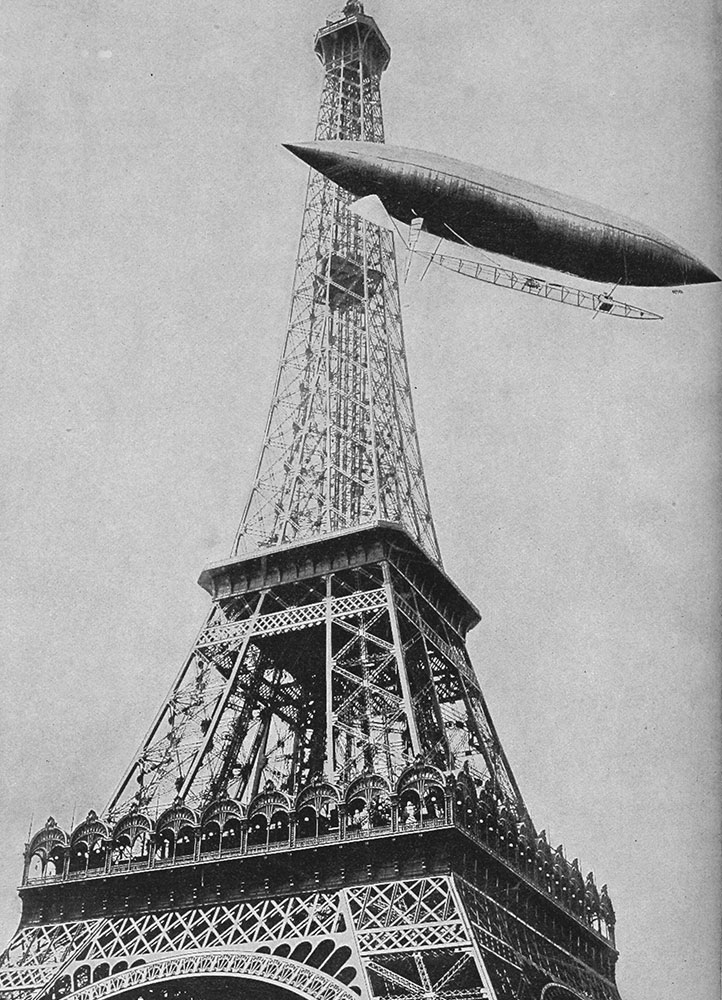
Santos-Dumont’s flight around the Eiffel Tower
While Santos-Dumont made waves in the sky, Parisian Louis Cartier was at the epicenter of avant-garde luxury design on the ground. His family business pushed the limits of high style in the French capital where discerning tastemakers, scientists, technologists and industrialists fueled an era of progress, change and innovation. When the aeronaut and the watchmaker, both stars in their respective industries, inevitably crossed paths, their shared passion for innovation and mechanical mastery fueled a lifelong friendship and gave the world a wristwatch whose legacy remains to this day, as seen in Cartier’s elegant Santos de Cartier Small Model novelties collection, unveiled this year at Watches and Wonders in Geneva.
The birth of the Cartier Santos
The legacy of Cartier’s iconic timepiece begins with Santos-Dumont, navigating above the clouds in the first years of the 20th century. Santos-Dumont realized that life in the skies would be considerably easier if he were in possession of a timekeeping instrument that didn’t require the constant fumbling of gloved hands to dig out a pocket watch from a waistcoat.
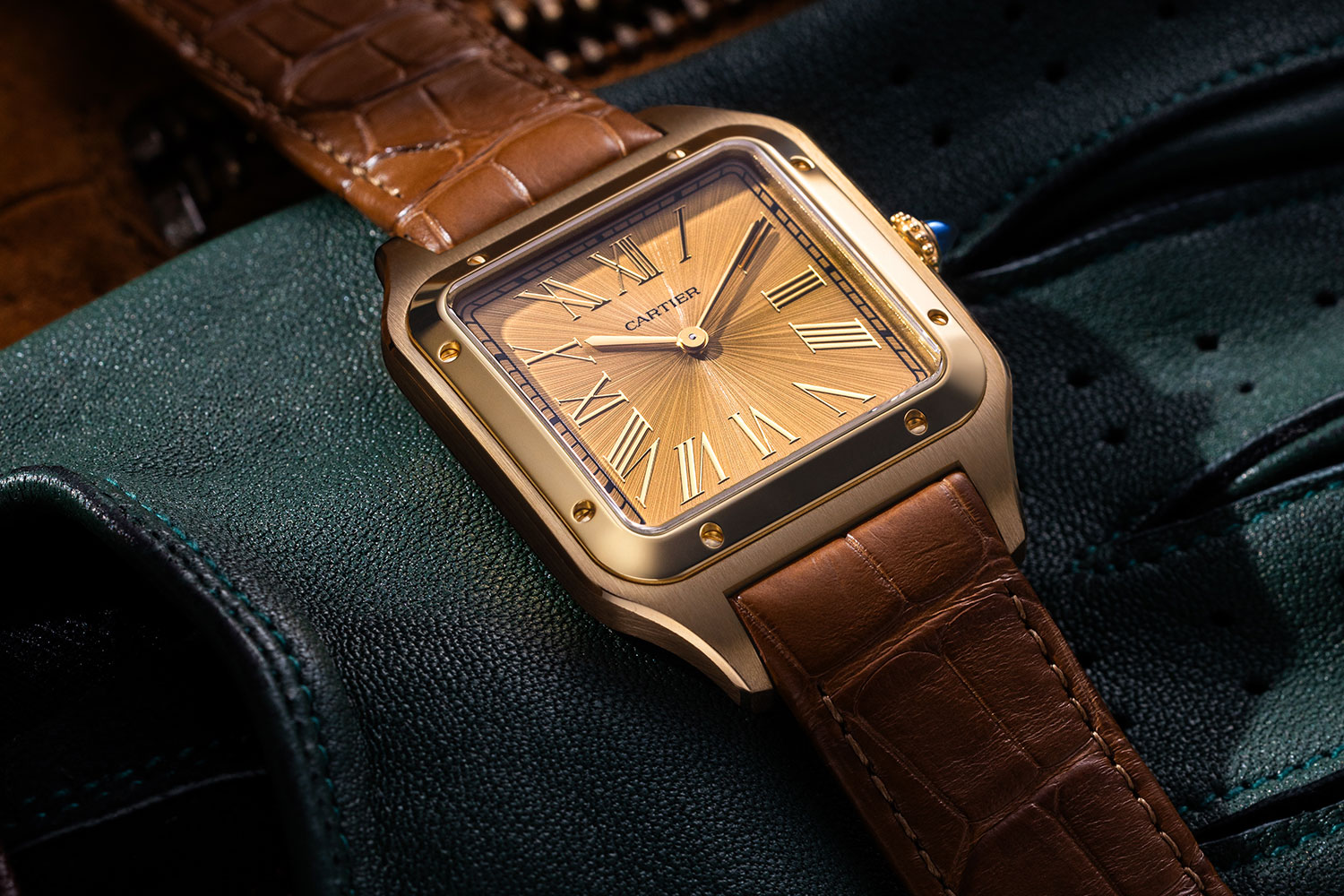
Cartier Santos-Dumont Yellow Gold XL (Image: Revolution ©)
Cartier, determined to attune to the desires of his avant-garde clientele, and his close friend, responded in 1904 with a radical proposition: a flat wristwatch with a bold square case, its form inspired not by the usual superfluous romantic flourishes of the day, but driven by pure functionality. It was affixed to the wrist with a leather strap and fastened with a small buckle. It was a groundbreaking piece of design, created for the air, but destined to become an icon on the ground. The watch, whose minimalism of over 100 years ago feels entirely modern and aligned with the contemporary tastes of today, represented cutting-edge design in its day. By putting a watch on the wrist, Cartier inadvertently revolutionized how watches were worn. The Cartier Santos was the first purpose-built men’s wristwatch, an act of design modernism before such a term even existed. At the time, it was the first modern watch designed to be worn on the wrist. The visible screws of this square watch, normally hidden in watchmaking, would become an aesthetic code of the collection, and were a truly avant-garde aesthetic detail at the time.

Cartier Santos de Cartier Dual Time (Image: Revolution ©)
The Cartier Santos was designed in a way that stepped outside of the aesthetic codes of its time. Timekeeping was via round pocket watches, but the Santos was square. The case and lugs were a single piece with curved corners and visible screws, perhaps informed by the prevailing spirit of industry. Yet for all its utilitarian roots, the Santos never lost its Parisian soul. Even as it flew higher, it remained elegant, defined by the signature Cartier touch of contrast: geometry, meticulous proportions, robustness and refinement. Sadly, the original Santos is lost to history, but its descendants have continued to be an iconic part of Cartier’s timekeeping story, and the spirit of the aviator — with his innovation, daring and elegant rebellion — remains to this day.
Small but mighty: The 2025 Santos de Cartier Small Model
This year, at Watches and Wonders 2025, Cartier reminded us that some of the greatest stories can find new expression in smaller chapters. Enter the new Santos de Cartier Small Model collection, a series that revisit the essence of the original while speaking “squarely” to contemporary tastes.

Cartier Santos de Cartier Small Model in steel and two-tone yellow gold (Image: Revolution ©)
With dimensions of 27mm by 34.5mm, the new small model echoes the proportions of the earliest Cartier Santos watches. Offered in all-steel, yellow gold, or bimetal gold and steel, these new models bring a jewelry-like precision to the wrist, exuding that signature elegance-meets-utility that is a hallmark of Cartier. The case retains the same clean, architectural lines of its larger siblings, and those signature screws remain as proudly visible as they always have been — reminding us of the watch’s industrial roots that were once so cutting-edge, but today seem astonishingly at home amongst contemporary aesthetics.
Lending a new chapter to the story; a new sunray-effect dial brings a feeling of refined depth and radiance, subtly catching the light. Dare we compare this to the shimmer of sunlight on polished fuselage metal? Each piece features a high-autonomy quartz movement tailored specifically for the smaller case size, offering Cartier’s signature reliability without the need for constant winding, a decision that priorities elegance and simplicity. The quartz caliber is entirely in keeping with the Santos ethos: to be worn, to be lived in, to accompany life’s adventures in a useful, simple way. And for those who still crave mechanical complexity, the Manufacture 1847 MC-equipped large model remains in the collection, water resistant to 10 bar.
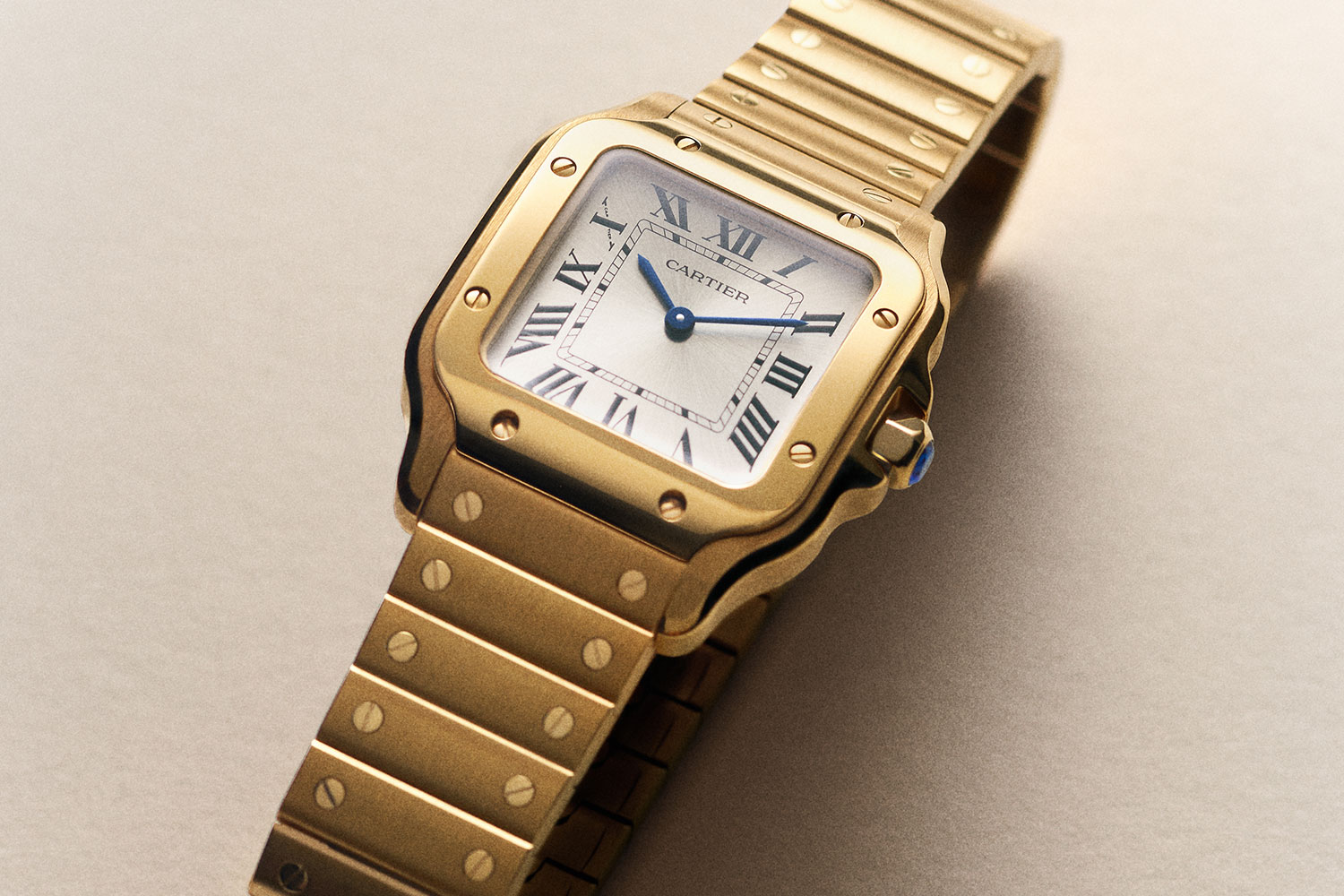
Cartier Santos de Cartier Small Model in yellow gold
Like all modern Santos watches, the small model features Cartier’s proprietary QuickSwitch System, which makes changing between bracelet and strap straightforward. Metal bracelets retain their comfortable, screw-less integration and come with SmartLink adjustment technology, allowing the wearer to size the bracelet without tools. This new version is as interchangeable as the collection’s larger models, with a choice of metal bracelet or leather strap. Crafted in calfskin for the non-precious versions and in alligator for the all-gold model, the leather strap is fitted with an ardillon buckle. In a world where excess is often favored, the small model exudes confidence in understatement.
The Santos legacy
While there is certainly much to admire about the Santos de Cartier Small Model purely through a fashion lens, it is important not to overlook its legacy. This is not a watch that was ever invented for runways. It was born in the cockpit of a flying machine, strapped to the wrist of a man defying gravity. Santos-Dumont was not just a pilot. He was an inventor, a futurist, and a style icon long before the term existed. His collaboration with Cartier wasn’t about the kind of brand promotion we see today with athletes or adventurers promoting a watch; it was a true meeting of function and form in men’s wristwear. He understood, as Louis Cartier did, that elegance and engineering were not mutually exclusive. The Santos watch embodies that spirit still. It is, and always has been, a symbol of modernity: not the fleeting, trend-led kind, but the enduring sort that emerges from design purity and utility. It is an icon whose purpose and practicality underpins its artistic status.

Cartier Santos-Dumont Skeleton (Image: Revolution ©)

Cartier Santos de Cartier Skeleton (Image: Revolution ©)
In 2025, the Santos de Cartier Small Model creates a bigger impact: the purity of the Santos story, speaking to a new generation that demand craftsmanship and watches that fit into the flow of modern life. It’s a boldly analog expression of thoughtful style in a world that is often over-saturated with novelty. Cartier at its best understands that luxury isn’t about complication, but conviction. The original conviction drove Louis Cartier to invent a practical pilot’s watch and a wristwatch. In 2025, that legacy continues to fly high with the same kind of spirit that sent Santos-Dumont above the clouds in the first place.
Cartier

You may also like

Editorial
Fore Of The Greatest Golf Watches Ever To Hit The Green, Inspired By Happy Gilmore 2
Aug 15, 2025
Editorial
Fore Of The Greatest Golf Watches Ever To Hit The Green, Inspired By Happy Gilmore 2
Aug 15, 2025

News
These Are The Most Iconic Singapore-Exclusive Timepieces Over The Years, And Then Some
Aug 8, 2025
News
These Are The Most Iconic Singapore-Exclusive Timepieces Over The Years, And Then Some
Aug 8, 2025

News
The New Cartier Santos de Cartier Small Model Packs a Big Punch
Jun 20, 2025
News
The New Cartier Santos de Cartier Small Model Packs a Big Punch
Jun 20, 2025