


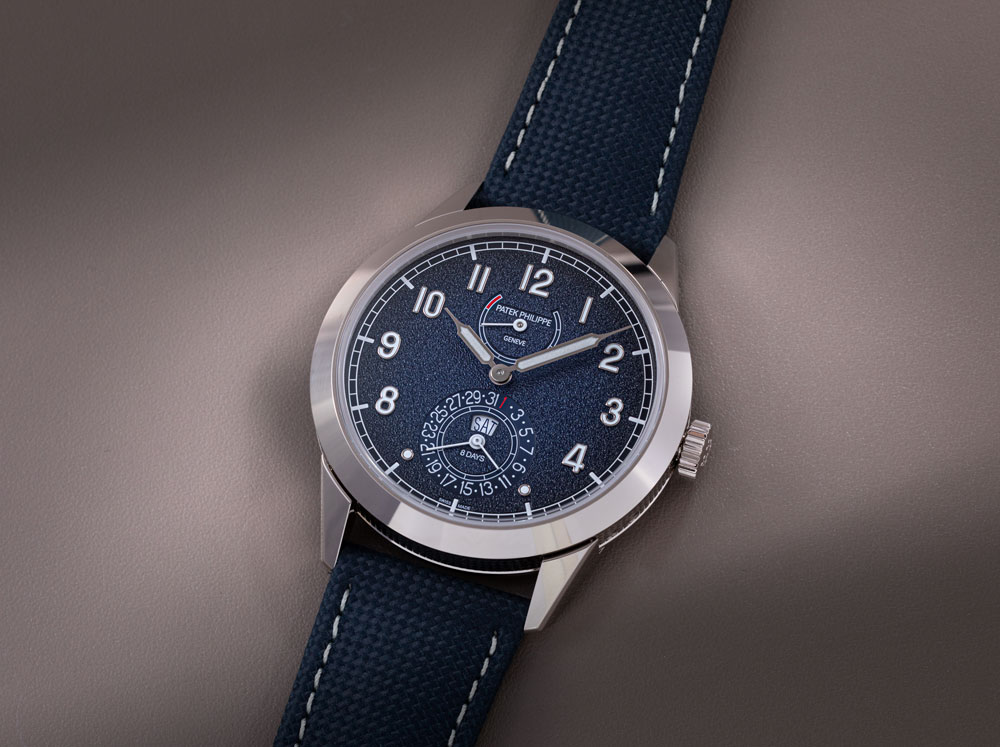
A Closer Look: Patek Philippe Calatrava 8-Day Ref. 5328G
Reviews
A Closer Look: Patek Philippe Calatrava 8-Day Ref. 5328G

It has been over a decade since Patek Philippe last introduced a wristwatch with a weeklong power reserve. The most recent was a now-retired Gondolo model launched in 2013. That absence is somewhat surprising, given the brand’s past leadership in this space. Just over two decades ago, the Genevan manufacture was at the forefront of extended power reserve complications, with a ten-day tourbillon among its technical highlights.
That changes this year. One of the more compelling introductions from Patek Philippe is the Calatrava 8-Day ref. 5328G. It has flown under the radar, perhaps overshadowed by the classical 38 mm platinum Calatrava with a salmon dial.

The all-new Calatrava with an 8-day power reserve and instantaneous day and date display. (Image: Revolution ©)
But beneath the ref. 5328’s modern exterior lies a movement of a very different character. Among the brand’s current offerings, its layout may be the closest nod to the pocket watches of old. Classical in architecture and technically refined, this newly developed movement delivers eight full days of running time from a single wind and features an instantaneous day and date display that advances precisely at midnight.
A brief history on long power reserve
In modern watchmaking, extended power reserves have become a showcase of technical achievement. Brands now compete with increasingly ambitious durations. A. Lange & Söhne offers a 31-day movement. Patek Philippe matches this with a desk clock. Hublot claims 50 days, and Vacheron Constantin tops the list at 65.
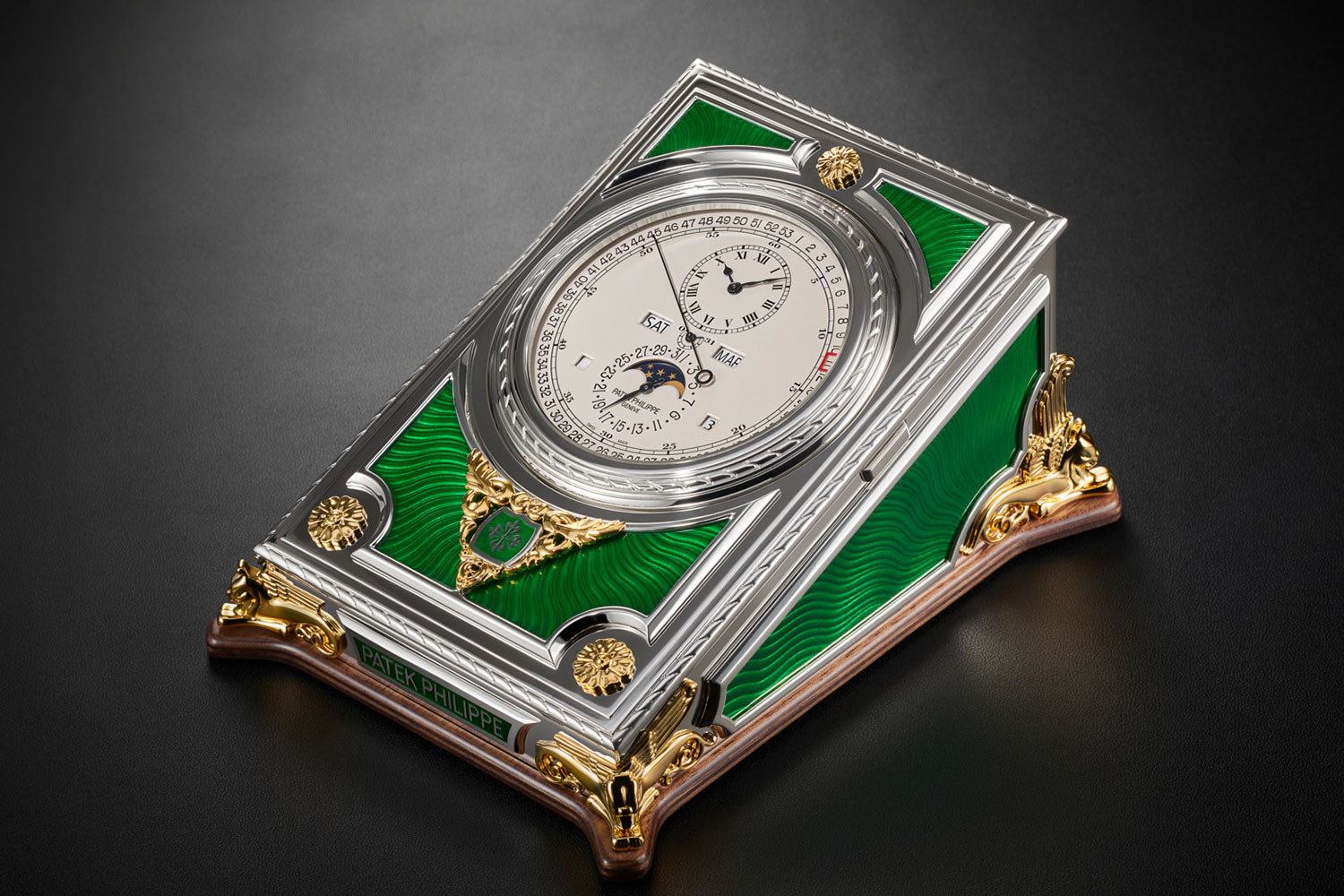
Patek Philippe Desk Clock Ref. 27000M
But the idea itself isn’t new. As far back as the late 1800s, travel clocks and pocket watches often had eight-day reserves. Their purpose, though, was purely practical.
The logic was simple. A travel clock designed for weeklong trips benefited from being wound only once. That extra day served as a safeguard in case the weekly routine was forgotten. Today, this rationale is less relevant. Automatic movements wind themselves during wear, and even for manually wound watches, month-long reserves are more a demonstration of technical prowess than practical necessity.

The all-new but rather old-school Patek Philippe Cal. 31‑505 8J (Image: Revolution ©)
Still, the principle behind a long power reserve has barely changed. Whether a century ago or today, it comes down to longer mainsprings.
What has changed is how efficiently and accurately these reserves can now be delivered. Early mainsprings were made from carbon steel, which produced highly inconsistent torque. In such cases, watchmakers relied on a clever device called the Geneva stopwork, or Maltese cross. It blocked the weakest and strongest sections of the spring, allowing only the most stable mid-range to be used. A beautiful example appears in an 1850 Czapek & Cie pocket watch, made just five years after the founders split from Patek.
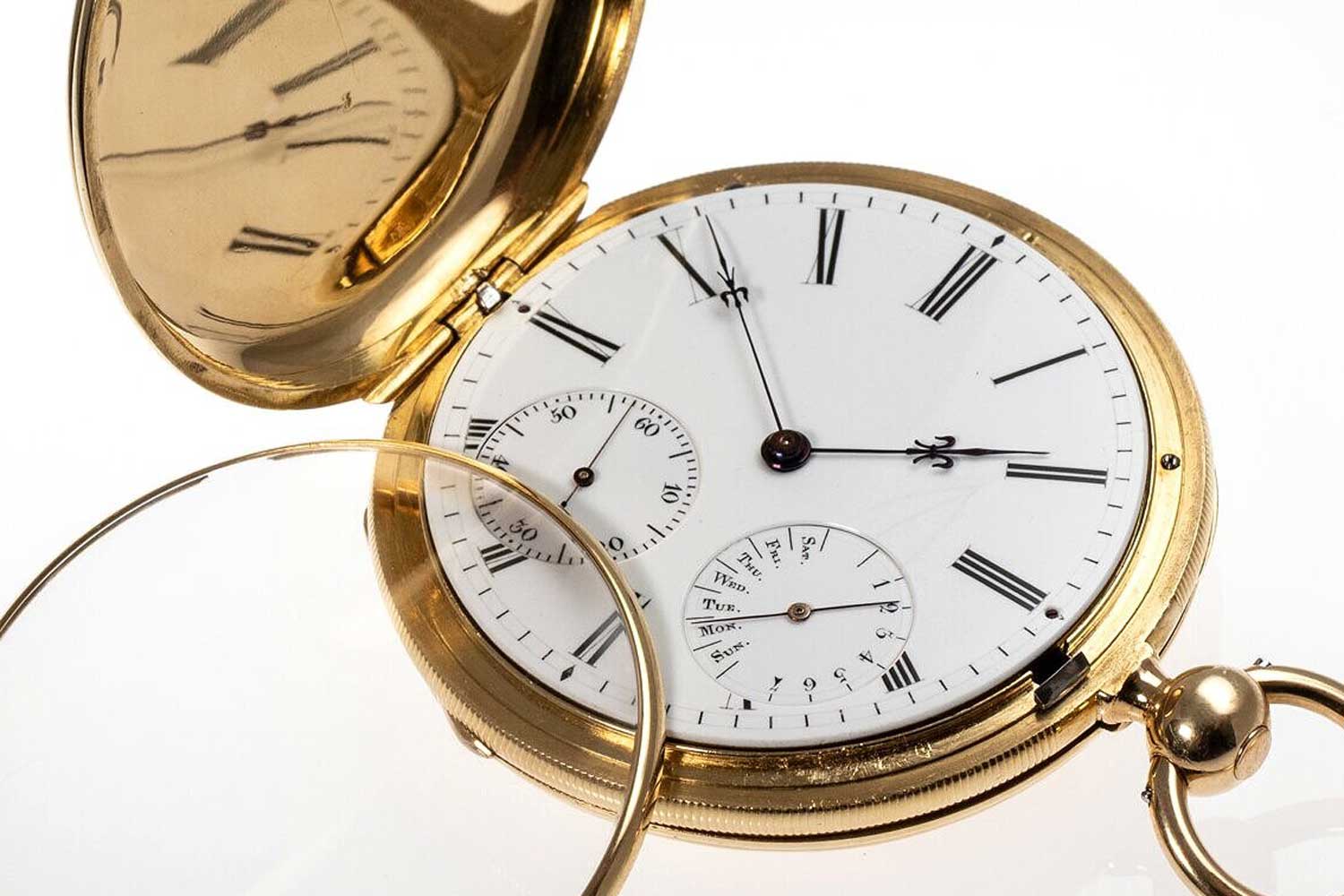
The Czapek & Cie 8-Day Power Reserve Pocket Watch No. 3430 (Image: The Naked Watchmaker)
When longer reserve was essential, watchmakers relied on a clever device called the Geneva stopwork, or Maltese cross. It blocked the weakest and strongest sections of the spring, allowing only the most stable mid-range to be used. A beautiful example of this appears in an 1850 Czapek & Cie pocket watch, made just five years after the founders split from Patek.
Eventually, modern engineering helped improve the strength of the mainspring. For example, the Nivaflex alloy invented in 1957. But this did not necessarily eliminate the need for Geneva stopwork in a weeklong power reserve watch driven by a single barrel. Even with the best modern materials, the torque difference between the beginning and end of the reserve remains a problem that cannot be fully removed.

The view just under the dial. (Image: The Naked Watchmaker)
So why do we no longer see Geneva stopwork in modern watches?
That is because most modern watches with longer power reserves are almost always equipped with more than one barrel. Those with a single barrel, like the first-generation IWC Big Pilot’s Watch with the cal. 5011, have proven to be poor timekeepers and were later replaced with twin barrels in subsequent iterations of the movement.
With twin barrels, each one only needs to store a shorter reserve. When they are coupled to unwind together (more on that later), they can somewhat reduce the torque difference between the beginning and end of the reserve.
Still, without the technology to shrink long-reserve barrels, they could not have fit into a wristwatch. Thinner, more elastic mainsprings made it possible to pack more coils into the same barrel. That is one reason why eight-day reserves, once limited to clocks and pocket watches, could finally work in a wristwatch. But of course, one rare exception came earlier. The mid-20th century Panerai ref. 6152 used the Angelus calibre 240. It was then the world’s smallest eight-day pocket watch movement, housed in a massive 47 mm case. That was about 15 mm wider than a typical men’s watch of the time.
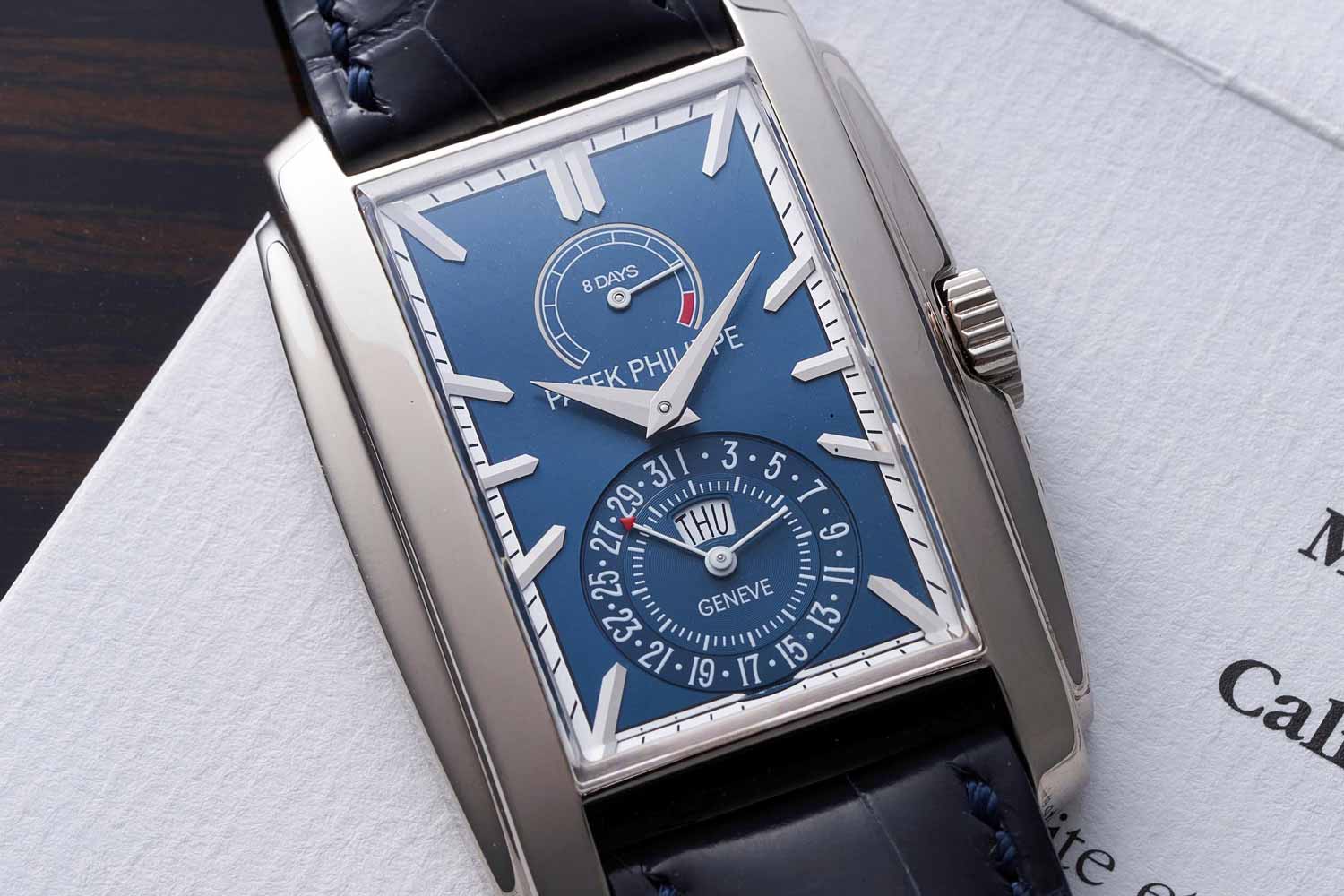
The Gondolo 8-Days ref. 5200G, with a day, date, and power reserve indicator, just like the current Calatrava 8-Day. (Image: Bonhams)
Real progress in the wristwatch arena came in 2000. IWC launched the Portugieser Automatic 2000 with calibre 5001, the first automatic wristwatch with a seven-day reserve. It would later define the Big Pilot’s Watch. That same year, Patek Philippe introduced the Gondolo 10 Day Power Reserve ref. 5100, inspired by the 1954 ref. 2554 “Manta Ray.” It became the first chronometer-certified wristwatch with a ten-day reserve. The rest is history.
A Calatrava that’s sporty and contemporary
The new 8-day power reserve watch returns with a completely different look from the last time it appeared in the brand’s catalogue. Back in 2013, Patek introduced the Gondolo 8-Day, which had a stepped rectangular case – very Art Deco, perhaps a little too stern for modern tastes.
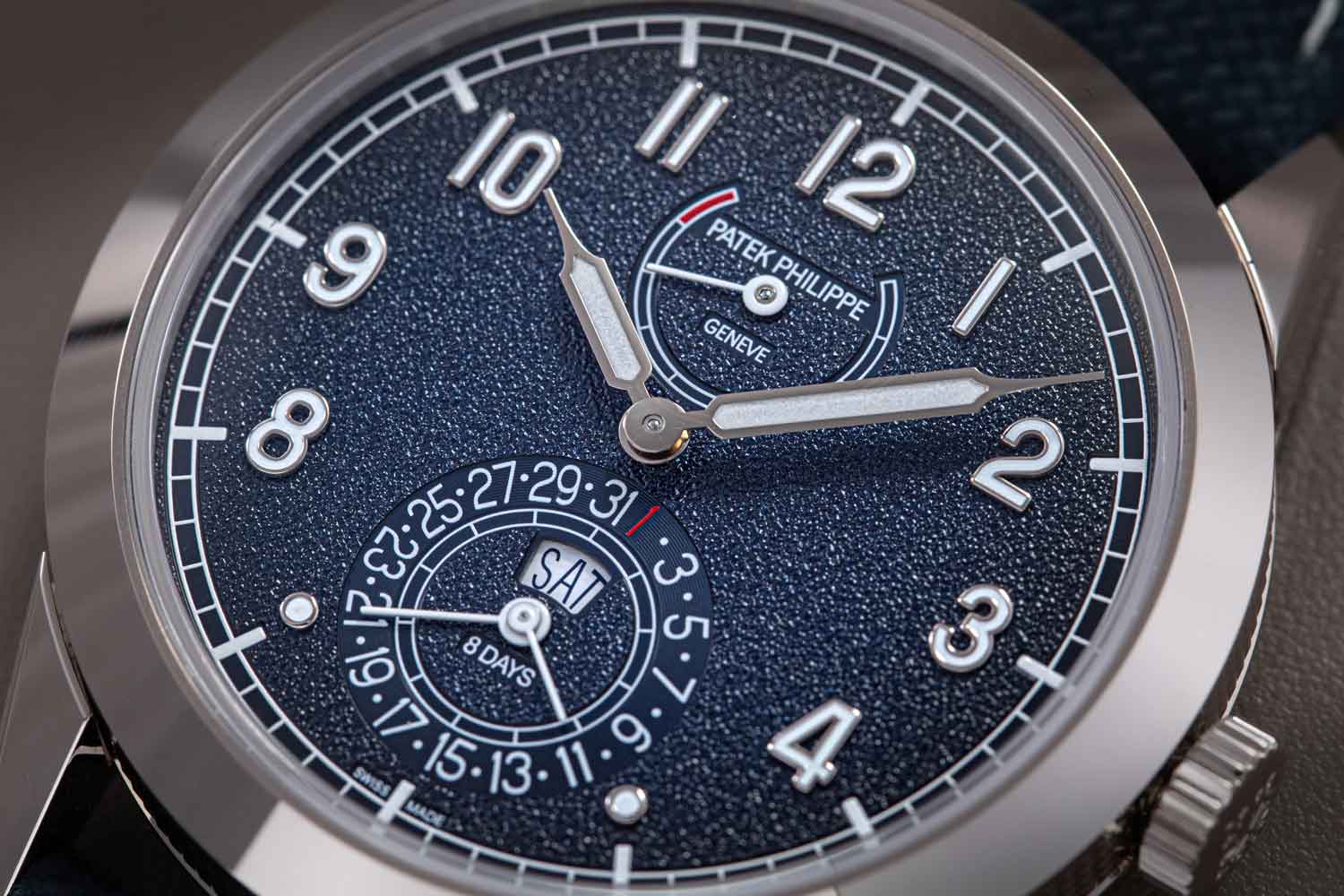
Who would have thought that in the 21st century, Patek Philippe would make a gradient and grained dial? (Image: Revolution ©)
So Patek brought it back in style. This time, with a totally different design that grabs attention but still earns nods from long-time collectors. The new ref. 5328 blends elements from two very different eras. The dial is contemporary, with a smoked, grained texture. The case, though, is rooted in tradition, especially with its hobnail-fluted band.
Let’s start with the dial. This is part of a slow but steady shift in Patek’s image – a move toward something younger, slightly sportier. You could argue it started in 2015 with the Calatrava Pilot Travel Time ref. 5524, but it really gained definition with the ref. 6007A in 2020, launched for the opening of its new manufacture. That direction became even clearer with the 5226G, which introduced this now-familiar formula: textured smoked dial, Arabic numerals, and hobnail case flanks.
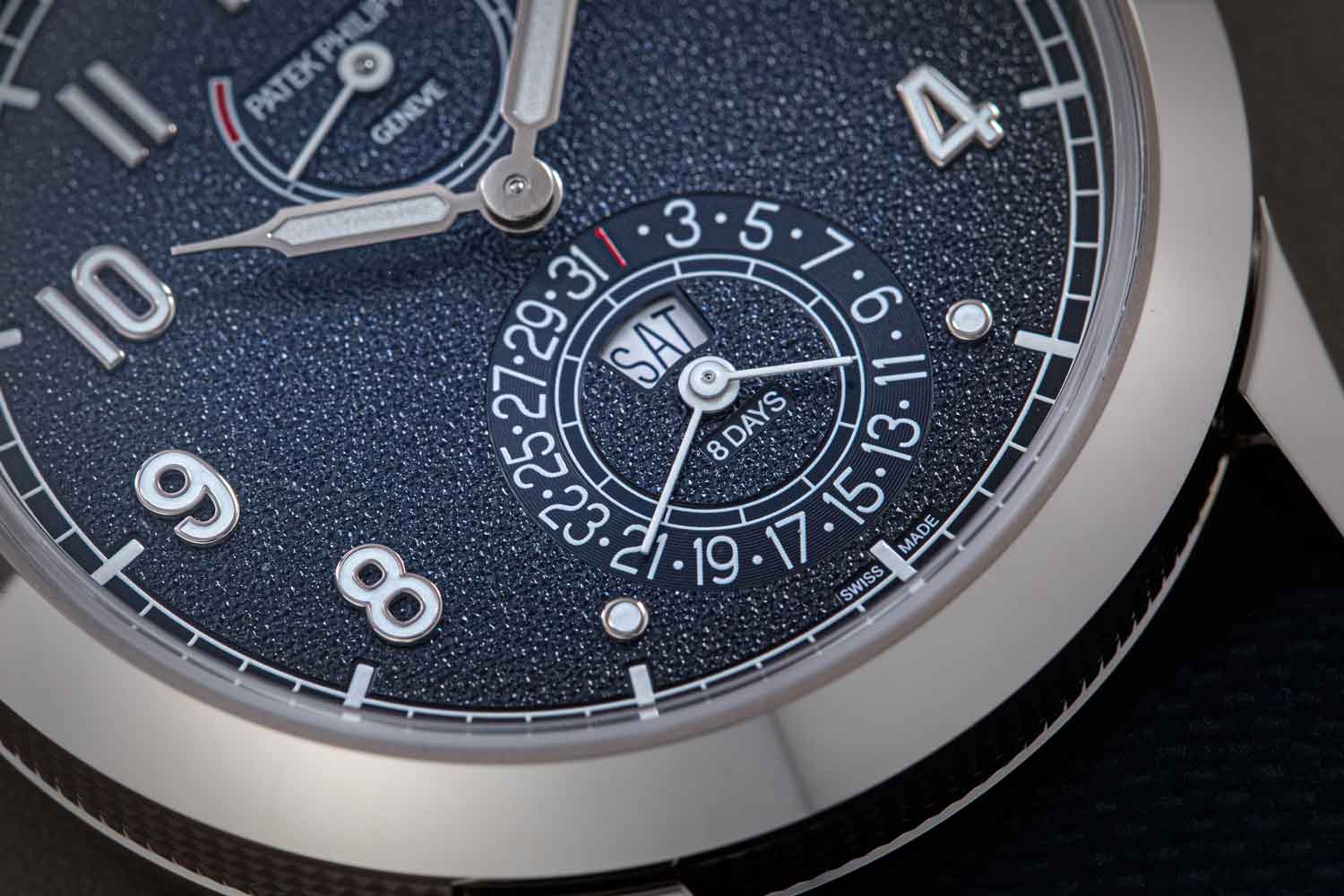
Arabic numerals and lume are always indulgently attractive on a Patek Philippe. (Image: Revolution ©)
Still, to say Patek is abandoning tradition would be unfair. The Calatrava ref. 6119 from 2021, with its bold double hobnail bezel and grey dial, is proof that classical design remains central. That same spirit lives on in the cleaner 6196P – smooth bezel, salmon dial, 38 mm – aimed squarely at purists. Patek is walking a fine line, but it’s doing it with purpose.
Now back to the 5328G. What makes this design meaningful is how it reintroduces mechanical craft to a new audience. It builds on the design language of the 2022 ref. 5226, with its smoked dial, hobnail case flanks, and Arabic numerals, but adds a deeper technical dimension. The watch now features an eight-day power reserve and a twin day-date display with both indications jumping instantaneously at midnight.
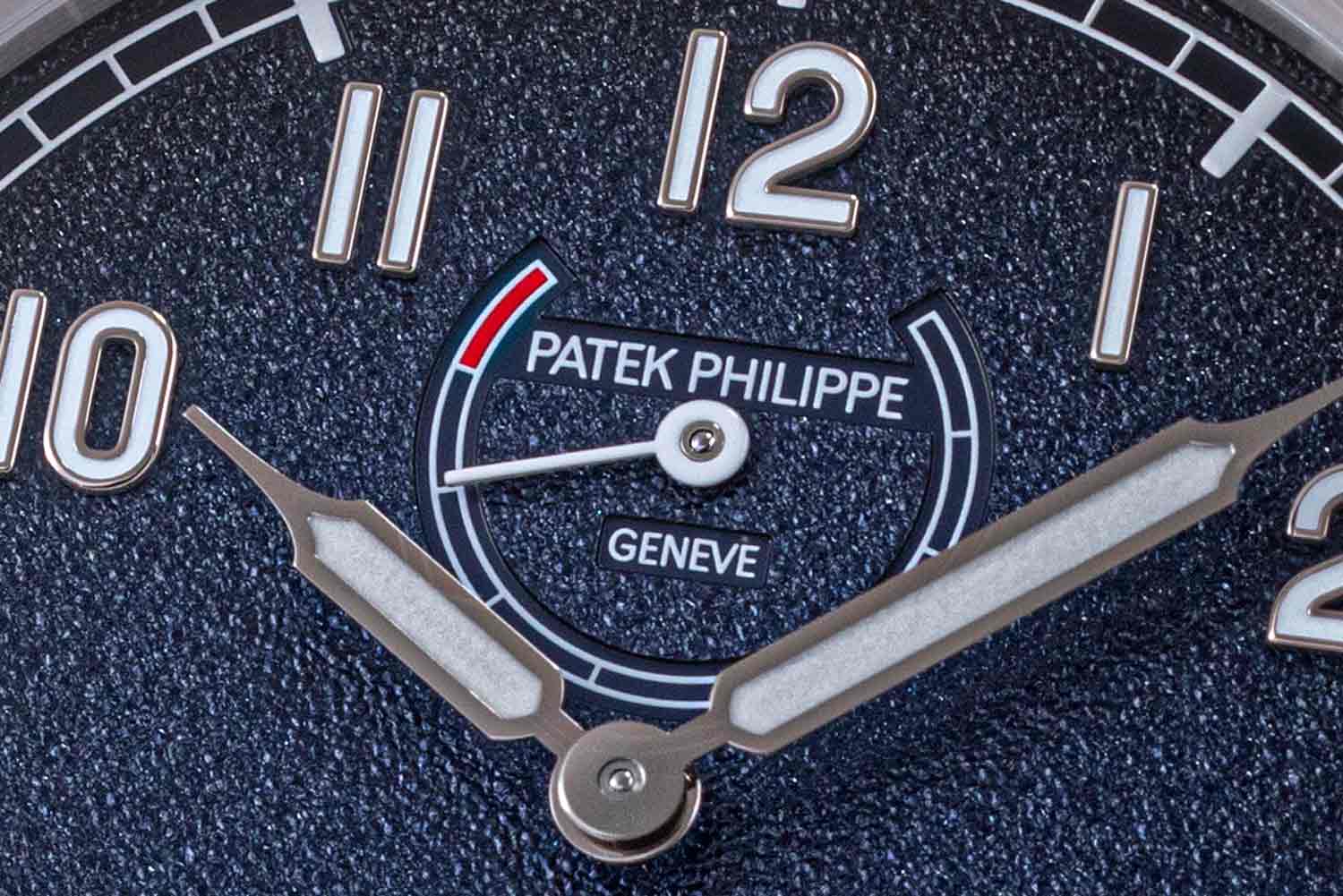
The Calatrava 8-Day actually has nine days of running time up its sleeve but is only marketed as eight, for good reason, because the final day’s torque supply might be unstable. (Image: Revolution ©)
But is the look purely modern? Not quite. A closer look reveals details pulled from the archives.
The Arabic numerals, for instance, have long been part of Patek’s vocabulary. You’ll find them most famously on the ref. 1518 perpetual chronograph from the 1940s. The rounded dot markers for five and seven o’clock also come from the same model.
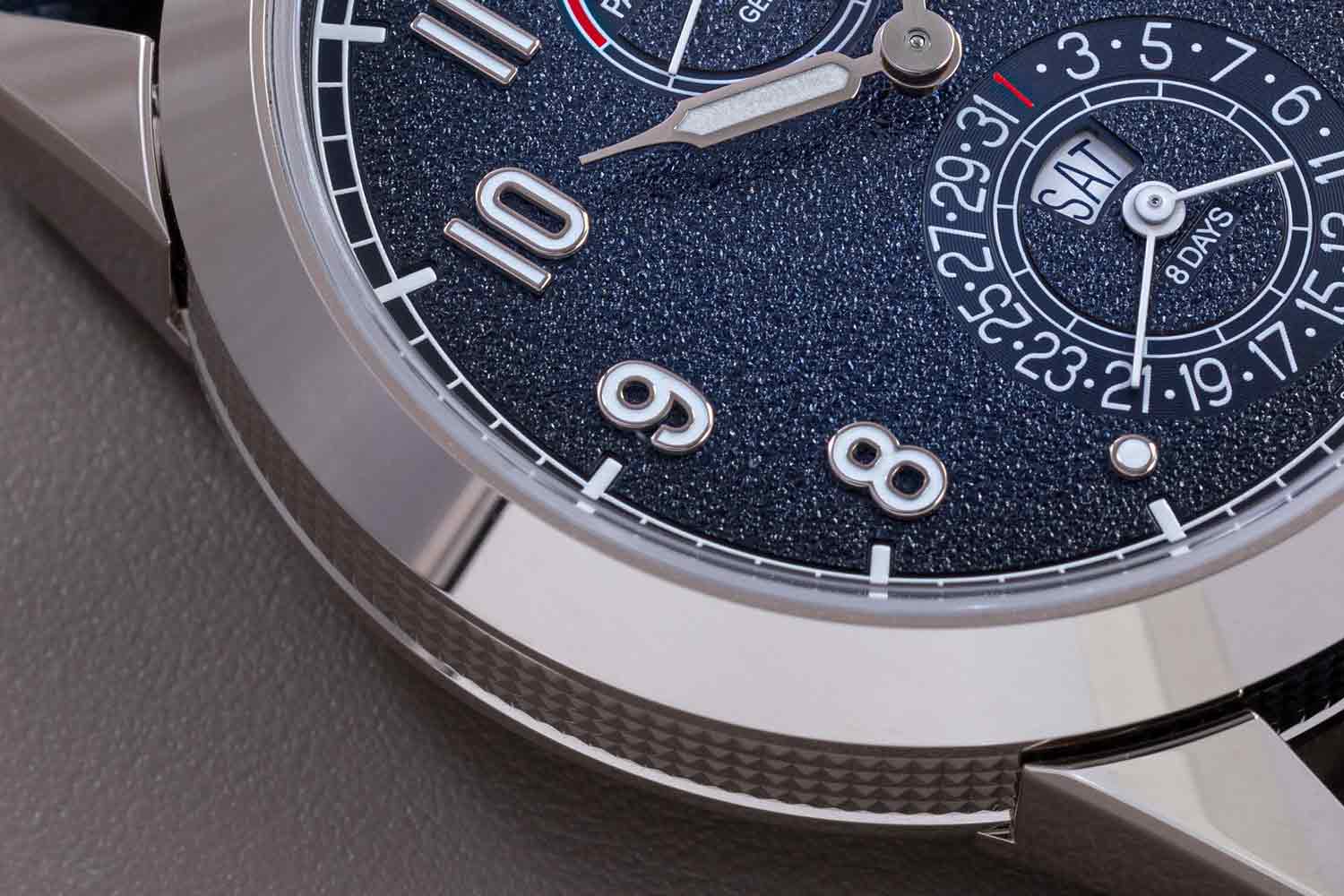
Notice the Clous de Paris, or hobnail, pattern on the caseband. (Image: Revolution ©)
Then there’s the oversized date sub-dial, with its clean sans-serif font. It recalls the ref. 2499, another heavyweight in the perpetual calendar chronograph line. The wide numeral ring gives it a confident presence. If there’s one thing that could be improved, it’s spacing, as the numbers do feel slightly crammed.
And of course, the two sub-dials at twelve and six o’clock echo the Gondolo 8-Day ref. 5200. But here the movement is new, and it’s round, not rectangular. Still, the good stuff stays. There’s the eight-day (technically nine, more on that soon) power reserve display at twelve, and the sub-seconds plus date at six. Nestling the day disc inside the same sub-dial is clever; it keeps things compact without sacrificing readability.
Now to the case. The 5328 is clean and direct. It features a flat, wide bezel and faceted lugs that break sharply from the case middle. From the top, the profile is classic and confident, echoing many of Patek Philippe’s older designs.
Turn it to the side, and it reveals a different character. The fluted case band, done in a hobnail pattern, adds texture and visual richness. These are tiny pyramids, lined up in tight rows. And the way it’s built is interesting. Because the entire case band is fluted, there’s no room to mount the lugs directly. So Patek attached them to the case back instead. That creates a small gap between the lugs and the mid-case, which is potentially a dust trap.
A classic, pocket-watch-style movement
If the modern styling of the watch is not quite to your taste – and that’s understandable – the good news is what lies beneath the dial. The movement is beautifully classical and could easily be matched with a more traditional dial in future editions.
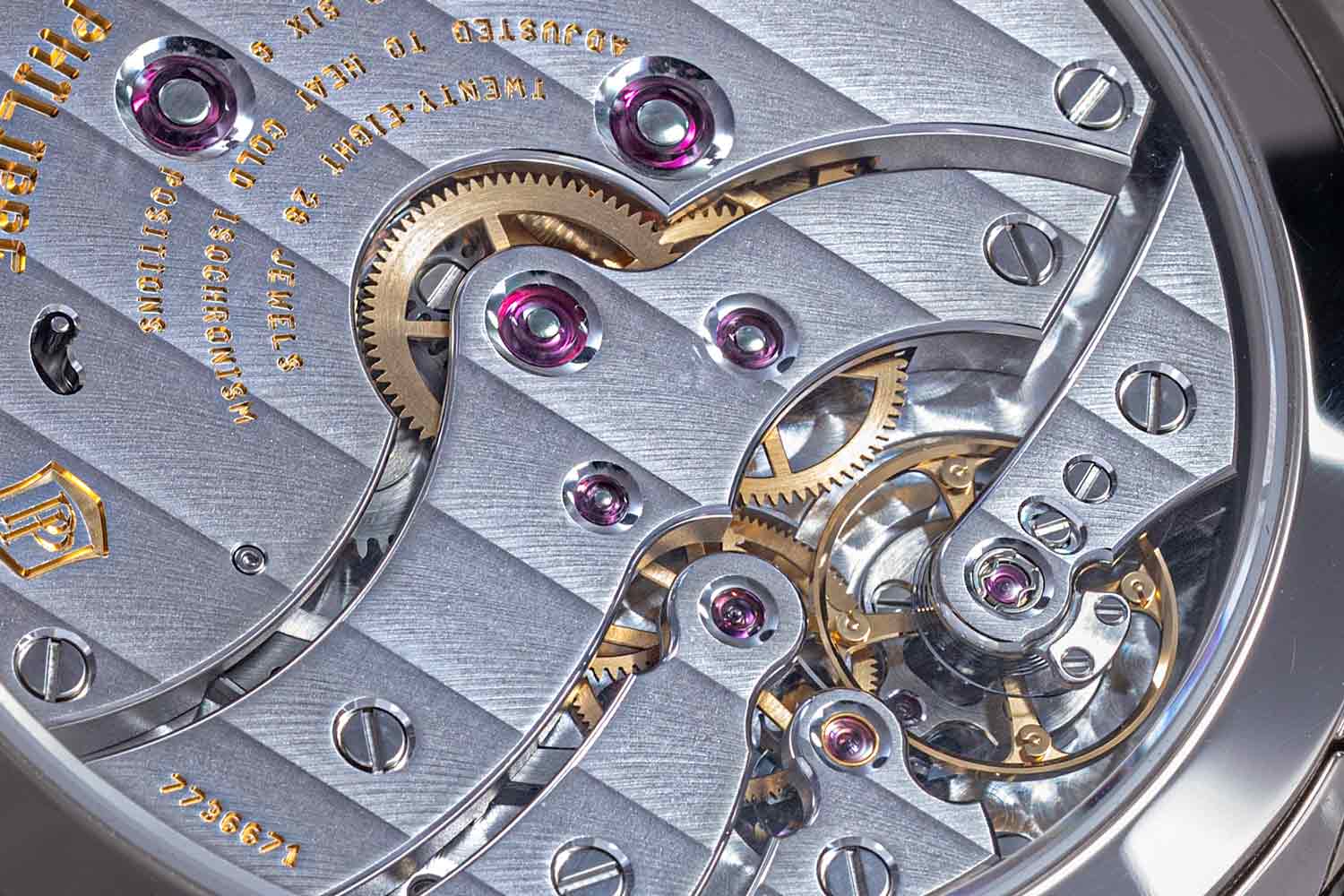
If I’m forced to nitpick one thing, it would be the curve above the central pinion – it isn’t quite as expressive as the one below. (Image: Revolution ©)
Patek Philippe has been leaning more into vintage pocket watch cues, particularly in the design of its bridges. This approach became evident with the cal. 30‑255 introduced in the ref. 6119 in 2021, but the new calibre 31‑505 8J takes it further. The bridges are longer, more refined, and flow with greater elegance. Instead of merely mimicking old-school forms, they capture the spirit of traditional movement architecture. It may well be Patek’s strongest modern effort yet at evoking the character of vintage watchmaking.
The increase in bridges also means more edges for Patek Philippe to showcase its finishing, especially the rounded, polished bevels. While these are not as broad or bright as those found in independent watchmaking, which operates on a very different scale, they represent a clear step up from the brand’s standards just a few years ago.

(Image: Revolution ©)
The bevelling is slightly wider now and carefully done, with occasional exterior angles that add character to the flowing lines. There are no interior angles, but that is not a drawback, because the overall look feels complete even without them.
Beyond the bridges, a few other elements add to the classical appeal. The curved text around the cannon pinion, along with the oversized jewels and their broad polished countersinks, all contribute to the visual harmony. These details may seem secondary, but when placed thoughtfully, they elevate the entire movement and reinforce its vintage character.
How the eight-day power reserve is achieved
The cal. 31-505 8J isn’t just a beautiful movement, it is also thoughtfully engineered, as one would expect from Patek Philippe. Though often seen as a classical Genevan watchmaker, the brand invests considerably in research and development, resulting in numerous patents aimed at improving movement design and performance.

(Image: Patek Philippe)
There are two key aspects worth understanding about this calibre. The first is how it achieves its eight-day power reserve. While not based on a specific patented invention, the approach still deserves attention, as it delivers a reserve two to three times longer than a typical wristwatch of similar size.
Patek Philippe uses two mainspring barrels arranged in series. This means the energy from both barrels is combined to extend the total duration of the power reserve. By contrast, barrels coupled in parallel deliver more torque but do not increase running time.

(Image: Patek Philippe)
In this movement, the main barrel has a slipping bridle, a feature not often found in hand-wound watches. It prevents overwinding by letting the mainspring slip once it is fully wound.
When you wind the watch, the auxiliary barrel is wound first. It then connects to the main barrel and winds it as well. If the main barrel reaches full tension, the slipping bridle lets it slip and stops the winding process to protect the mechanism.
As the watch runs, the main barrel unwinds first and powers the gear train. At the same time, the auxiliary barrel keeps feeding energy into the main barrel, helping to keep the power output stable until both barrels are fully unwound.
And of course, the escapement comes directly from Patek Philippe’s Advanced Research programme, a decade-long effort focused on developing silicon components. In this movement, the escape wheel, balance spring, and balance are all made of lightweight, low-friction silicon. This reduces both energy loss and wear, contributing to better efficiency and longer power reserve.
Strictly speaking, the twin barrels store enough energy for nine days of power reserve, which is why a careful eye will notice nine slots on the power reserve indicator. However, Patek Philippe states that the watch is only guaranteed to run accurately for eight days. The ninth day is intended purely as a safety margin, which is why it is not officially mentioned in the specs.
A patented upgrade for a sharper day and date jump
While the original Gondolo 8-Day from 2013 already featured an instantaneous day and date display, the new cal. 31‑505 8J uses a patented system first seen in the 2024 Cubitus ref. 5822.
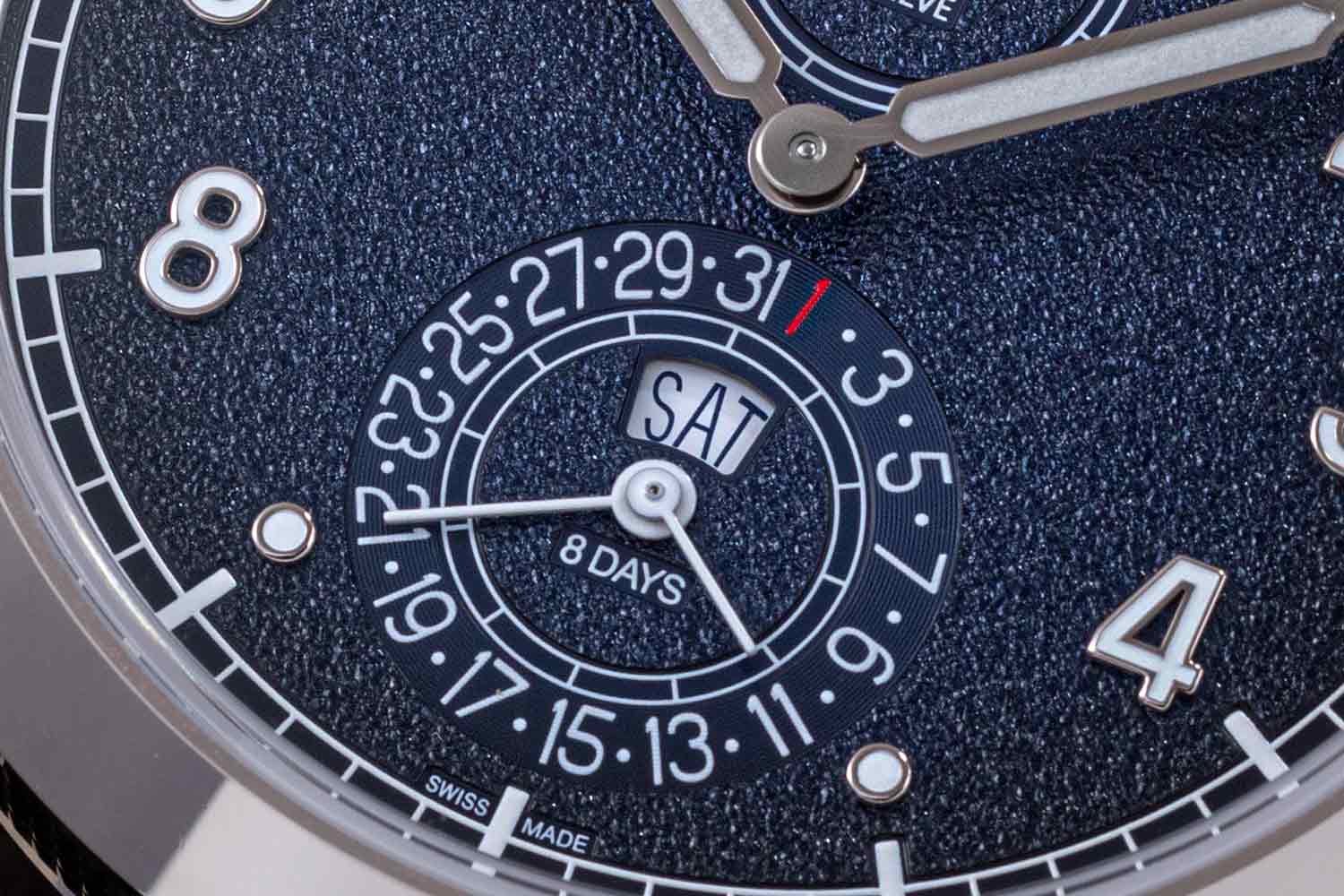
Three things in one counter: day, date, and seconds. (Image: Revolution ©)
At the heart of the upgrade is a redesigned 24-hour wheel with a cam and a dual-function spring. This system addresses a known challenge: to achieve an instantaneous day jump, the mechanism requires high torque, something the large twin barrels can easily deliver. But too much torque can be problematic, potentially causing the day disk to overshoot, resulting in double jumps or misalignment. The dual-function spring solves this in two ways: it gradually stores energy throughout the day for a clean, sharp jump at midnight, and at the same time, it moderates the torque to ensure just the right amount reaches the jumping mechanism. To further minimise the risk of error, the day disk is pierced to make it lighter and reduce its inertia.
Perhaps most usefully, the mechanism allows you to set the time forward or backward at any hour – even during the day and date jump – without any risk of damaging the movement. That’s something most traditional calendar mechanisms can’t handle. The only improvement one might wish for is the ability to set the day and date via the crown, instead of using recessed corrector buttons on the case flank.
Concluding thoughts
The Patek Philippe Calatrava 8-Day ref. 5328G doesn’t get as much attention as the popular salmon dial model, but it’s one of the most complete watches the brand has made in recent years. It meets the standard of both traditional craftsmanship and modern performance.
The dial is clean and symmetrical, with an appealing, well-balanced layout showing the day, date, and power reserve. The case has classic Calatrava styling, while the blue grained dial gives it a more relaxed, everyday feel.
And most importantly, the movement inside is one of the most beautiful hand-wound designs we’ve seen from Patek or any major high-end brand. But it’s not just a beauty queen: it’s technically impressive too, with an instantaneous day and date jump, plus a solid nine-day power reserve.
This is the kind of watch that might not stand out at first, but the more time you spend with it, the more you notice its thoughtful details and mechanical quality. And spending time with it, as I would imagine, is something very easy, thanks to the weeklong power reserve keeping it on your wrist.
Tech Specs: Patek Philippe Calatrava 8-Day
Reference: 5328G
Movement: Manual-winding Cal. 31‑505 8J PS IRM CI J; 8-day power reserve
Functions: Hours and minutes; small seconds; day; date; power reserve indicator
Case: 41mm × 10.52mm; 18K white gold; water-resistant to 30m
Strap: Blue calfskin with fabric pattern and white gold folding clasp; additional taupe calfskin strap
Price: USD 70,700
Patek Philippe

You may also like

News
These Are The Most Iconic Singapore-Exclusive Timepieces Over The Years, And Then Some
Aug 8, 2025
News
These Are The Most Iconic Singapore-Exclusive Timepieces Over The Years, And Then Some
Aug 8, 2025

Through the Looking Glass: Tinted Sapphires
Apr 20, 2025
Through the Looking Glass: Tinted Sapphires
Apr 20, 2025

Auctions
All The Highlights From Phillips’ Hong Kong Watch Auction: XX
Apr 17, 2025
Auctions
All The Highlights From Phillips’ Hong Kong Watch Auction: XX
Apr 17, 2025