


Editorial: What The 1908 “Settimo” Says About A Changing Rolex
Editorial
Editorial: What The 1908 “Settimo” Says About A Changing Rolex

There was a time when new releases from Rolex followed a familiar script. You could never predict its novelties precisely, but they all arrived in a package that felt like a reshuffling of familiar elements with a touch of surprise — perhaps a change of colour on the bezel, a slight shift in font and proportion on the dial, or a subtly updated case design. And for some reason, these were ineffably exciting. At 8 am, when the curtain lifts on Watches & Wonders, almost everyone rushes to the window of Rolex’s booth to catch the mini yet big surprises.
But that seems to be changing. The momentum has been building over the past couple of years. It is clear the brand is rethinking its position in the watch world, trying to reach a broader audience, extending both the lower and upper age limits of its customer base, while pushing the entire catalogue further upmarket. And that is when we start seeing releases that arrive almost out of nowhere.
2025 and the changing character of Rolex
This year especially solidifies that shift. To everyone’s surprise, it introduced two models that are entirely new. One is the Land-Dweller, new from every angle down to the escapement. The other is the Perpetual 1908, which comes with a newly designed bracelet called the Settimo, a construction without end links and unlike anything we have seen in the past few decades of the Rolex catalogue.
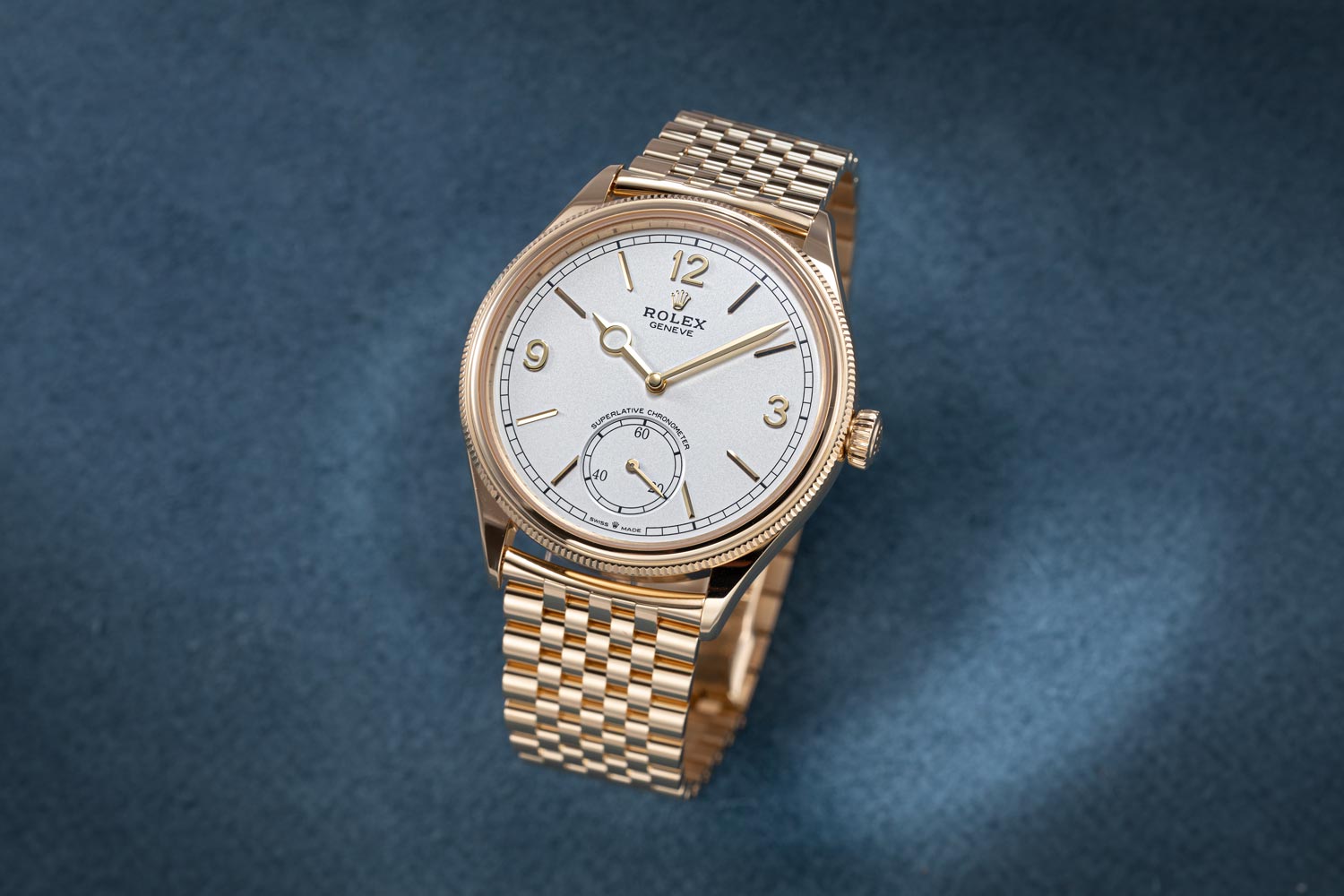
The all-new seven-link bracelet is looking good in gold. (Image: Revolution ©)
For a long, long time, the Rolex catalogue has been tightly controlled, with only two types of case styles: the more fluid, classical case used for the Classic lineup, and the more rigid, masculine case for the Professional lineup. As for bracelets, there were just three: the Oyster, Jubilee, and President.
But in this year alone, we’re seeing two brand-new bracelets: one for the Land-Dweller and another for the Perpetual 1908. Just like that, the number of Rolex bracelet styles jumps from three to five. There are also two new cases, an integrated case for the Land-Dweller and a slim, dressy case for the Perpetual 1908 (which technically debuted in 2023, but we’re including it here to make the point).
-

- The new flat Jubilee bracelet for the Land-Dweller family (Image: Rolex)
-

- A classic two-tone Jubilee bracelet on a Datejust (Image: Rolex)
-

- The ultra-luxury President bracelet that’s only available in precious metals (Image: Rolex)
-

- And the ubiquitous Oyster bracelet (Image: Rolex)
If this doesn’t suggest that Rolex is loosening up, no longer being quite so rigid about its catalogue and finally opening up to more options and more watches, then it’s hard to say what does. This is arguably more significant than releasing playful dial options, which the brand has always done from time to time, though those rarely sparked the kind of ultra-hype we’ve seen in recent years. New cases and bracelets, compared to new dials, feel more permanent and require far more thought before being added to the catalogue. They aren’t just new variants that can come and go. They are new lines that stay.
So why did Rolex decide to go against its decades-old formula and introduce the Settimo bracelet?
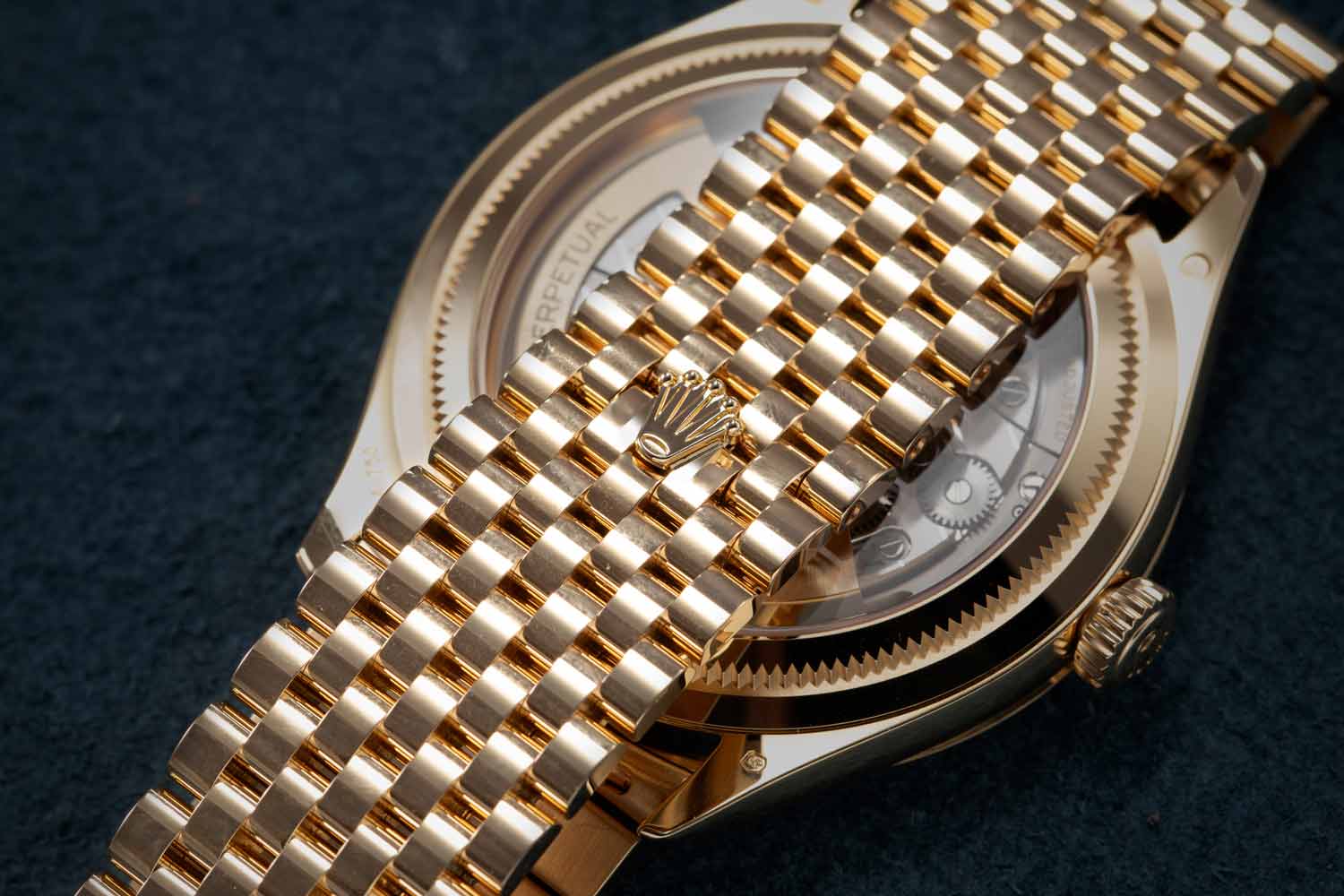
Settimo means seven in Italian, a name that reflects the seven rounded, beautifully polished links of the bracelet. (Image: Revolution ©)
Rolex is right up there in terms of sales. Its position as the largest Swiss watch brand is so solid that the combined sales of Cartier, Omega, Audemars Piguet, and Patek Philippe in 2024 would only just come close to what Rolex sold. But then again, Rolex’s average retail price is only a fraction of those from higher-end brands like Blancpain and Breguet, which all share one trait in common: no matter what they do, they will always have dress watches.
And while Rolex does offer a large family of Classic models, they are not dress watches in the most traditional sense. Practical and reliable in their own way, these models still leave a noticeable gap in the catalogue. Rolex’s answer is to ensure that, in the long run, it maintains a lineup of dress watches that will remain relevant and desirable to its clientele. So off goes the Cellini, and in came the all-new Perpetual 1908 in Rolex’s Watches & Wonders lineup in 2024.
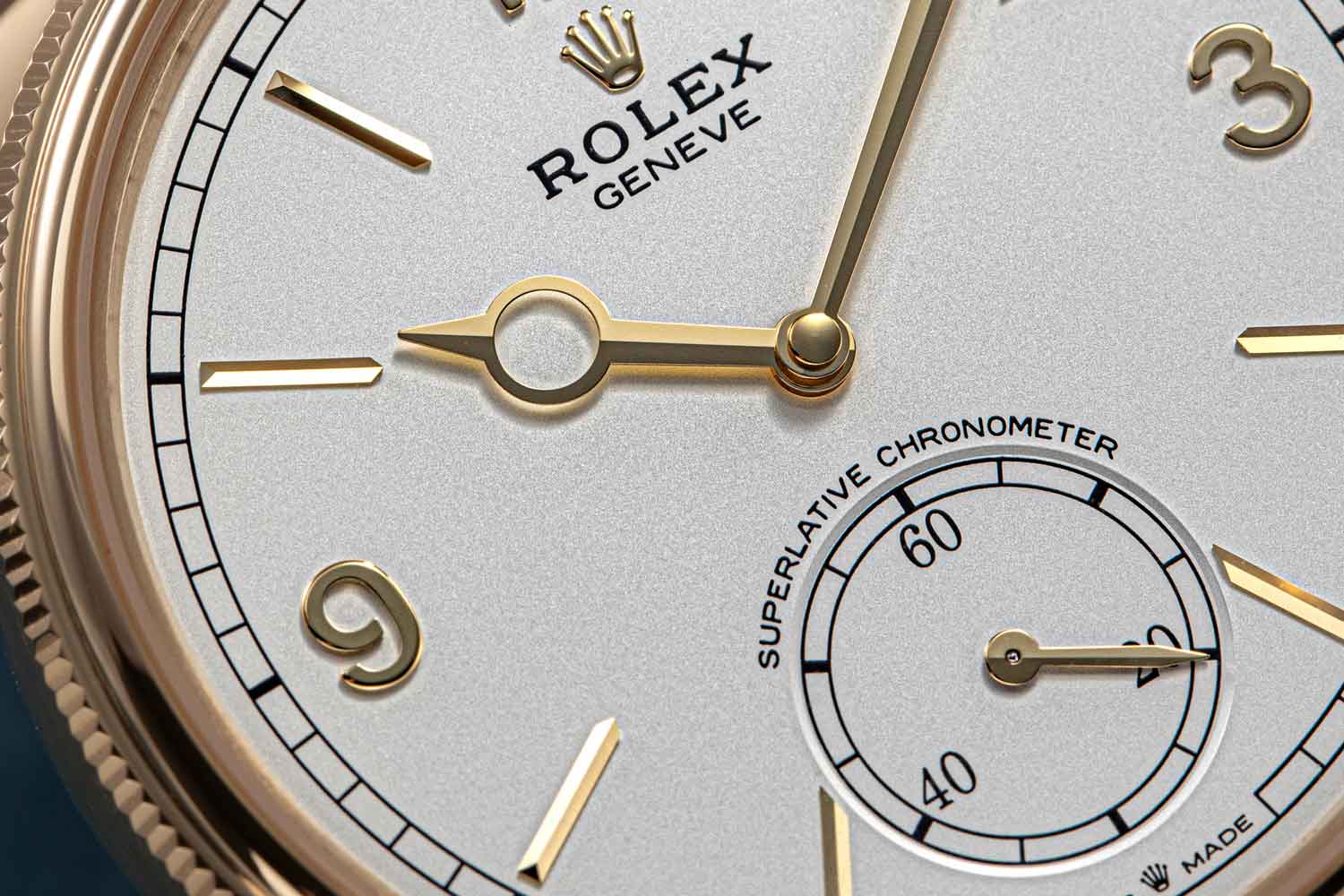
The 1908 features a sleek dial graced with Arabic numerals 3, 9 and 12 and faceted index hour markers. The hour hand is Breguet-style, while the minute hand is shaped like a two-edged sword (Image: Revolution ©)
While the 1908 shared some characteristics with its predecessor, it is very much a different watch. We could go on about how the case and movement are slimmer and more refined, or how the dial adopts a more retro design with a small seconds subdial. But those are just specs on paper. What matters is that the 1908 now feels a lot more attractive, and for the first time, the dress watch manages to shine brighter than some of the brand’s sports models, which have traditionally been its mainstay.
But the 1908 lacked a bracelet. It came on a leather strap — the very thing the brand once removed from much of its catalogue. Remember when the Day-Date came on leather just a few years back? So it makes sense that the brand needed to give it a bracelet. But which one? That’s the surprise.
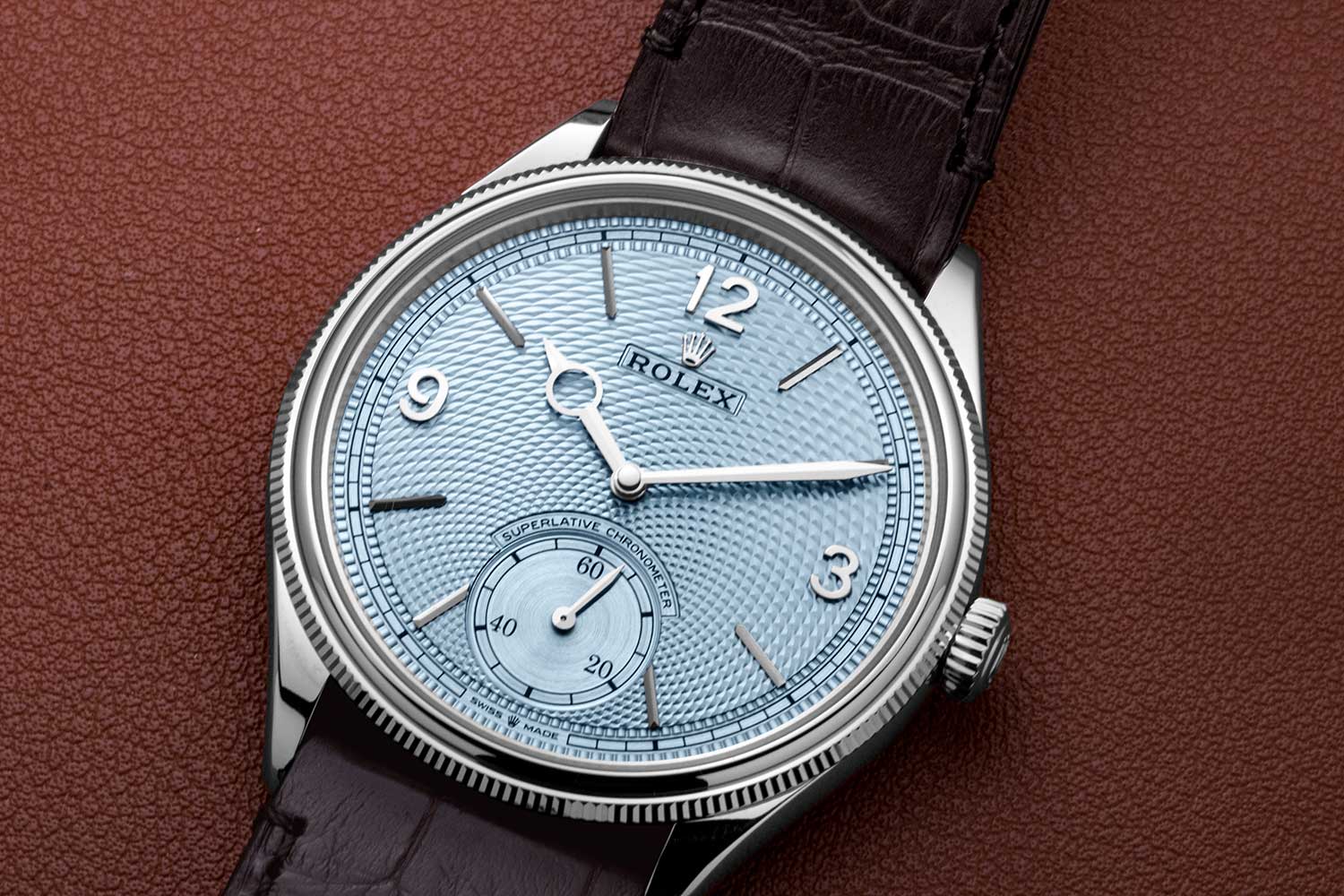
The 2024 release of the Perpetual 1908 ref. 52506 was presented on a leather strap (Image: Revolution ©)
To complete the look of a proper mid-century dress watch, Rolex had to let go of what it already had. To match the slimmer, more refined case that measures just 9.5 mm tall, it needed a bracelet that was thinner, more supple and more elegant. The answer was a new seven-link bracelet, which immediately feels more nuanced than the five-link Jubilee. Most unexpectedly, Rolex removed the end links and gave it a straight-end design. That is a rare move, not just for Rolex but for modern watchmaking in general. And of course, another highlight is the concealed clasp, similar to the one found on the Day-Date. It is a very satisfying detail, with only the five-pointed crown floating on the bracelet to mark where the two ends meet.
That’s why the consensus around the 1908 “Settimo” at the fair was cheerfully clear that it felt like a vintage watch, genuinely so in its details. Except, of course, it is built like a 21st-century Rolex. It is solid, robust, and wider than any true mid-century piece, with a case that now measures 39mm.
Not your usual vintage styling – this is Rolex
The 1908 feels modern not only because the case measures 39 mm, but because its presence comes from all around. The Settimo bracelet, especially, adds to how large the watch feels on the wrist. Typically, a Rolex bracelet tapers sharply toward the clasp, even in Professional models like the Explorer 36. But the Settimo bracelet does not follow that formula. It stays almost the same width from one end to the other.
That is something you might expect from vintage beads-of-rice bracelets from various brands, but when the design is scaled up without changing its proportions, the result feels unexpectedly pronounced.
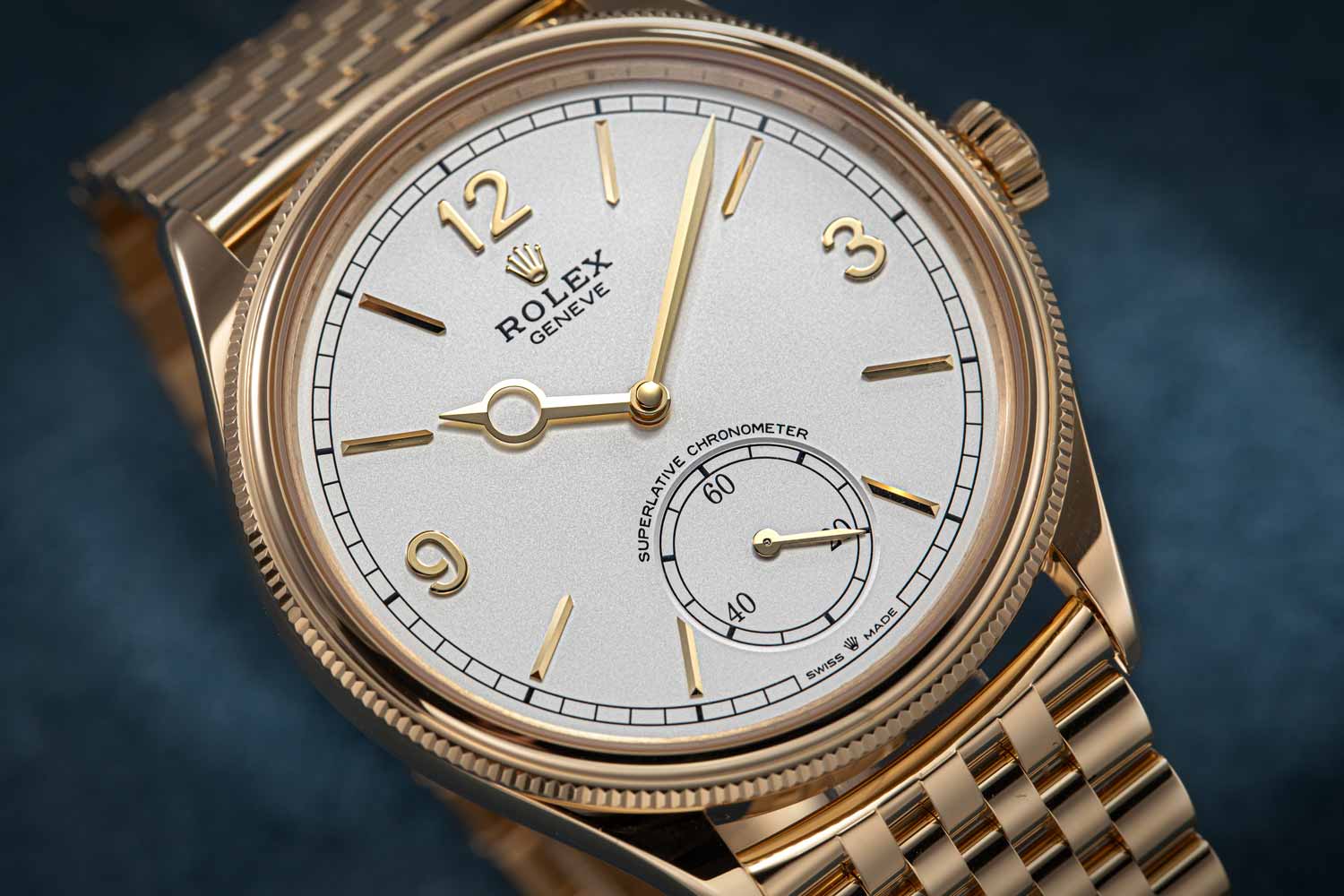
A charming detail of the 1908 is its two-step bezel, made up of a thin domed ring and another thin fluted ring. The fluting is echoed on the edge of the case back, a delightful touch you notice when handling the watch and seeing the call back. (Image: Revolution ©)
The upside, however, is that it looks absolutely striking. There is a generous spread of gold links, all beautifully polished, and it catches the light in a way that feels confident and masculine. Rolex has long been known for the solidity of its construction, and these proportions help reinforce that strength. This is Rolex making a dress watch in its own way, though it is not hard to imagine that changes may come in the future. That could be as simple as introducing a smaller variant of the 1908, much like how the Land-Dweller now has both an older and younger sibling in the family. A smaller case could make the straight bracelet feel more proportionate. Or the update could be more involved, such as adjusting the bracelet’s shape to introduce a slight taper, in line with what most other Rolex bracelets already do.
More broadly, this reflects the fact that the 1908 is still a very new line, and it is no secret that Rolex is still finding its footing in the world of dress watches. Naturally, there are features the brand is experimenting with, and it shows.
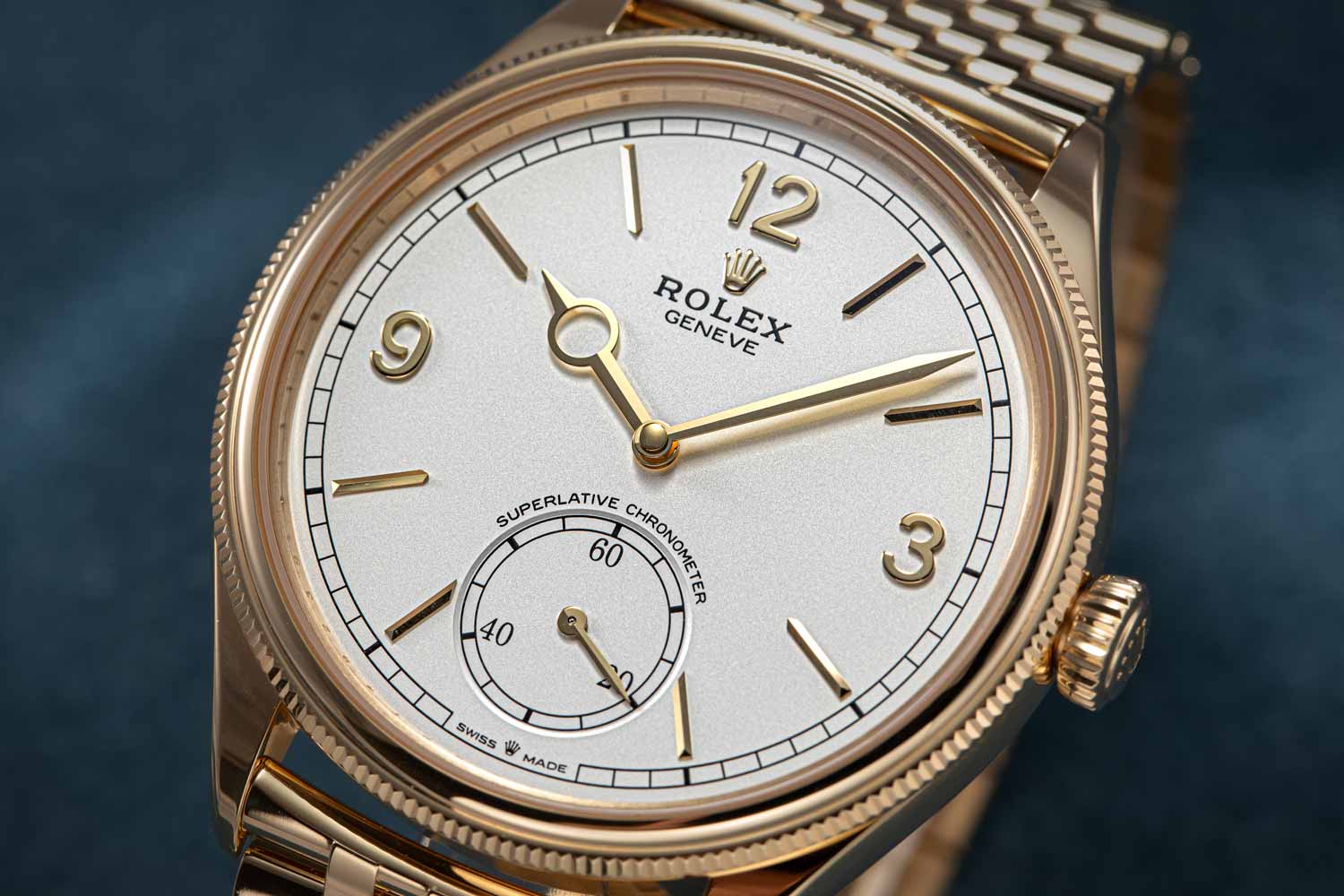
The 1908 features a sleek dial graced with Arabic numerals 3, 9 and 12 and faceted index hour markers. The hour hand is Breguet-style, while the minute hand is shaped like a two-edged sword (Image: Revolution ©)
On the dial, for instance, the overall layout is lovely, with Arabic numerals at the quarters and a small seconds counter. The finishing also stands out, with a subtle sparkle that is unlike the typical brushing or lacquering found on most Rolex dials. It reminds me of a short-lived white-dial Oyster Perpetual from 2018 to 2020, which I still think is the most stunning OP dial of the past decade.
A closer look, however, reveals that the handset could be more refined. The minute hand, in particular, feels slightly out of proportion near the tip. That said, it is a very minor detail, and I should be clear that this is purely a matter of personal preference.
Still, I believe the 1908 line will continue to grow and evolve. One day in the future, people may look back at this first generation and appreciate it for being courageous, and even love it for its quirks.
A new movement, and a new way to present it
Once an unthinkable trait, the open caseback is now slowly becoming the norm for Rolex’s higher-end watches in precious metals. And with the see-through back comes a new movement construction and finishing approach that makes the view worth revealing.
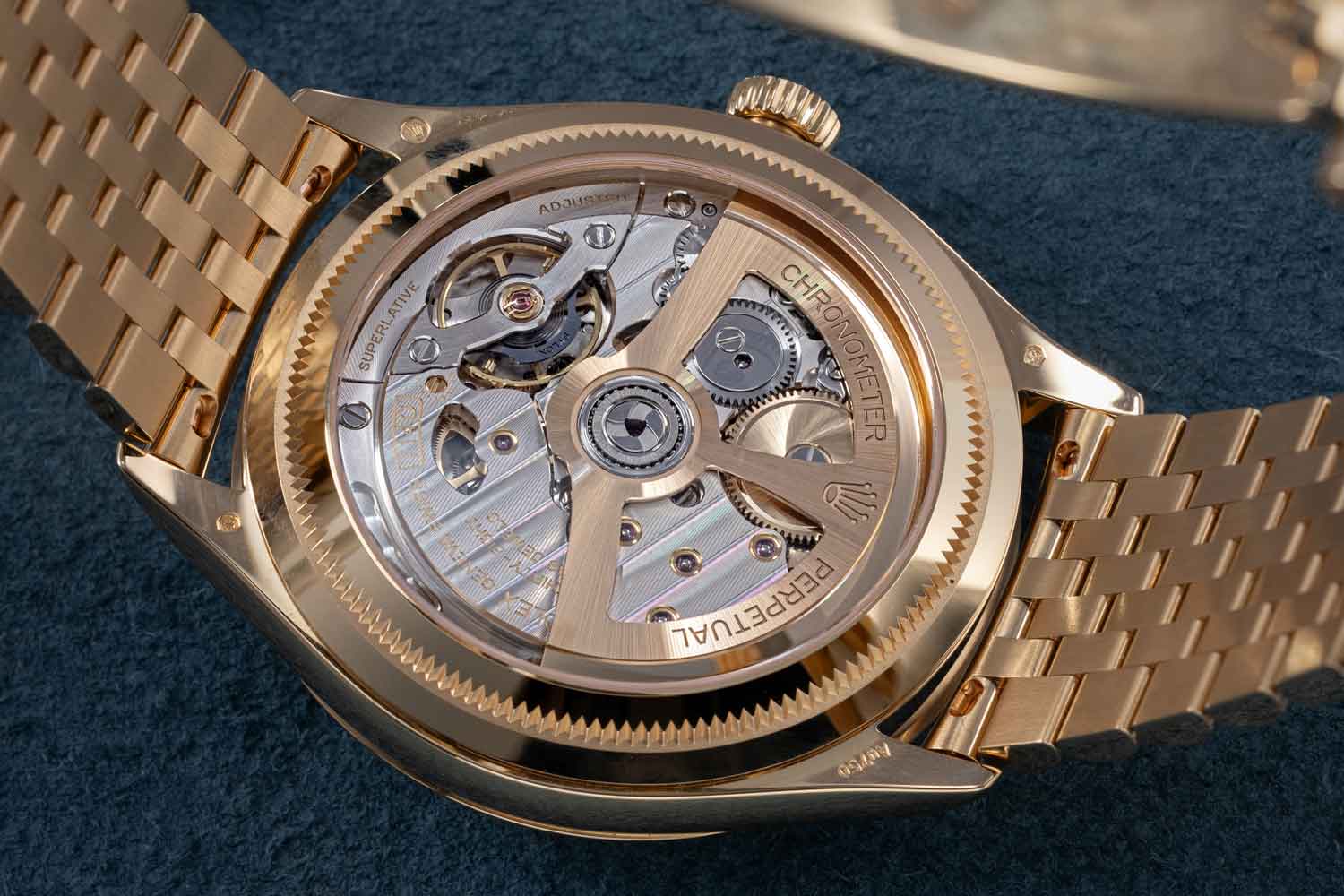
Among all the new features of the 1908, the open case back is the most immediately surprising, displaying the beautiful cal. 7140. (Image: Revolution ©)
The calibre 7140, an all-new movement introduced by Rolex in 2023, features several classical elements, including gold chatons and a few skeletonised sections that reveal the wheels beneath. The overall construction is also different from conventional Rolex calibres in that it is very flat, with many components visible on a single plane. For example, the barrel ratchet wheel and the winding mechanism are both exposed. And thanks to its flat construction and the use of a Syloxi silicon hairspring instead of the taller overcoil Parachrom, the movement helps make the 1908 the thinnest Rolex in the entire catalogue.
More importantly, it is finished in a way that sets it apart from the brand’s closed-case movements. The plates now carry Geneva striping, or more precisely, Rolex’s own interpretation of it, with narrow grooves between each wide stripe. There are gold chatons, spiral brushing on the gilt barrel ratchet wheel, and of course the gold rotor, all of which elevate the overall look. As for bevels, the balance bridge and its surrounding plate are finished with a more pronounced bevel, while other bridges feature a narrower edge.
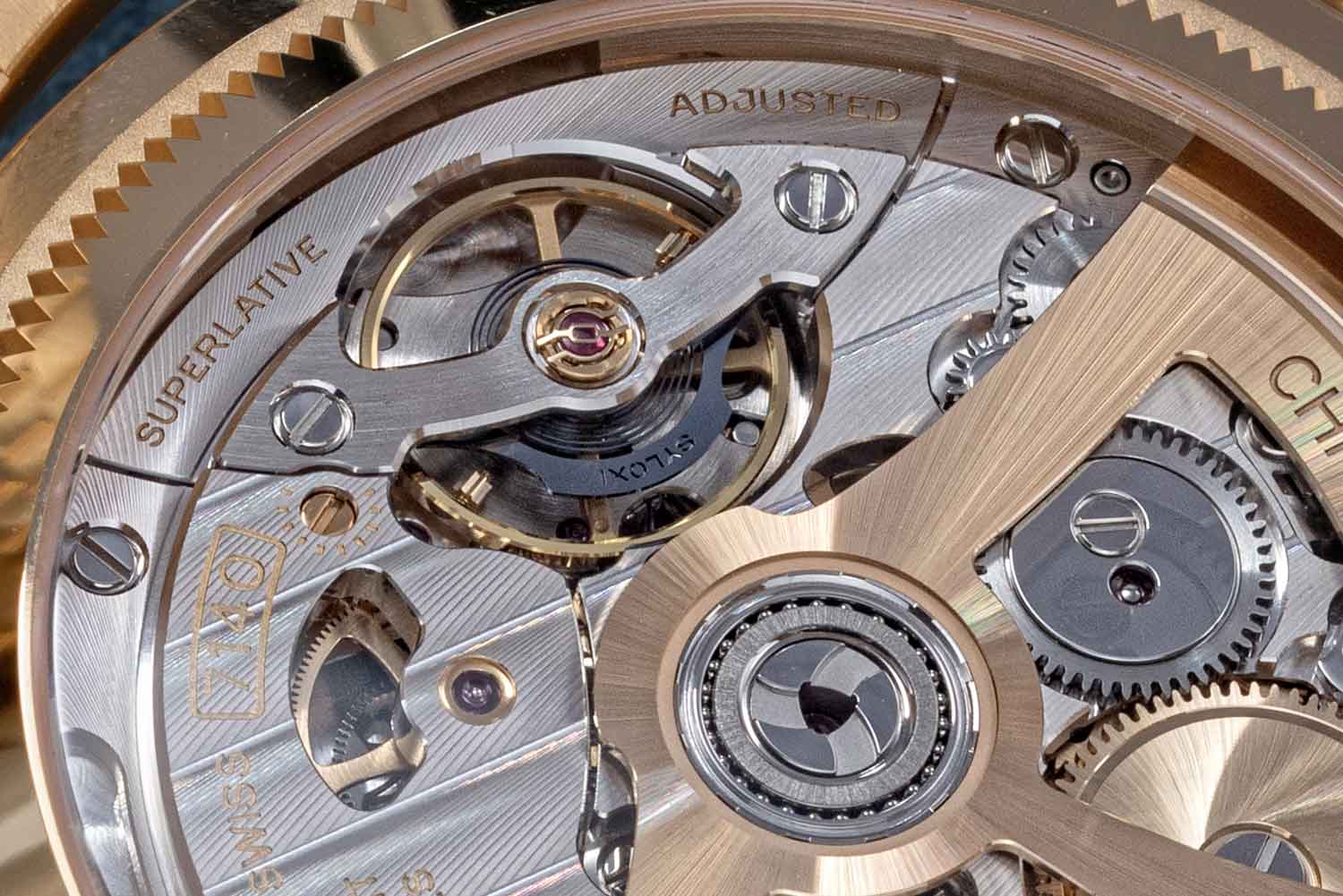
Skeletonisation is nearly unheard of for Rolex, but just below the “7140” marking is a window that reveals the auxiliary gear train converting centre seconds to a small seconds display at six o’clock. This mechanism is not found in the cal. 7135 of the Land-Dweller, which explains the absence of this opening in that movement. (Image: Revolution ©)
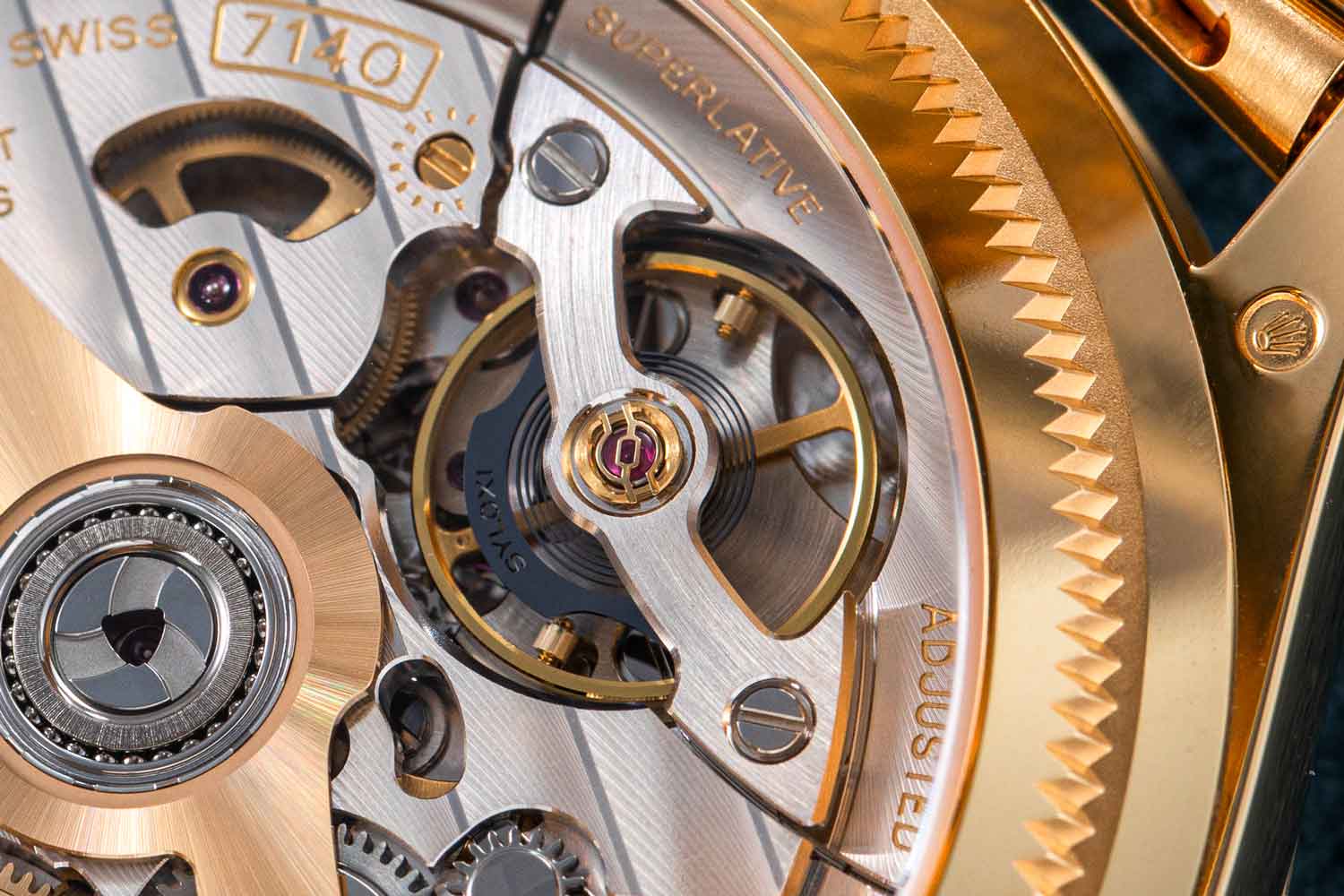
Notice the Syloxi hairspring, a rare sight on a men’s watch. But it’s clear that Rolex now uses silicon hairsprings when thinness is a priority. (Image: Revolution ©)
But despite all of this, it is clear that the movement is still largely produced and finished by industrial means. While the result is undoubtedly the best we have seen from Rolex and among the best at this price point, it is hard not to wonder how hand-finishing would look on a Rolex, especially since the brand has recently begun exploring decorative crafts like cloisonné enamel and guilloché.
Where will the 1908 lead Rolex next?
The world of watches has been shaken up over the past decade, with global collector interest reaching an all-time high. Naturally, brands are expected to adapt to the pace, or better yet, help shape it.
Rolex, a brand known for thinking long term, is perhaps more careful and cautious than any other, and has handled the recent boom (and the potential cooling ahead) with measured restraint. That includes not ramping up production aggressively, and more importantly, creating watches that are entirely unexpected, opening new doors for existing customers and reaching entirely new ones.
The 1908 sits at the forefront of this shift. It represents Rolex’s move into the dress-watch category, a space traditionally dominated by the old guard of high watchmaking. But Rolex isn’t trying to imitate. Instead, it offers something few others can: exceptional solidity and reliability. That mission is now expressed more clearly with the addition of a bracelet, something Rolex has always done exceptionally well.
With it, the 1908 collection feels more complete. It marks the beginning of a new chapter for Rolex, in design, in intent, and in where the brand goes next.
Tech Specs: Rolex Perpetual 1908
Reference: 52508
Movement: Self-winding cal. 7140; 66-hour power reserve
Functions: Hours and minutes; small seconds
Case: 39 mm × 9.5 mm; 18K yellow gold; water-resistant to 50m
Dial: White
Strap: 18K yellow gold Settimo bracelet
Price: USD 35,900
Rolex
You may also like
Editorial
Time Zone to Time Zone: Rolex and Cortina Celebrate the GMT-Master
Oct 28, 2025
Editorial
Time Zone to Time Zone: Rolex and Cortina Celebrate the GMT-Master
Oct 28, 2025

People
John Wayne: Hollywood’s Ultimate Cowboy and His Watch Legacy
Jul 25, 2025
People
John Wayne: Hollywood’s Ultimate Cowboy and His Watch Legacy
Jul 25, 2025

Editorial
Oasis Reunited — Will Liam Gallagher’s Watch Game Return Too?
Jul 23, 2025
Editorial
Oasis Reunited — Will Liam Gallagher’s Watch Game Return Too?
Jul 23, 2025