


A Closer Look: Breguet Type XX Chronograph “250th Anniversary”
Reviews
A Closer Look: Breguet Type XX Chronograph “250th Anniversary”

Breguet is marking its 250th anniversary this year in a way few brands do, celebrating both its historic icons and modern creations. It started by bringing back a single-hand pocket watch from over two centuries ago. At the same time, it used one of its best modern lines as a base for métiers d’art.
Now the third chapter focuses on one of the brand’s most popular models. The Type XX Chronograph returns in a modest 38.3 mm size and, importantly, in gold. That matters because gold has been extremely rare for the Type XX, with only three known examples ever made.

Classy and sporty at its best (Image: Revolution ©)
Gold-standard style, everyday size
Fans of Breguet’s pilot’s chronograph will recall that the Type XX lineup was completely updated just two years ago. That update received mixed reactions, especially about its large 42 mm size and the addition of a date window. This overshadowed the fact that the movement inside was entirely new and quite sophisticated, featuring a patent-pending flyback system.
The anniversary model addresses these concerns and then some. For starters, the size is now a more modest 38.3 mm, actually slightly smaller than the vintage originals from the 1950s.
The thickness has also been reduced by about 1 mm, now measuring 13.2 mm, thanks to the removal of the automatic winding system. While the watch remains relatively thick, it’s arguable that the Type XX benefits from this kind of masculine and luxurious presence. It looks right on the wrist. For those seeking something thinner, dressier watches, rather than sports models, might be the better option.
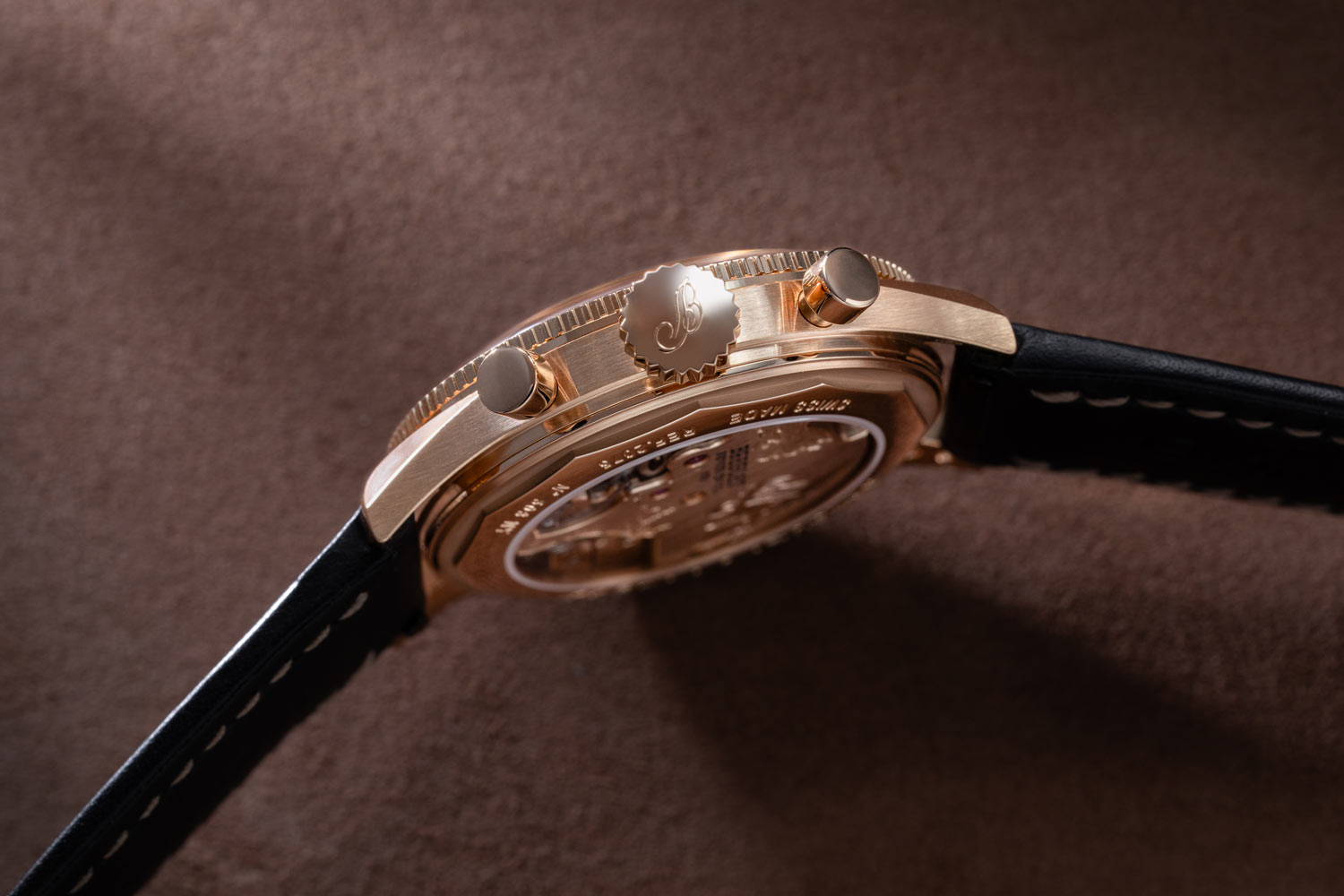
Side profile, clean and sharp. (Image: Revolution ©)
The date window is also gone, restoring the clean, no-nonsense dial seen on the original Type XX models from the 1950s. In fact, the date was absent even on some modern references, such as the ref. 3800 Aéronavale from the 1990s.
But for the anniversary edition, Breguet has done more than just reduce the size and strip away the date. It has also switched the case material from steel to gold. With most brands, that might be seen as a simple move to justify a higher price. But in the case of Breguet, a gold Type XX carries real weight.
That’s because gold has always been exceptionally rare for this model. The military-issued Type 20s were made exclusively in steel, naturally. But the civilian Type XXs, too, were almost always steel. In fact, only three gold examples are known to exist. One is now part of the Breguet museum collection in Paris. Another surfaced at a Phillips auction a few years ago, backed by an extract confirming it was sold in 1956.
As expected, the gold used here is Breguet’s proprietary alloy that was first introduced earlier this year on its initial 250th anniversary model. It is essentially yellow gold with palladium, which is usually found in white gold. This combination creates a cooler tone that is less prone to tarnishing than traditional yellow gold, giving the watch a fresh and modern look while still honoring its heritage.

Just love the typography of the numerals on the bi-directional bezel. (Image: Revolution ©)
Thoughtful details for a special edition
Both the dial and caseback of the Type XX Chronograph “250th Anniversary” feature subtle details that clearly reflect the brand’s aviation heritage.
For example, the dial bears a small “Al” mark between seven and eight o’clock. This isn’t a reference to Artificial Intelligence, but rather the chemical symbol for aluminium. The dial itself is made of anodized aluminium, which gives it a matte black color and a distinctive texture.
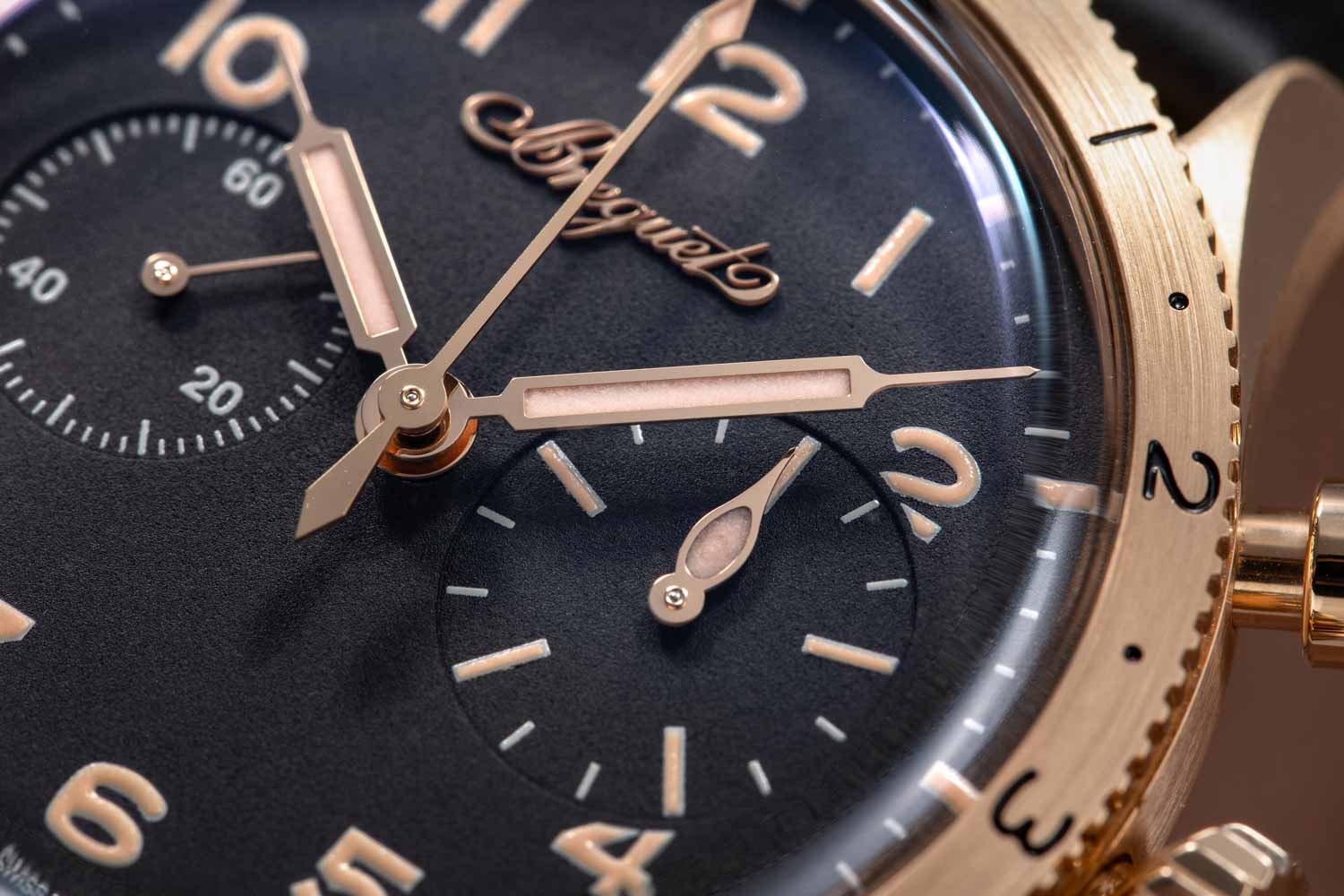
One of those rare times when non-white lume feels fresh, not faux patina — it just works with the case and hands. (Image: Revolution ©)
The choice of aluminium is deliberate, paying tribute to Louis Charles Breguet, a direct descendant of the renowned watchmaker Abraham-Louis Breguet and a pioneering figure in aviation. Louis is best known for developing reconnaissance aircraft used by France during World War I and throughout the 1920s.
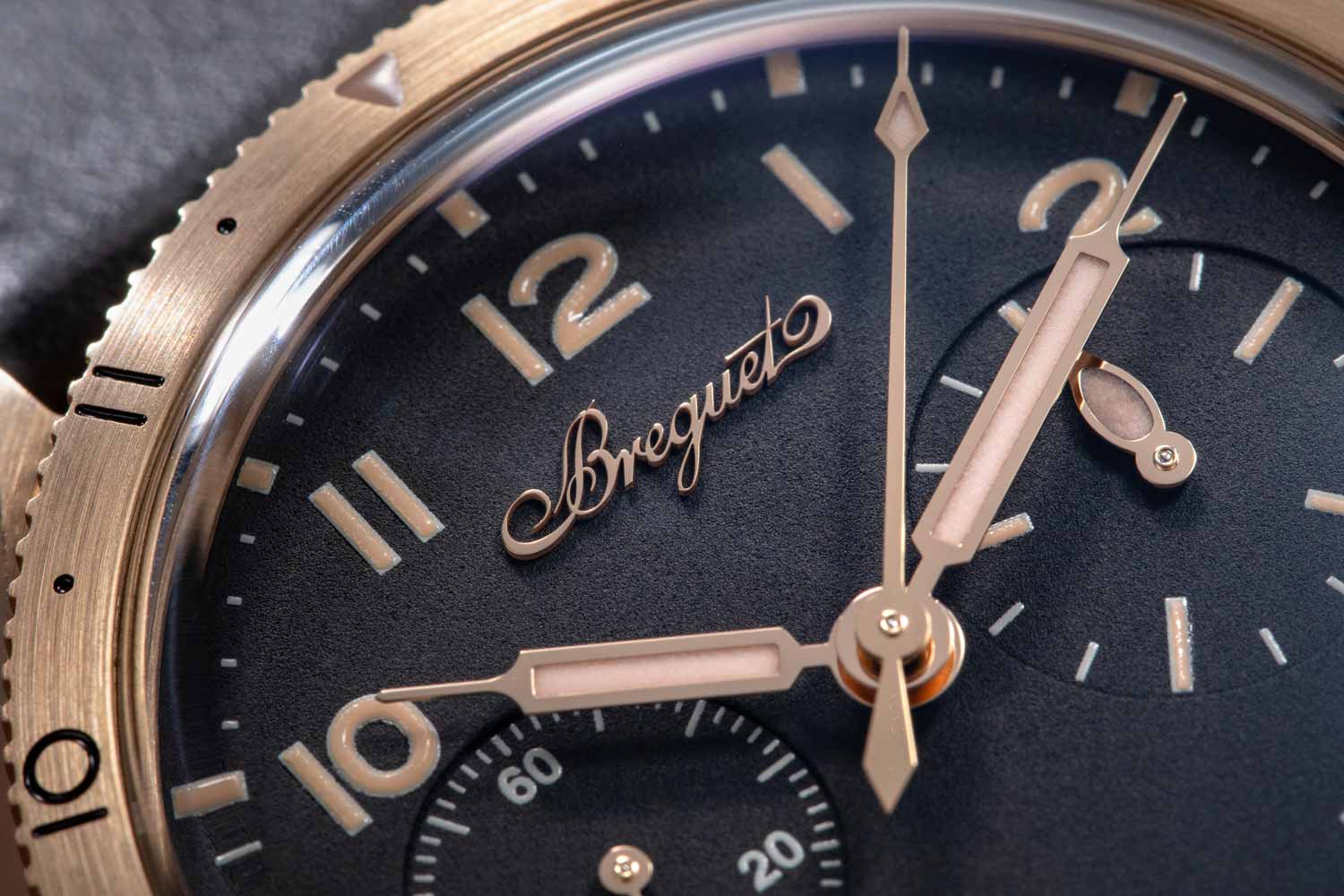
Notice the applied logo in Breguet gold. (Image: Revolution ©)
On the caseback, a three-quarter plate is hand-engraved with an airplane flying above two land masses. The airplane depicted is the Breguet 19TR Super Bidon, the model used for the first-ever nonstop flight from Paris to New York, which took 37 hours. The engraving even faithfully includes the plane’s extra-large fuel tank, marked with a question mark.
It’s worth noting that hand engraving on movements usually consists of lettering, while detailed graphics are typically machine-made. Here, however, the engraving is done entirely by hand, the traditional way, making this 250th anniversary model unique.
The three-quarter plate is also coated in Breguet gold and features more refined finishing than usual. The polished, rounded bevels are noticeably thicker, reminiscent of those found on independent watchmakers’ time-only pieces. However, I noticed a section of the bevel opposite the reset pusher that is neither fully rounded nor polished, suggesting this particular example we’re looking at might be a prototype.
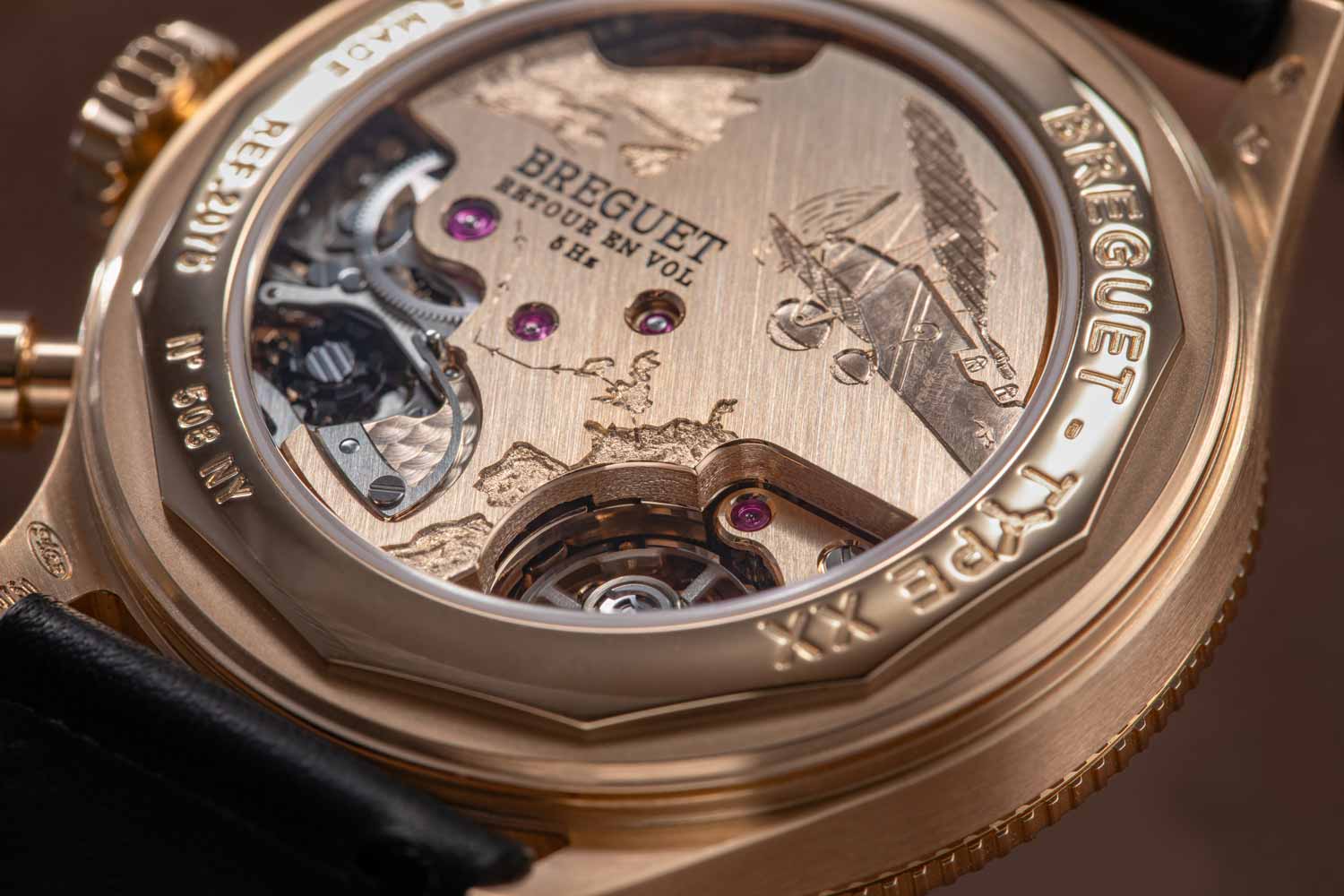
The case back reveals an engraving. (Image: Revolution ©)
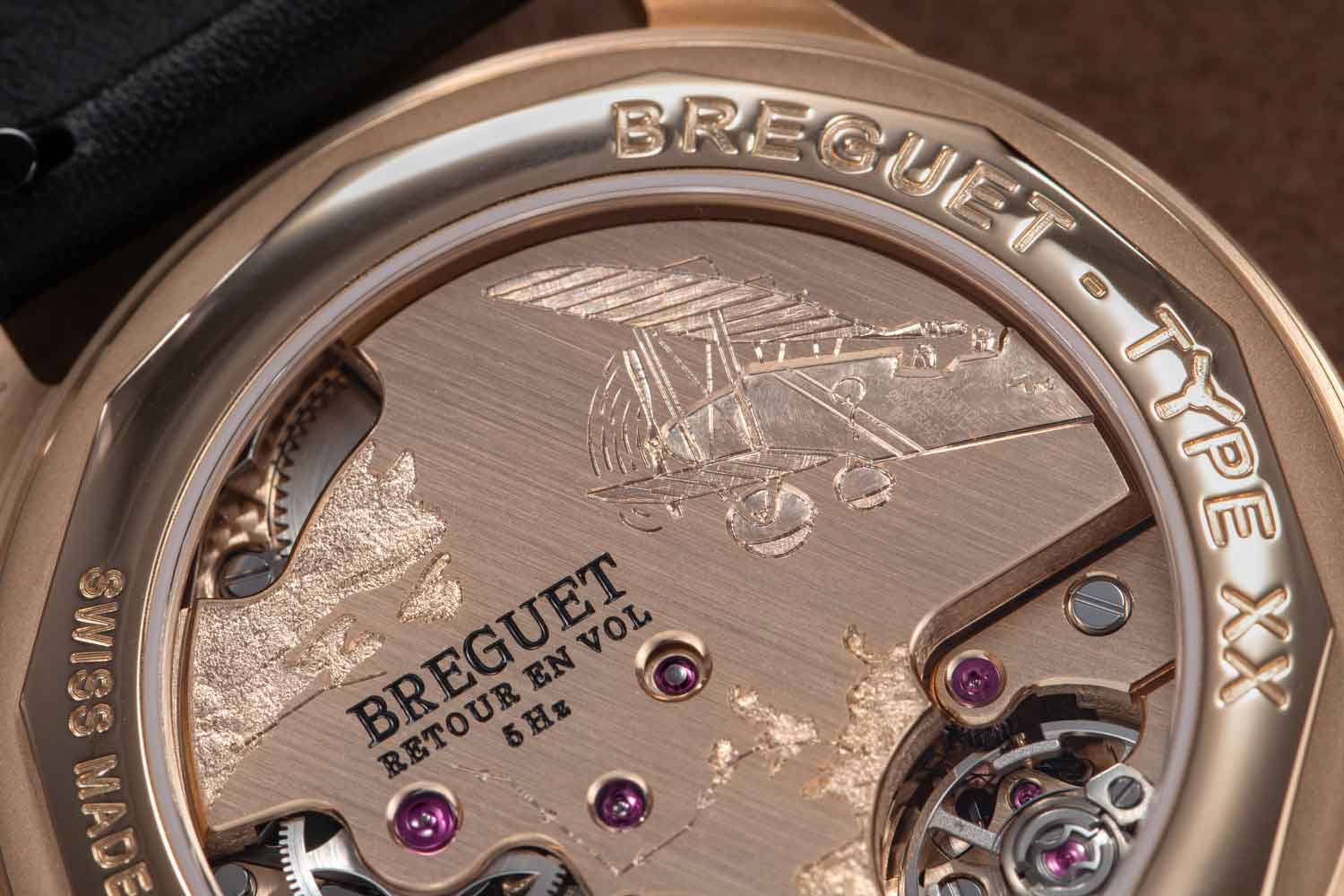
The engraving depicts the Breguet 19 aircraft in flight, tracing its 1930 route from Europe to North America. (Image: Revolution ©)

Image: Revolution ©
High-tech flyback
Some may regret that the view through the caseback is mostly hidden by a three-quarter plate (that is, if you are not a fan of engraving). That’s because Caliber 7279 is based on the automatic Caliber 728, an advanced chronograph movement introduced just two years ago.
Both the Cal. 728 and Cal. 7279 use a vertical clutch system, meaning there’s less to see compared to traditional horizontal clutch movements, where many parts are stacked. So, the presence of the three-quarter plate doesn’t make much difference. In fact, I’m glad the automatic winding system has been removed here. A hand-wound chronograph feels much more classical, even considering the vertical clutch and its less visually interesting movement.
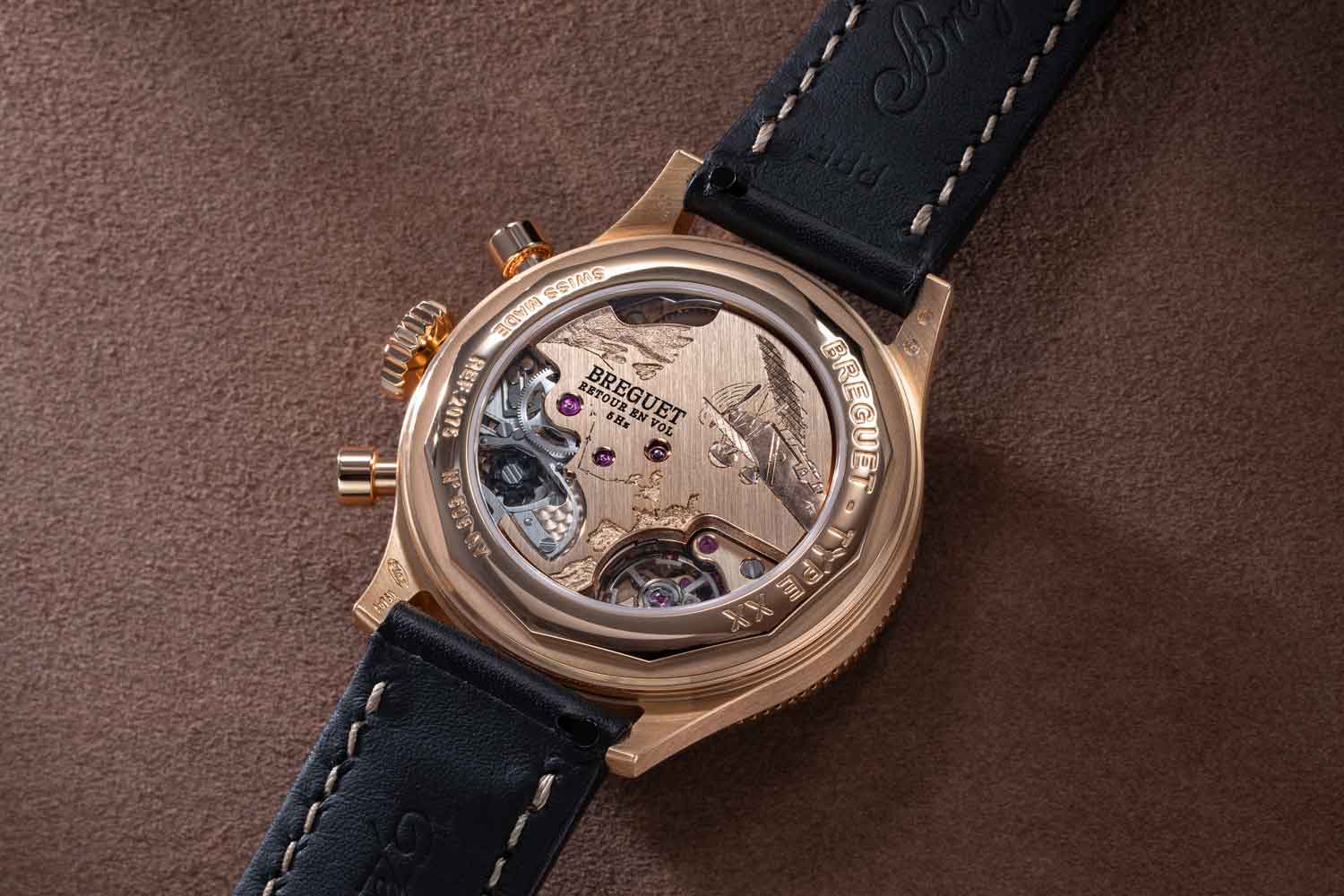
Image: Revolution ©
The three-quarter plate also conceals some important features. The Cal. 728 wasn’t developed just as any chronograph — it’s a clever flyback chronograph. Breguet holds patent-pending technology in its flyback mechanism, including an additional buffer spring in the reset construction. This spring stores enough energy with each push before triggering the levers, ensuring the flyback or reset action happens with consistent force and protecting the mechanism.
The movement beats at a high frequency of 36,000 vibrations per hour (5 Hz), yet still offers a comfortable, modern power reserve of 60 hours.
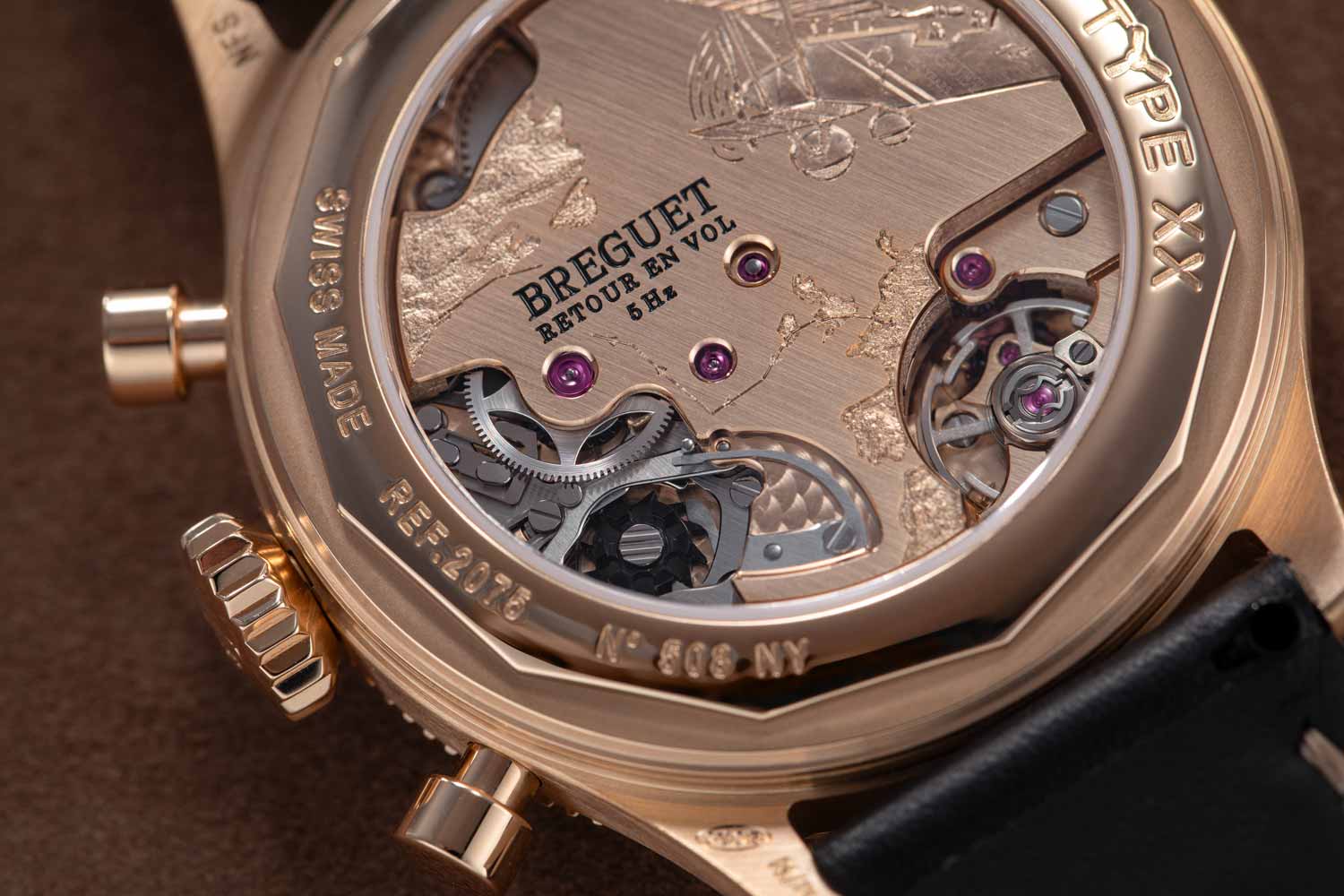
Image: Revolution ©
Concluding thoughts
The Breguet Type XX Chronograph “250th Anniversary” delivers what collectors have long wanted: a modest size and a clean, no-date dial. But Breguet adds a historical twist by casing it in gold – a reference to one of the brand’s rarest Type XX variants, of which only three are known.
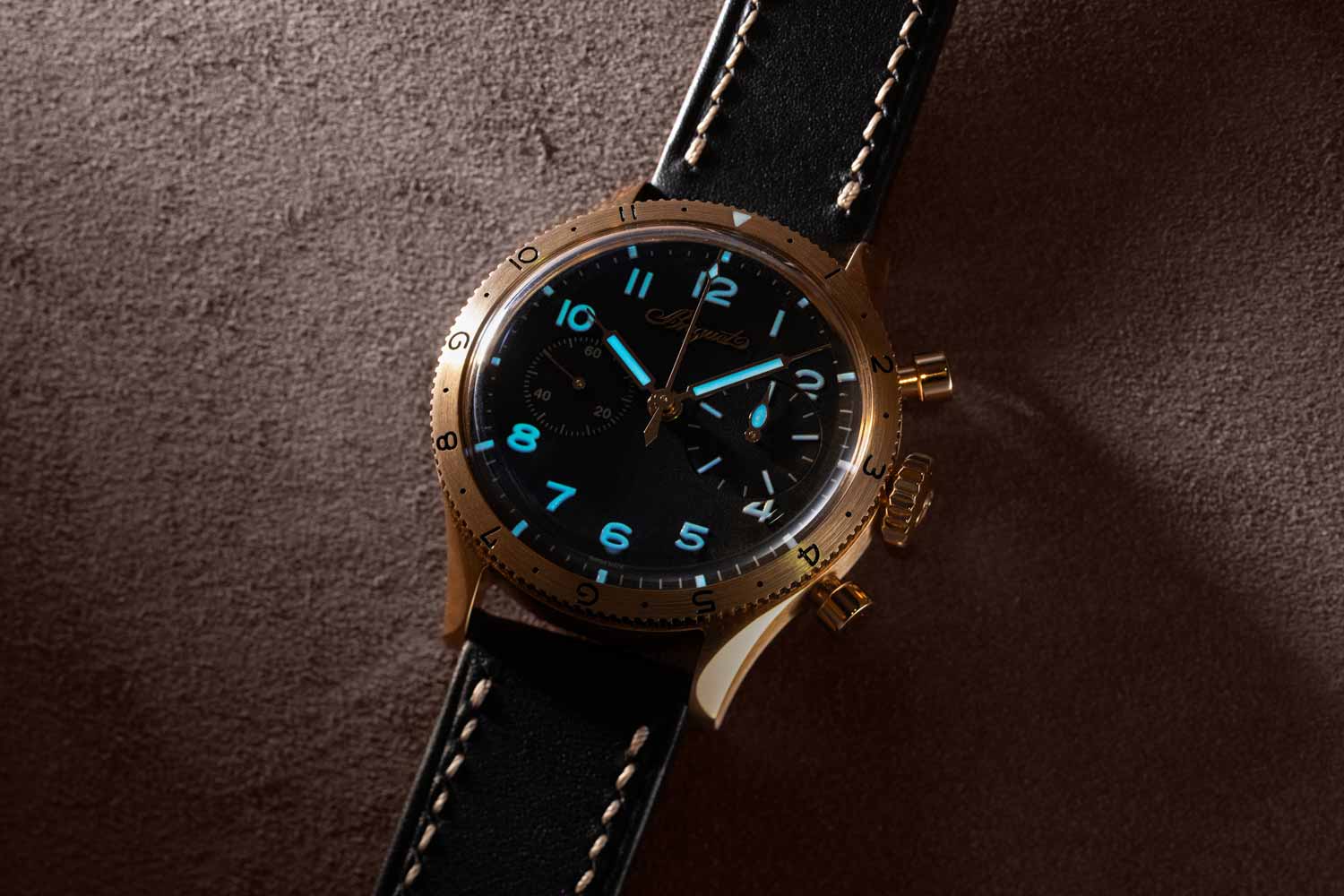
The hands, hour markers and chronograph counter at 3 o’clock are coated with beige luminescent paint that emits a blue glow in low-light conditions. (Image: Revolution ©)
Tech Specs: Breguet Type XX Chronograph
Reference: 2075BH/99/398
Movement: Cal. 7279; manual-winding; 60 hours power reserve
Functions: Hours, minutes, seconds, and flyback chronograph
Case: 38.3 mm x 13.2 mm; 18k Breguet gold; water resistant to 50 m
Strap: Black calfskin strap with pin buckle
Availability: At boutiques and retailers
Limited edition: No
Price: USD 43,500
Breguet
You may also like

News
Breguet Unveils the Classique 7225 with a Magnetic-Pivot 10 Hz Balance and the Phase de Lune 7235
Oct 24, 2025
News
Breguet Unveils the Classique 7225 with a Magnetic-Pivot 10 Hz Balance and the Phase de Lune 7235
Oct 24, 2025

News
Breguet Marks 250 Years with the Marine Hora Mundi 5555
Sep 12, 2025
News
Breguet Marks 250 Years with the Marine Hora Mundi 5555
Sep 12, 2025

News
Breguet Marks 250 Years With New Boutique At ION Orchard, Singapore
Aug 20, 2025
News
Breguet Marks 250 Years With New Boutique At ION Orchard, Singapore
Aug 20, 2025