


A Closer Look: Piaget Sixtie at Watches & Wonders 2025
A Closer Look: Piaget Sixtie at Watches & Wonders 2025

At Watches & Wonders 2025, Piaget is all set to introduce several new models (except they’ll only be revealed in the next two days), with the Sixtie collection standing out as the highlight of the year. This all-new range features a redesigned case and bracelet, drawing inspiration from the brand’s design legacy while offering a fresh take for today.
A new trapezoidal case shape
Like many watchmakers with a strong design heritage, Piaget created some truly distinctive case and bracelet designs in the 1960s and 1970s. Today, the brand draws inspiration from its past, particularly from those watches with asymmetrical square shapes — or perhaps more accurately, trapezoidal forms — to create the new Sixtie collection.
-

- Piaget redefined the contours of precious pieces and women’s watches with daring and avant-garde designs, to echo the flamboyance that marked the late 1960s
-

- A vintage Piaget watch with a trapezoid case
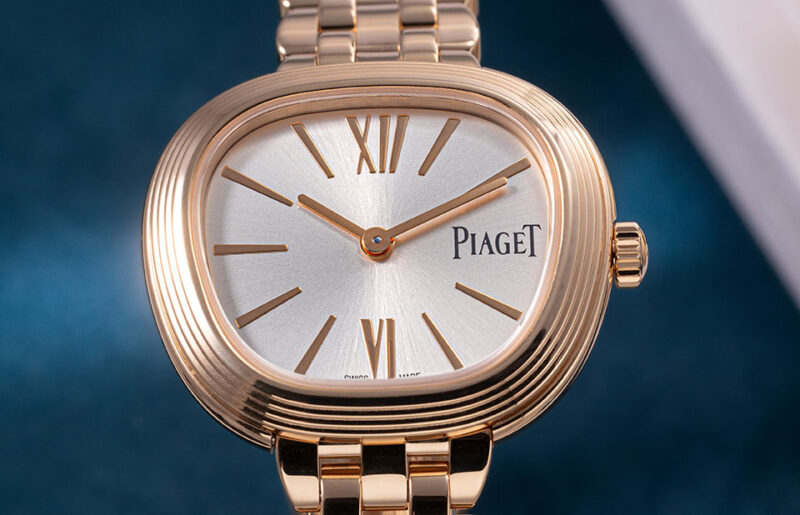
The Sixtie watch boasts a case that is wider at the top and tapers down towards the bottom, making it a clear example of a trapezoidal shape. However, the excitement goes beyond its shapely form. Upon closer inspection, you’ll notice that the bezel is finely stepped, with five delicate steps that create a gentle slope from the case flank to the crystal at the top.
This clever design enhances the presence of the case with a broad bezel, giving it a bold and striking appearance, yet it avoids feeling visually heavy, something that would have been the case with a wide bezel of the same thickness throughout. In fact, the stepping is not uniform; the top bezel and case flank are wider, while the three strips in between are finer. This variation creates a rhythm within the design, showcasing the brand’s attention to detail.

The finely chiselled gadroons on the bezel echo the spirit of the iconic Piaget watch owned by Andy Warhol — which was then later named after him. Image: Revolution ©
Moving from the case to the dial, the inaugural version features a simple yet familiar design — the silver dial and baton indices are unmistakably Piaget. However, there are a few noteworthy details to mention. For instance, the baton indices aren’t strictly rectangular; instead, they are trapezoidal, with a subtle radial enlargement. Additionally, the brand’s logo is cleverly placed at the three o’clock position, replacing the traditional horizontal hour marker.

Against a satin-finished dial, golden hour markers and baton hands keep the look to a minimum with the clean lines of Roman numerals. Image: Revolution ©
Currently, the case is only available in a 29mm × 25.3mm size, which is typical for ladies’ watches in the modern era but would have been a gentleman’s watch in the past. The dial is also available in its simplest, most minimalistic format (save for a little gem-setting). It’s worth looking forward to future expansions of the collection, potentially offering larger sizes for matching men’s and women’s watches, as well as more interesting dial designs and materials.
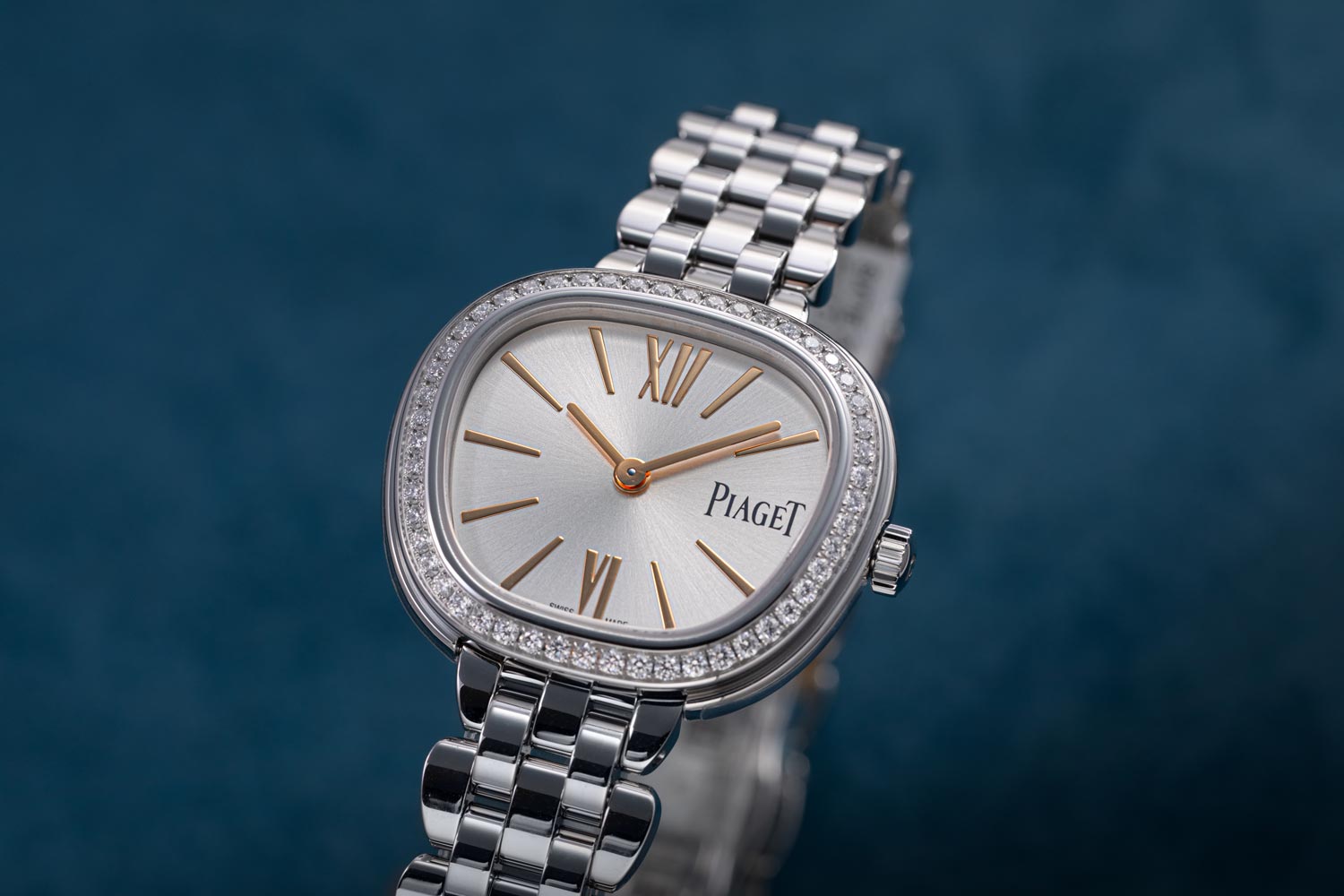
Image: Revolution ©
A new bracelet design for the times
It’s probably not an exaggeration to say that half of the excitement around the new Sixtie lies in the bracelet, because it’s rare to find a major brand releasing a brand-new collection that includes a new bracelet as well.

Piaget Sixtie plays host to four new references: in full 18K pink gold, pink gold and diamonds, steel and diamonds, and two-tone 18K pink gold and steel. Image: Revolution ©
The bracelet of the Sixtie consists of five individual links in a row, with the three middle ones being more rectangular in shape. The two outer links are more unusual — they are essentially trapezoidal, exactly the same shape as the case, but split into two halves, now sandwiching the three regular links. As a result, the bracelet is simple yet still manages to continue the look and feel of the case, creating a genuine integrated effect.

The new Sixtie bracelet is interlaced with trapeze-shaped links that drape over the skin. Image: Revolution ©
The finishing of the bracelet is simply high-polished, but it works for a small watch like this.
Quartz movement
Inside the watch is the Cal. 57P, a quartz movement by Piaget. Fortunately, the dial only shows hours and minutes, so it doesn’t give away the quartz nature of the movement with the unmistakable one-second ticking. Thanks to the quartz movement, the watch has an incredibly thin profile of just 6.5 mm, offering unmatched wearing comfort compared to most mechanical pieces.

Image: Revolution ©
Tech Specs: Piaget Sixtie
Movement: Quartz 57P
Functions: Hours and minutes
Case: 29mm × 25.3mm × 6.5 mm; 18K pink gold o steel or two-tone; water-resistant to 50m
Dial: Sunburst silver
Strap: 18K pink gold, steel or two-tone bracelet
Piaget

You may also like

Editorial
Inside the Piaget x Andy Warhol ‘Collage’ Watch: A Pop Art Legacy Reimagined
Oct 20, 2025
Editorial
Inside the Piaget x Andy Warhol ‘Collage’ Watch: A Pop Art Legacy Reimagined
Oct 20, 2025

All The Best Jewelry Watches from Watches and Wonders 2025
Apr 17, 2025
All The Best Jewelry Watches from Watches and Wonders 2025
Apr 17, 2025
Piaget at Watches and Wonders 2025: Sixtie, Andy Warhol, Piaget Polo 79
Apr 4, 2025
Piaget at Watches and Wonders 2025: Sixtie, Andy Warhol, Piaget Polo 79
Apr 4, 2025