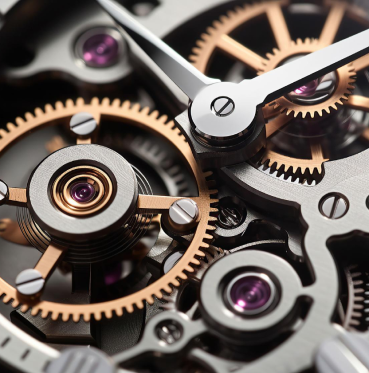



Rolex gem-set watches are all about quality, exclusivity and artistry
Rolex gem-set watches are all about quality, exclusivity and artistry

Since the day luxury watches went from niche to mainstream, all everybody wants is a Rolex on the wrist, and then some. Well, there is no question that Rolex watches are indeed among the most sought-after timepieces on the planet, but only the truest Rolex fanboys and girls know that the real stuff of your Rolex dreams are the ones which are neither overtly promoted nor freely communicated. They’re known affectionately as the off-catalog watches.
This is quite possibly the highest level in Rolex watch collecting one could ever attain. Because it is the uppermost echelon of Rolex haute horlogerie where some of the most splendid, fantastical — and occasionally extravagant — models reside. Models like the legendary Rainbow Cosmograph Daytona, the Leopard Cosmograph Daytona, Eye of the Tiger, SARU, special edition Day-Dates featuring Arabic dials studded full of baguette-cut rubies, emeralds or sapphires, and many more.

Rolex Daytona 116588 TBR (Image © Revolution)
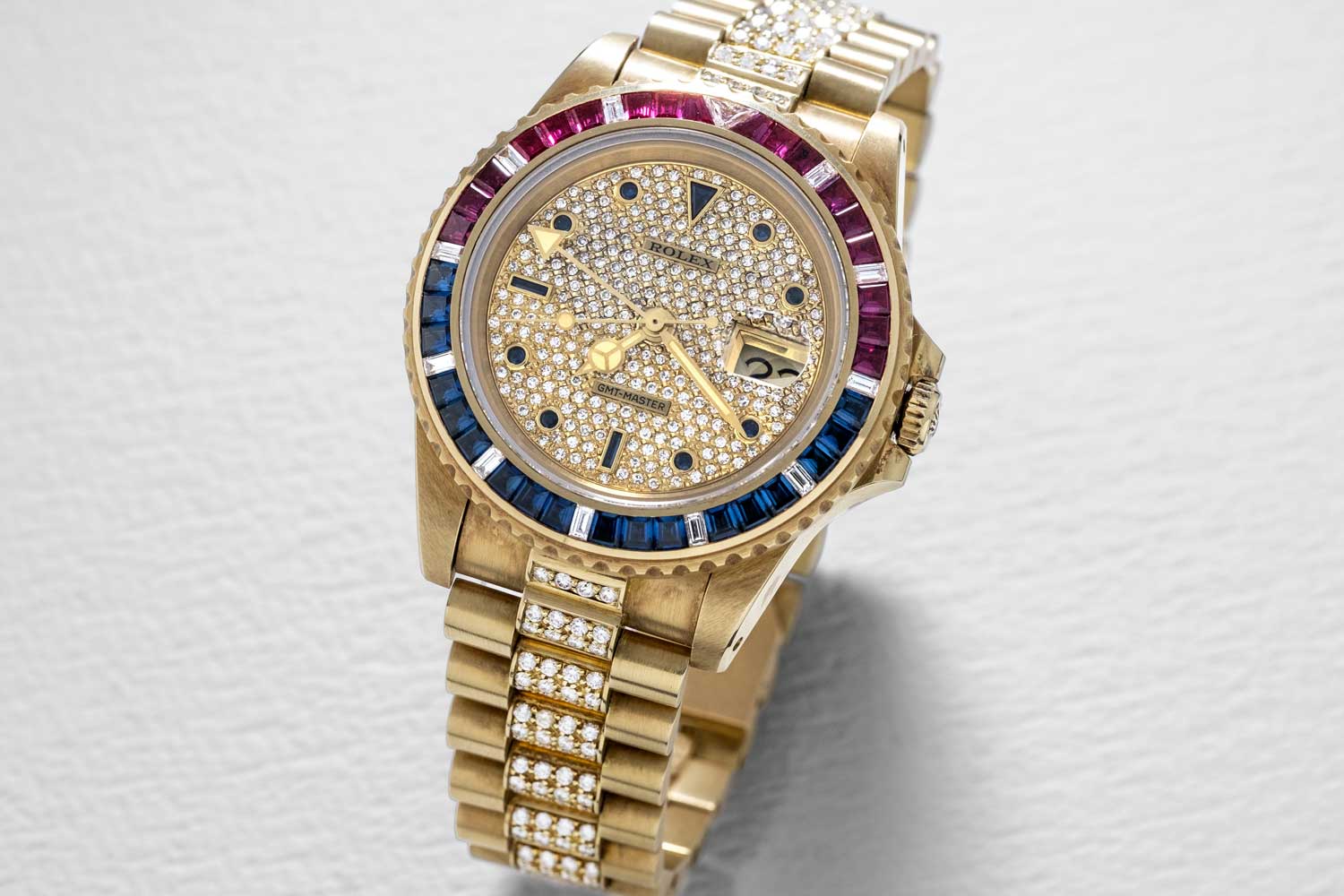
Rolex GMT-Master ref. 16758 SARU (Image © Revolution)
Other than being the ultimate grail watch for many Rolex lovers, these watches have one other thing in common in that they epitomize the very best of Rolex’s gem-setting and gemology expertise. But here’s the good news: Rolex imbues all its gem-set watches with the same internal savoir faire, whether it’s a fully festooned off-catalog reference or a lightly frosted classic daily wear model with just a smidge of bling.
So let’s now delve a little deeper into the specifics. Gem-setting is an age-old craft, likened to many quintessential métiers d’art such as enameling, engraving and guilloché. The French call it sertissage and, as with the other forms of métiers d’art, it spans an array of different techniques. In watchmaking, and particularly at Rolex, there are two key areas of focus, namely gem-setting and gemology, which sound similar in name but actually refer to completely different skill sets.

Oyster Perpetual Lady-Datejust in Everose gold with full pavé diamonds
Inner Beauty
Gemology is the study of gemstones and the gemologists who perform the work are responsible for examining and selecting the stones, scrutinizing every last one of them for the tiniest imperfection. Rolex has an extremely stringent quality criteria which accepts only the highest quality natural stones. Whether they are diamonds or sapphires, rubies or emeralds, they must undergo a series of rigorous verification procedures.
Indeed, Rolex’s gemologists have a range of analysis tools at their disposal, some of which were specially developed for Rolex, that can study each stone down to the molecular level. Thorough information on the chemical composition of a stone tells the gemologists everything they need to know about its purity and hence quality. Diamonds, for example, are systematically tested via X-ray imaging to confirm their authenticity. It is undoubtedly a very exact science but the Rolex gemologists also call upon on their own expertise to grade the gemstones, comparing them with a set of certified master stones to assure both beauty and consistency.

Diamonds are systematically authenticated via X-ray imaging
Here there are several, sometimes opposing, factors at play. At Rolex, diamonds are always evaluated by the naked eye. A gemologist’s ability to discern a colorless stone is always a point of fascination and wonderment for jewelry and gemstone enthusiasts. Only diamonds graded D, E, F and G will be accepted, as these are the four highest grades on the Gemological Institute of America color scale. The first three letters are considered colorless, with G being the best grade on the near colorless range. Importantly, the manufacture prizes uniformity in size, colorlessness and clarity for diamonds used in all its watches.
On the other hand, the criteria changes dramatically when it comes to colored stones such as sapphires, rubies and emeralds. Now instead of colorlessness, the gemologist searches for intensity and saturation, in a bid to select the most striking hues in all colors of the rainbow. With colored gemstones, the brand takes particular care in ensuring that all the stones on a given watch are of the same hue, and that those to be set in a chromatic sequence form a harmonious whole. This requirement is met through a careful sorting process carried out by hand, stone by stone, in the Rolex workshops.

Everose Rainbow Oyster Perpetual Cosmograph Daytona Ref. 116595RBOW, 2018
But while the criteria for color depends on the type of stone in question, clarity is much easier to ascertain. Rolex accepts nothing less than the most translucent natural gemstones and only IF, or internally flawless, diamonds for its watches, which is essentially the highest category on the grading scale in gemology.
That said, a lot of what the gemologist is able to discern by observing the stone has to do with its cut, which is the result of the gem-cutter’s expertise. A perfectly cut stone allows light to penetrate at all the right angles to be reflected off the pavilion, thereby throwing out maximum brilliance. Its overall symmetry and the shape of its facets, along with the number of facets, determine how the human eye perceives its true color and clarity. Indeed, in very well-cut diamonds you could even catch a hint of rainbow hues as they sparkle under the light.

Perfection in colorlessness, Rolex Oyster Perpetual Lady-Datejust in white gold with pavé diamonds
Perfect Setting
After the gemologists have done their part, it’s time for the gem-setters to work their magic. From here on, it is equal parts science and art because everything comes down to the setter and the stone, assisted only by manual tools. Bezel rollers, burnishers, beading tools, claw bending tools, gravers, clamps, pushers and burrs all take turns securing gemstone to watch. And Rolex gem-setters have done a phenomenal job especially with magnificent references like the GMT-Master II SARU featuring trapeze-cut sapphires and rubies as well as diamonds, along with a single triangle-cut diamond at 12 o’clock. And this is just one variation of the famous Rolex SARU.
Other eye-wateringly gem-set GMT-Master II references include the black sapphire and diamond SANR as well as the blue sapphire and diamond SA, several of which also come with full brilliant diamond dial, case and bracelet. Emerald-set models are extremely rare but not entirely elusive. Rolex has been known to use them in watches like the Day-Date 40 featuring trapeze-cut emeralds with baguette diamond and emerald indexes, complete with a full diamond pavé dial.

60 trapeze-cut sapphires and diamonds set all around the bezel
Deploying a subtle touch, the gem-setter works closely with designers who bring an aesthetic finesse to the timepieces, as well as the case and bracelet engineers who weigh in on the optimal approach for placement of the stones. To get a sense of how fastidious Rolex can be with its gem-set watches, observe how perfectly the stones occupy every part of the bracelet link, or how neatly they line up on the bezel, with absolutely no empty spaces to be found. This is because gem-setter, designer and engineers work in unison to determine the precise amount of metal required to hold every stone in place. Rolex tolerances are to within no more than two hundredths of a millimeter — that is around a quarter of the diameter of a human hair!
Once the gem-setter establishes where a specific stone is destined to be set, it is carefully picked up and placed into the metal, which is then gently pushed around the edges of the stone in order to secure them in place. Completely on par with jewelry making, the skill of the gem-setter comes through in the ability to select the appropriate tool, deploy it at the correct angle, and apply just the right amount of force — and then repeating everything for up to 3,000 times in some references. It is a highly tactile process where the gem-setter’s touch is paramount to bringing the timepiece to life. The last step here is to polish the metal prongs in order to intensify the watch’s splendor.

Flawless diamonds and flawless gem-setting on a classic President bracelet
Some common techniques favored by Rolex includes bead setting which is used on surfaces which are paved. In this instance the stones used are always brilliant-cut round diamonds held down by three to five small, bead-shaped metal prongs. It’s similar to claw setting but claw setting tends to be used for bigger stones and feature longer prongs while exposing more of the stone. Rolex also employs the closed setting particularly for the diamond indexes, along with channel or baguette setting which is typically paired with baguette- or trapeze-cut stones. This stunning technique showcases rows of gemstones aligned side by side without any metal in between, just the edges of the gold folded over on top and bottom to keep them secure.
Equal parts science and art, gem-set Rolexes steal the show whenever they appear and who could blame them? For they sparkle with such intensity and brilliance as to affirm the ingenuity imbued during every stage of their creation.
Rolex

You may also like
Editorial
Time Zone to Time Zone: Rolex and Cortina Celebrate the GMT-Master
Oct 28, 2025
Editorial
Time Zone to Time Zone: Rolex and Cortina Celebrate the GMT-Master
Oct 28, 2025

People
John Wayne: Hollywood’s Ultimate Cowboy and His Watch Legacy
Jul 25, 2025
People
John Wayne: Hollywood’s Ultimate Cowboy and His Watch Legacy
Jul 25, 2025

Editorial
Oasis Reunited — Will Liam Gallagher’s Watch Game Return Too?
Jul 23, 2025
Editorial
Oasis Reunited — Will Liam Gallagher’s Watch Game Return Too?
Jul 23, 2025