


A Closer Look: A. Lange & Söhne Minute Repeater Perpetual
Reviews
A Closer Look: A. Lange & Söhne Minute Repeater Perpetual

Since launching its first collection in 1994, A. Lange & Söhne has created an impressive array of complications. Some take the form of inventive interpretations of established ideas, such as the Zeitwerk, while others are traditional complications, often realised with sophisticated solutions, presented both on their own and combined in highly complex timepieces. The three traditional complications are calendrical, timing, and chiming, specifically, the perpetual calendar, chronograph, and minute repeater. Lange brought all three together in the Grand Complication in 2013. When it comes to perpetual calendar chronographs, which is something of an obligatory combination for a haute horlogerie house, there is the Datograph Perpetual originally launched in 2006, and up north, the 1815 Rattrapante Perpetual Calendar in 2013, the Datograph Perpetual Tourbillon in 2016 and the Tourbograph Perpetual ‘Pour le Mérite’ in 2017.
Aside from the Grand Complication, the minute repeater has appeared only on its own, as in the Richard Lange Minute Repeater, or paired with a jumping numerals display in the Zeitwerk. Notably, in all three of these watches, the minute repeater is executed in different ways, with the chiming works in the Grand Complication being the most complex (plus grande et petite sonnerie) and also the most traditional.
This year, A. Lange & Söhne unveiled the Minute Repeater Perpetual that combines a perpetual calendar with a minute repeater alone for the first time. Unlike perpetual calendar chronographs, a minute repeater paired with a perpetual calendar is slightly rarer. Considering that a minute repeater demands painstaking hand adjustment and tuning by the most experienced watchmakers, and that both mechanisms, short of a sapphire dial, can’t be fully displayed, it’s no surprise this pairing is generally avoided. The only other makers that have combined the two alone are Jaeger-LeCoultre, Patek Philippe and Vacheron Constantin (The third of the Big Three, Audemars Piguet has done so before and quite beautifully but, save for its Grande Complication watches, not in the modern era). Its only real rival in production today is the Patek Philippe Ref. 5374G. The A. Lange & Söhne Minute Repeater Perpetual, meanwhile, is limited to just 50 pieces.
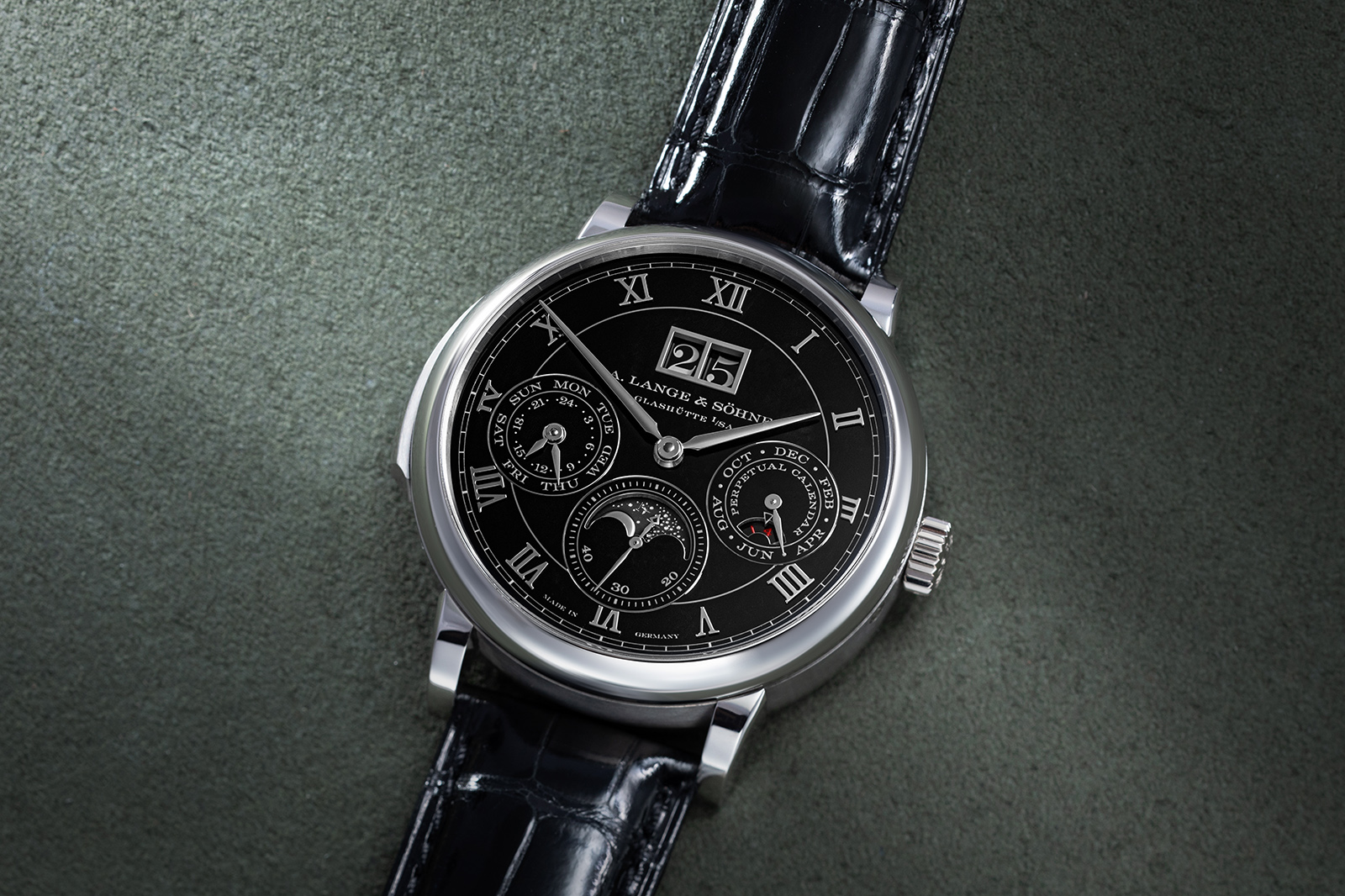
A. Lange & Söhne Minute Repeater Perpetual (Image: Revolution ©)
Cased in platinum with a black enamel dial, it is physically a very beautiful watch – the most beautiful in its category to my eye and beautiful in a way that feels unmistakably, even inevitably, Lange. There is a sense of restrained drama that only Lange seems able to pull off convincingly.
Platinum Case and Black Enamel Dial
Like the Langematik Perpetual, the Minute Repeater Perpetual belongs to the Saxonia family, which is a line that Lange describes as being devoted to ‘finding the best conceivable – which means technically optimised and aesthetically perfect – mechanical solution.’ Looking at this watch, it’s hard to refute that.
The proportions of the case are excellent. At 40.5mm wide and 12.1mm in thickness, it’s more compact than the Patek Ref. 5374G, which comes in at 42mm by 12.28mm. It is also unusually compact for a complicated Lange; the Datograph for instance is 41mm x 13.1mm and the Lange 1 Perpetual Calendar measures 41.9mm x 12.1mm.
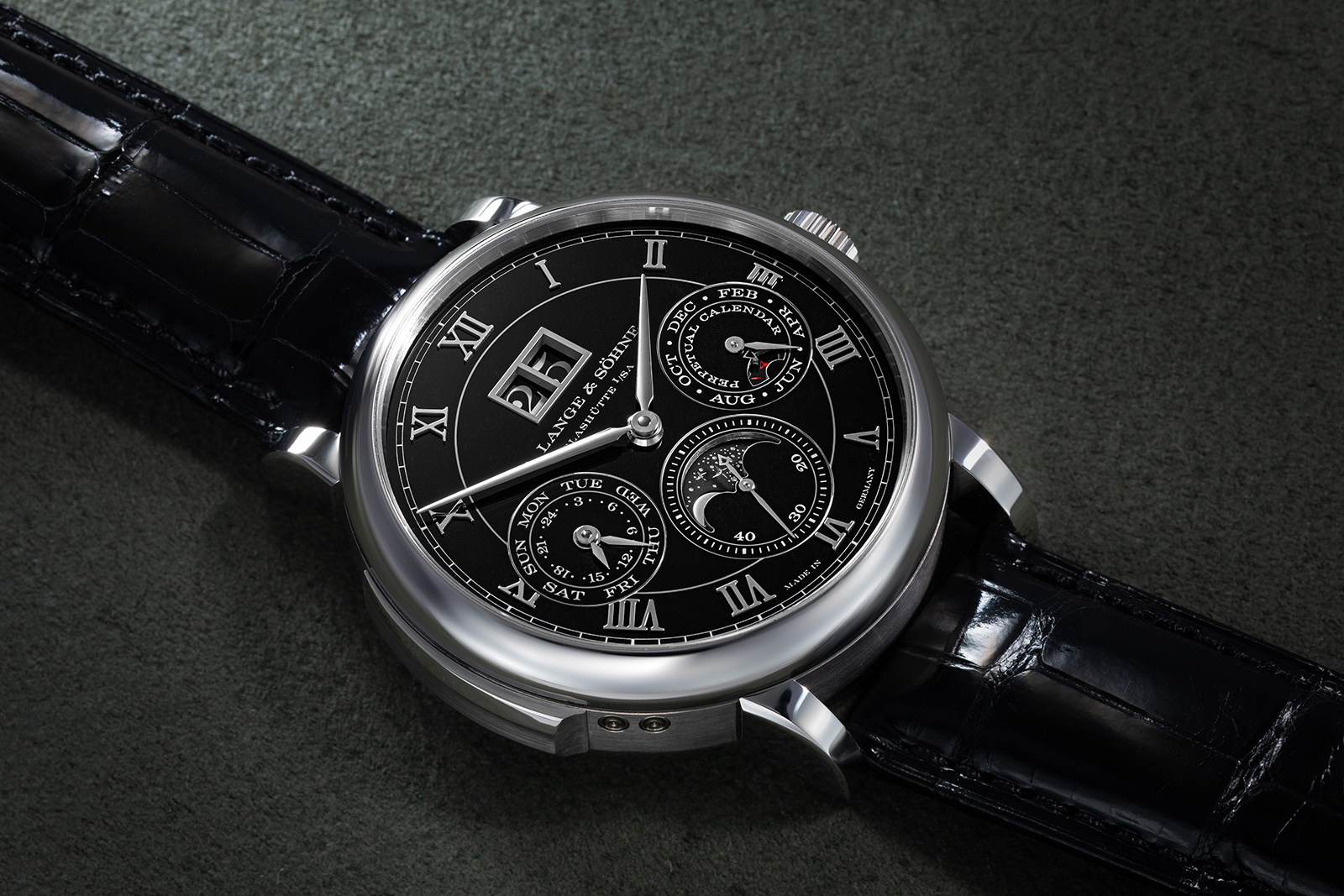
(Image: Revolution ©)
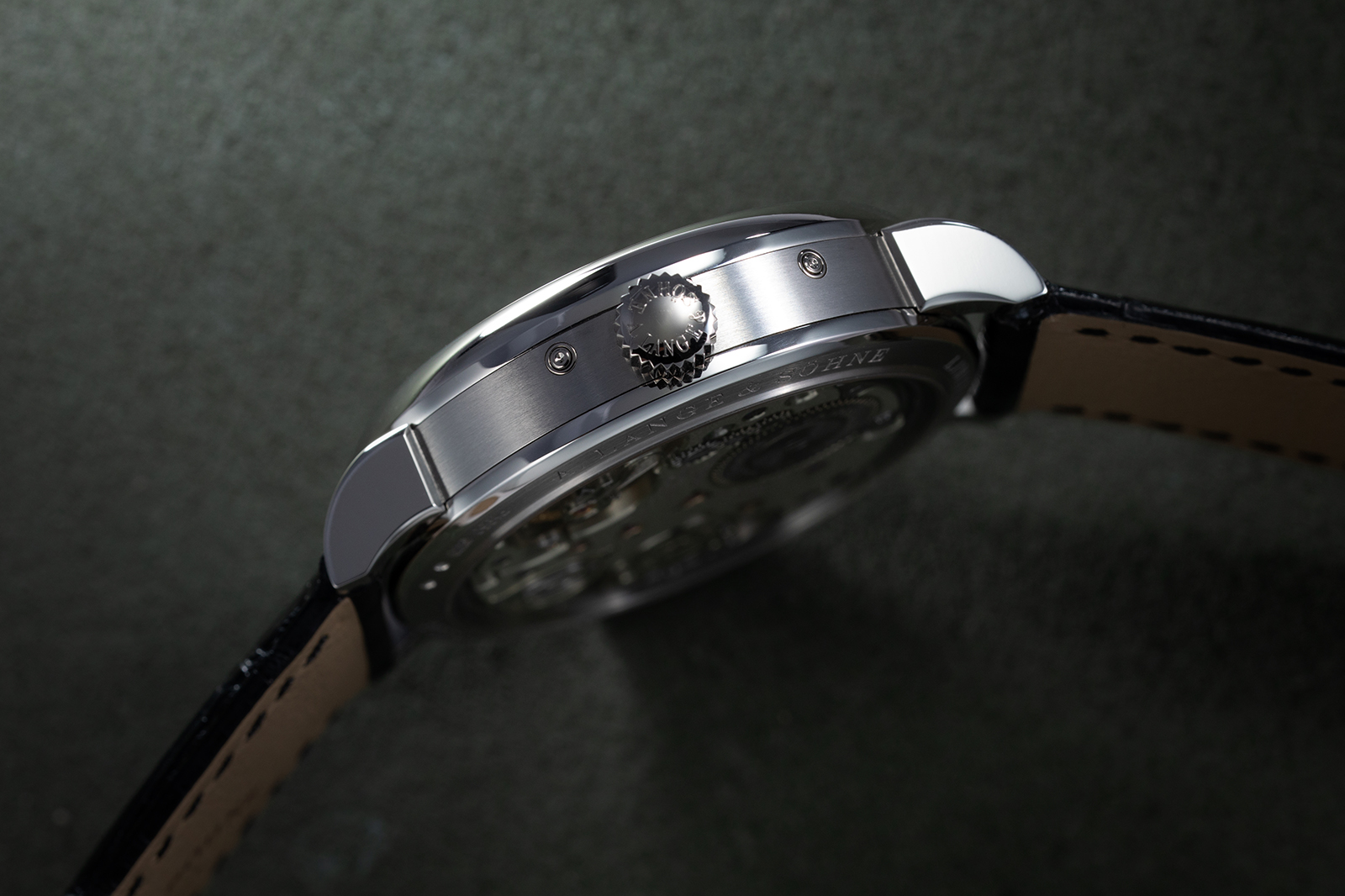
The lugs and notches are polished while the flanks are brushed. To achieve this, the lugs are finished separately and soldered to the case middle (Image: Revolution ©)
Much of its development was focused on creating a practical and wearable high complication. Chiming watches are notoriously difficult to make water resistant because the slide that operates the striking mechanism creates an opening, and sealing the case too thoroughly can diminish the acoustics of the chimes. The Patek ref. 5374, for instance, is not water resistant. But given that the market for such high-end watches often includes regions with high humidity, and that the steel parts in the movement are left pure without nickel plating, water resistance was a necessity. The watch is protected to a depth of 20 metres.
The case middle is satin-brushed, as is characteristic of Lange watches, while the notched lugs are polished and stepped outward from the case band. Platinum, combined with the case design, gives the watch an impenetrable sense of solidity, yet it remains elegant and unobtrusive enough to disappear under a cuff when needed.
Lange’s perpetual calendars have always been designed for ease of resetting once the watch stops. In addition to individual correctors for the day, month, and moon phase, there is a single corrector inset in the case band at two o’clock that advances all calendar indications simultaneously.
The dial is arresting. It is in glossy black enamel, applied over a gold base, with long, delicate, tapering lance hands. It comprises four parts with the sub-dials made separately and then inlaid into the main dial, and overall the dial looks richer for it. In terms of design, it’s a masterclass in balance and proportion where every element is well-resolved and holds its place.
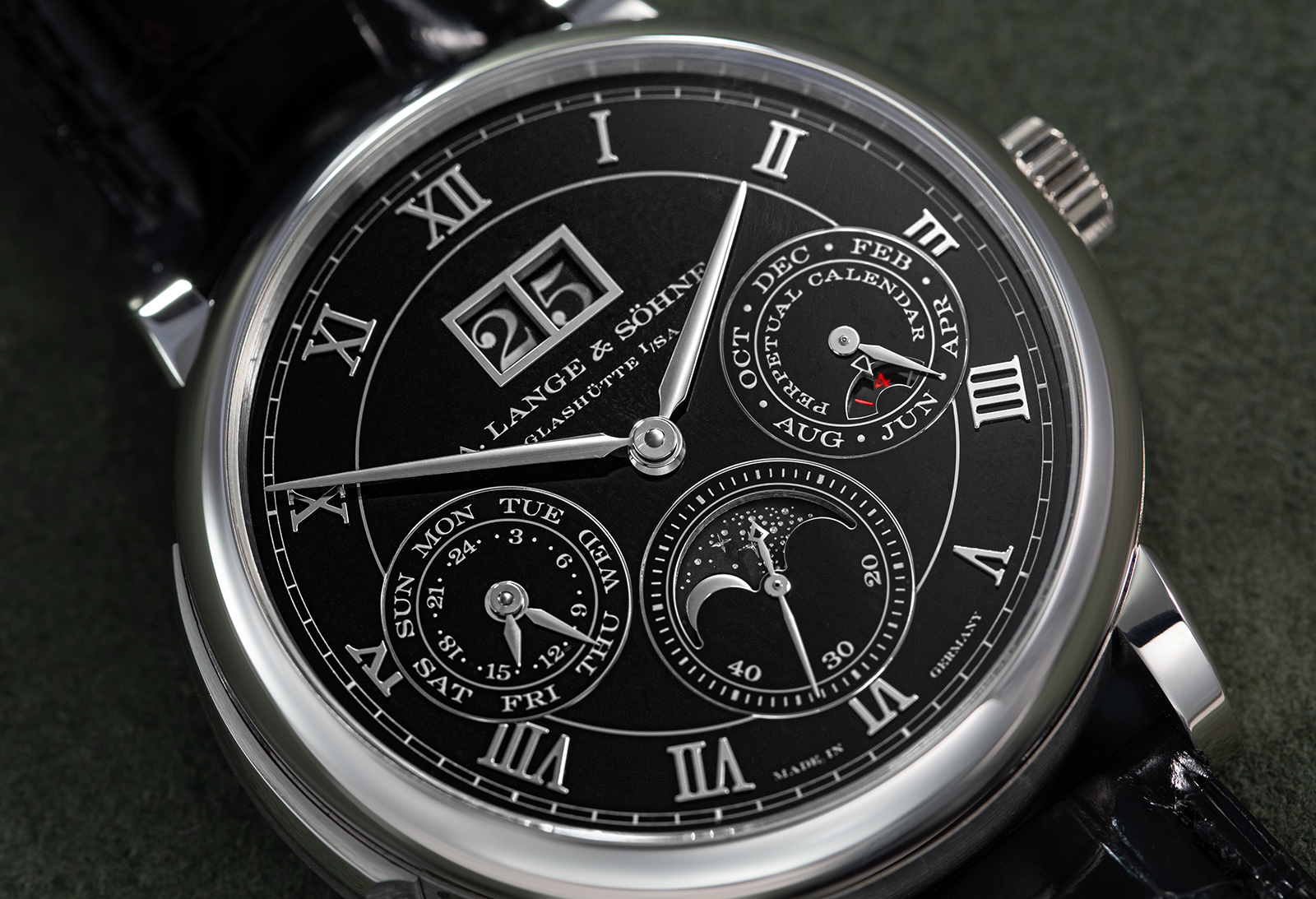
The black enamel dial consists of four parts. The sub-dials were made separately and inserted into the main dial (Image: Revolution ©)
Big date displays often dominate a dial by design but the date discs are rendered in black here to match the dial, so they don’t disrupt the overall calm. The applied Roman numerals in rhodium-plated gold stand out crisply against this dark ground and contrasts wonderfully with the delicately printed railway minute track. The moon phase disc, also in black, features two gold moons surrounded by over a hundred hand-engraved stars.
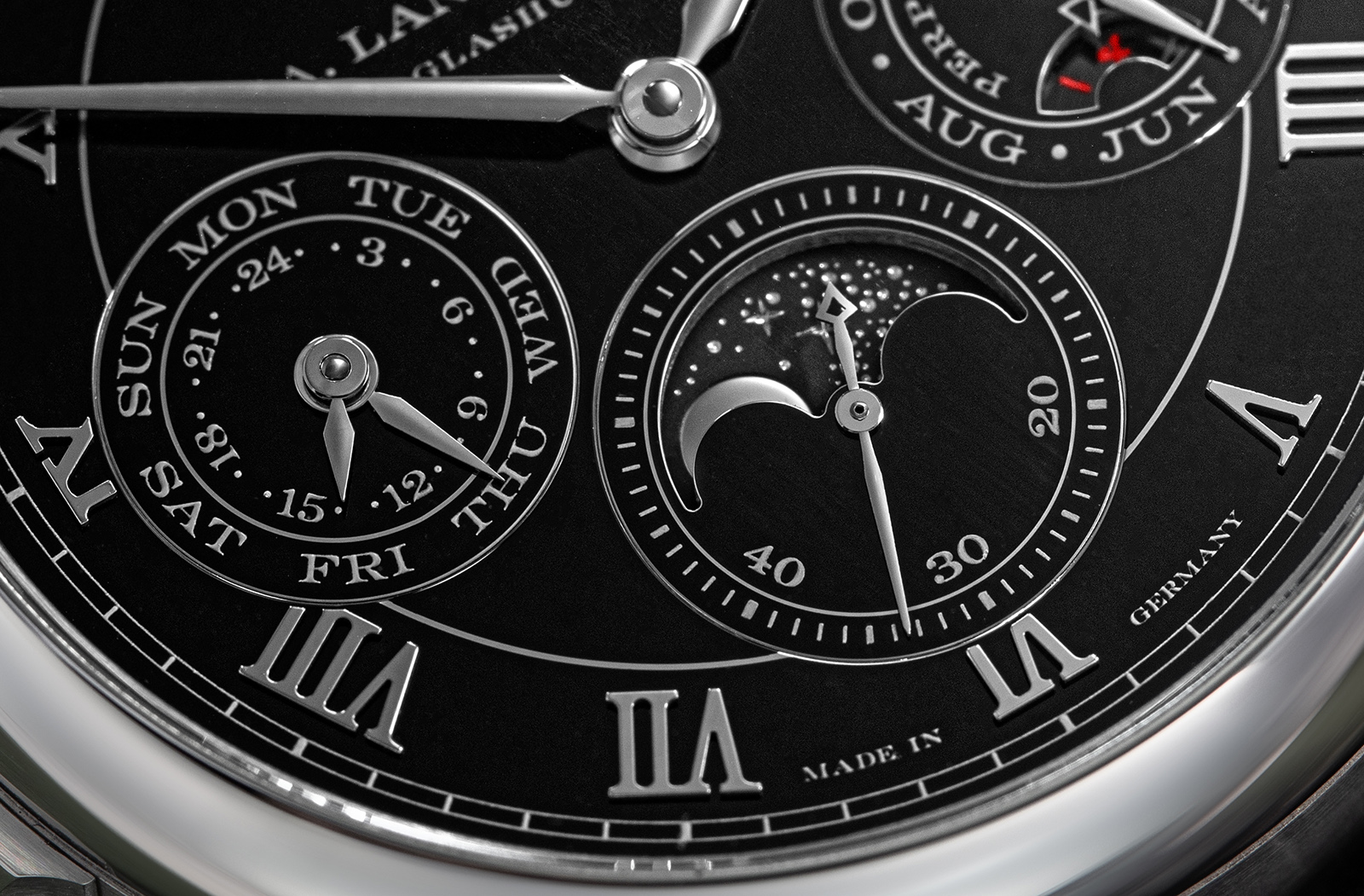
The moon phase disk has two gold moons, along with over a hundred hand-engraved stars (Image: Revolution ©)
In contrast to the Langematik Perpetual, which features a smaller leap year sub-dial tucked into the edge of the month display, the leap year here is indicated by a discreet sector-shaped aperture within the month sub-dial itself. Within the four-year cycle on the leap year disc, the leap year is highlighted in red so it pops immediately. Notably, all the indications use Lange’s regular typeface rather than the condensed style of the Langematik Perpetual, giving the dial a dramatically different look. It not only improves legibility but also feels more composed and visually balanced. In fact, there is a sense of dignity about the overall design that seems almost radical for a perpetual calendar, due in part to having a big date instead of a date pointer.
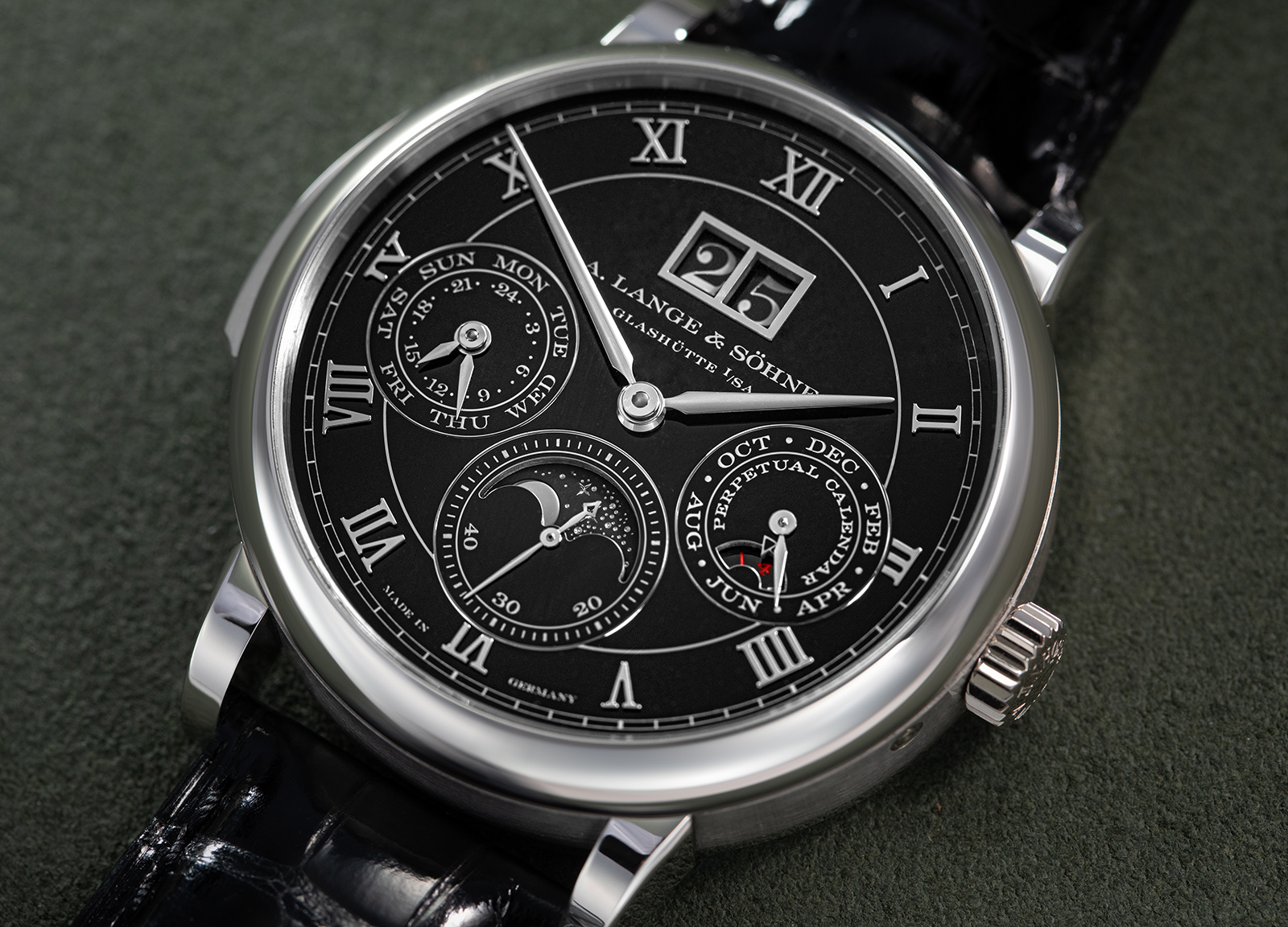
(Image: Revolution ©)
Calibre L122.2
The new Calibre L122.2 shares the same basic architecture as the Calibre L122.1 in the Richard Lange Minute Repeater. Anthony de Haas pointed out that they did not simply take the existing Richard Lange Minute Repeater base movement and stick the perpetual calendar module from the Langematik Perpetual on top. If they had done that, the watch would have been too thick – about 14mm instead of 12.1mm. Instead, parts of the perpetual calendar are partly integrated into the base calibre. The gear train was derived from the Richard Lange Minute Repeater and like the latter, it has a hacking seconds function. However, the hammers and fly governor are repositioned at slightly different angles. The governor has been slightly redesigned to be more compact to free up room for the perpetual calendar parts.
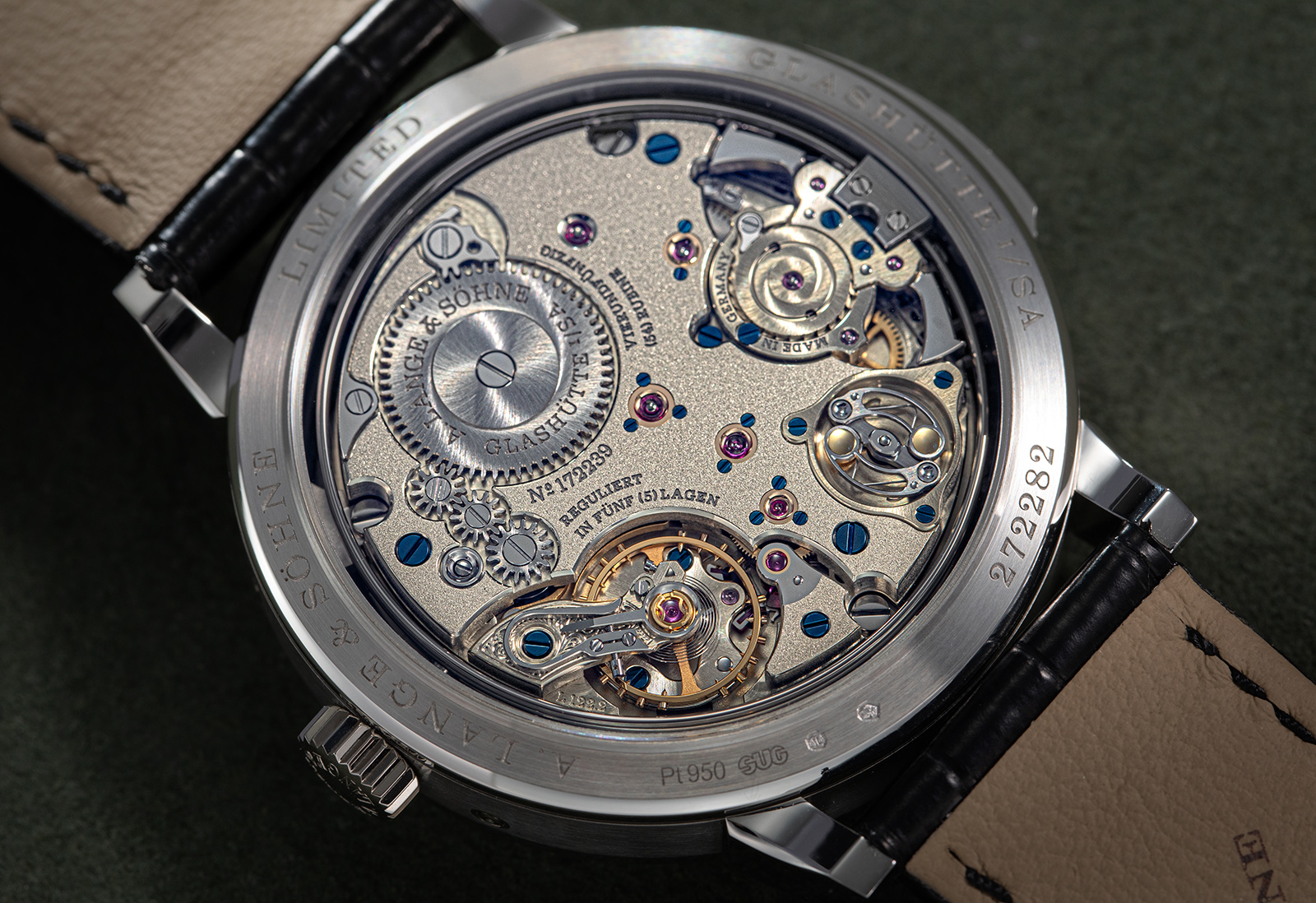
In the Calibre L122.2, the wheel train occupies the left side of the movement while the strike train is arranged on the right (Image: Revolution ©)
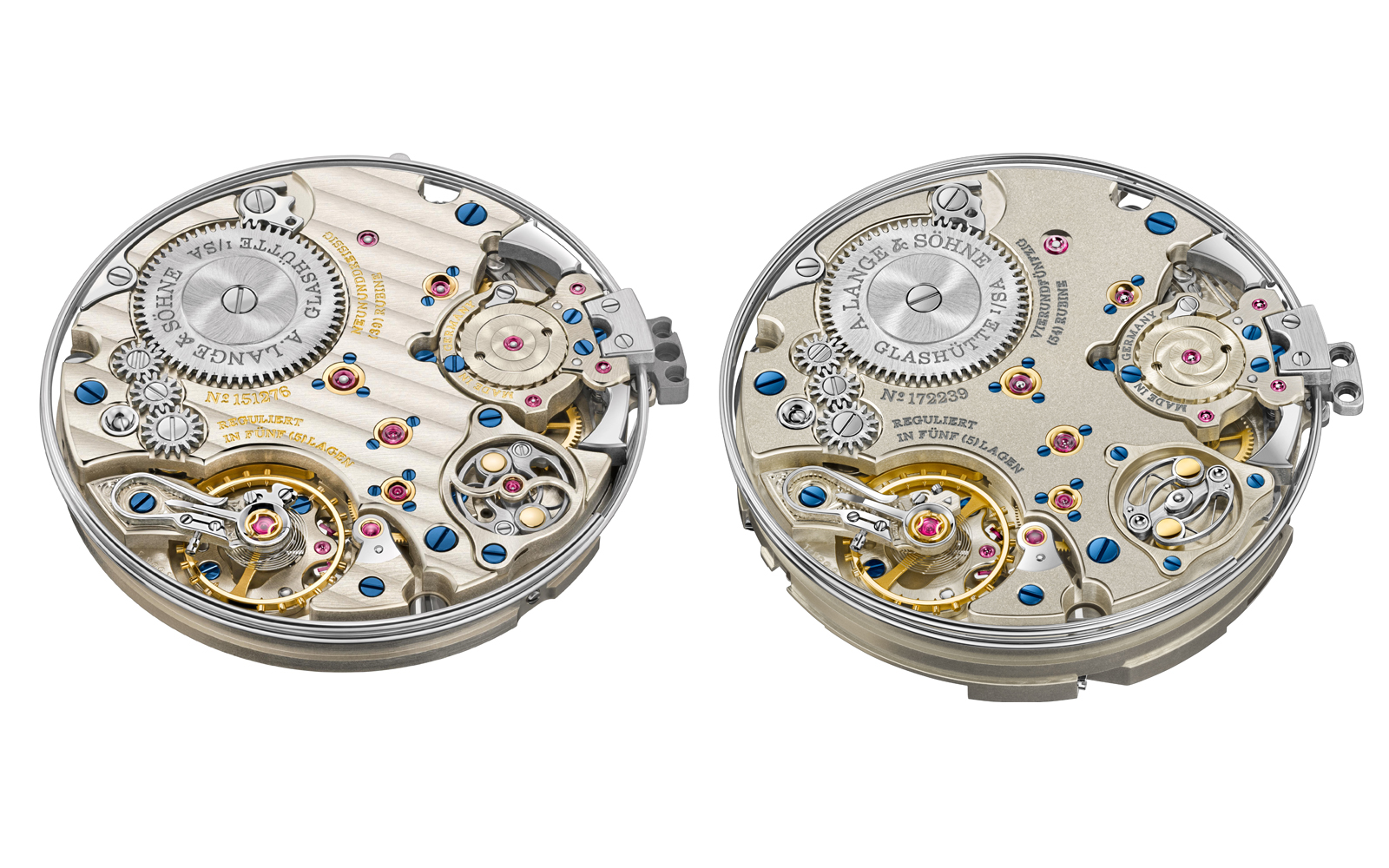
The Richard Lange Minute Repeater calibre L122.1 (left), and the new Minute Repeater Perpetual calibre L122.2 (right)
While the calendar mechanism in the Lange 1 Perpetual Calendar relies on a large peripheral 12-month program wheel that doubles as the month ring itself, the Minute Repeater Perpetual has a more traditional construction.

At its core, the system relies on three sub structures: a 48-month program wheel that stores the logic of month lengths across a four-year cycle, the stepping and control levers that read this information and trigger the necessary corrections and the display trains that show the big date, day, moon phase and month. What’s interesting is that with the integration of a big date, a train is needed to connect the date mechanism to the 31-tooth wheel and end-of-month cam at the bottom. They can’t simply be implanted into the big date.

The minute repeater is particularly sophisticated in that it has a system that eliminates the silent interval between the completion of the hours and the start of the minutes when there are no quarters to be struck. In Lange’s design, it is also inherent that there is no silent pause between the hours and the quarters. Minute repeaters are rare enough to begin with; they demand so much care and skill that few watchmakers ever attempt them and when they do, sticking to proven methods is simply good sense. Hence, innovations like the removal of dead time remain exceptionally rare.
In a traditional minute repeater, this pause exists because of how each rack is driven. There is no direct connection between the hour and quarter racks. The hour rack is driven directly by the repeater barrel, while the quarter rack is driven indirectly by a pinion that rotates freely on the barrel arbour. This pinion is set in motion by a finger fixed to the square of the barrel arbour. The time it takes for this finger to reach a post on the pinion can vary, causing a variable gap between the hours finishing and the quarters starting. Only the quarter rack and the minute rack are directly connected; the minute rack is moved by a hook or pawl pivoted on the quarter rack. However, this driving hook typically engages one of five (or seven) teeth on the minute rack, and slight variations in where the hook lands on these teeth can introduce minor differences in timing as well.
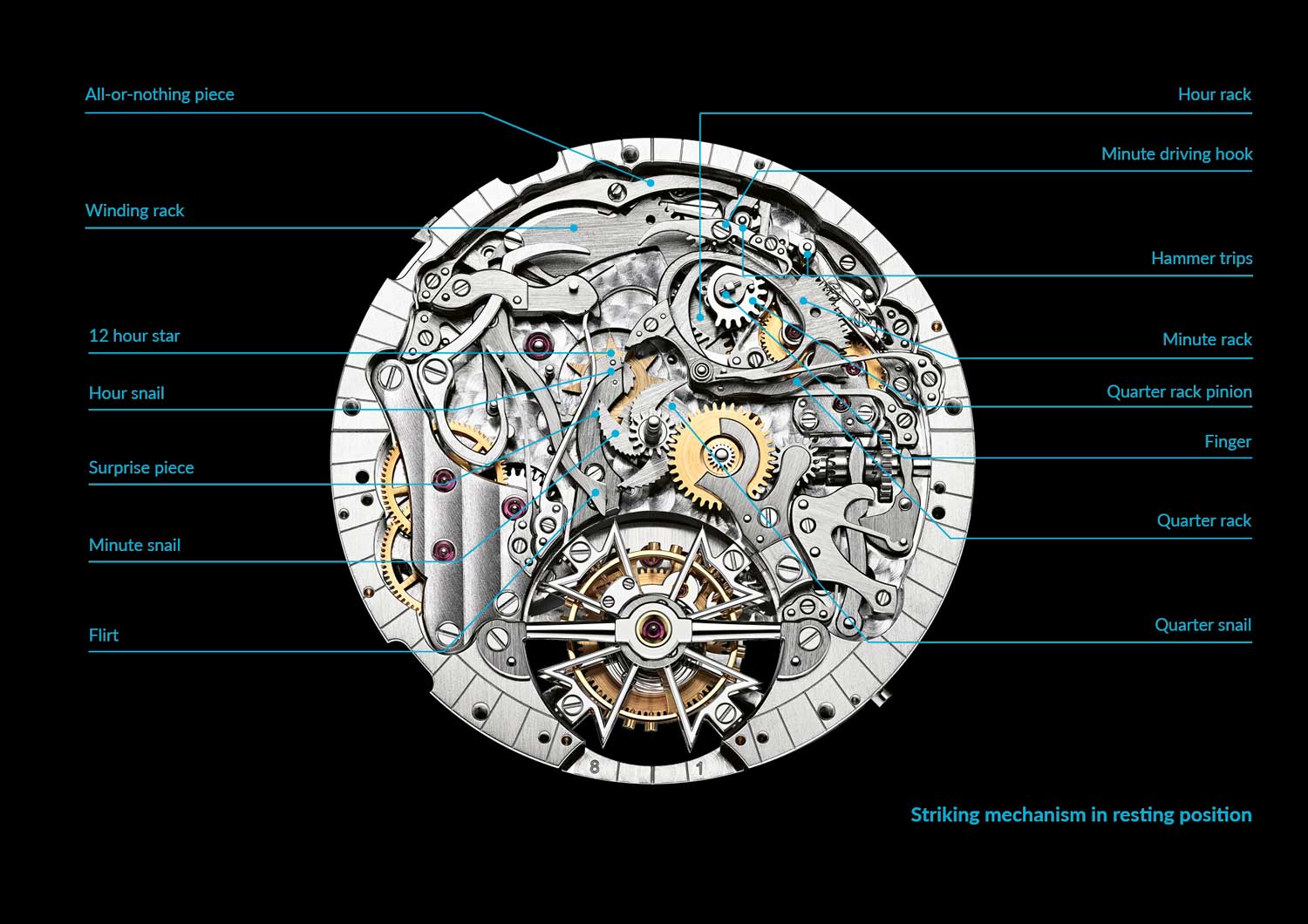
An example of a traditional minute repeater
In Lange’s repeater, the hour rack is of a different design. The hour, quarter, and minute racks are concentric and they all pivot on the same axis. The hour rack is no longer a circular rack and better resembles the other racks, featuring internal teeth on its hollow and is driven by a pinion on the repeater barrel arbour. The pinion moves the rack via internal teeth during winding and unwinding. The hour rack has a feeler on one end that directly interacts with the hour snail. In a traditional repeater, by contrast, the hour rack does not touch the snail at all; instead, the winding rack that winds the repeater barrel has a feeler attached to it that drops onto the snail. The hour rack is then moved simply because it is squared to the barrel arbour and its travel depends entirely on how far the barrel is allowed to unwind.

This is the striking mechanism in the Richard Lange Minute Repeater. The Minute Repeater Perpetual employs the same sophisticated rack design to reduce dead time
In Lange’s design, the hour rack itself reads the snail and determines its own range of motion. As the hour rack moves, it tensions a spring arm that links it to the quarter rack. This spring stores the energy needed to drive the quarter rack forward once it is released. In contrast to a typical repeater, the winding lever drives a train which winds the repeater barrel. (On the bridge side, the train jewels are visible before the repeater barrel.) To keep the sequence exact, there is also an all-or-nothing piece of a different design. It is a pivoting blocker that holds the quarter rack in place while the hour rack is tensioned. As the hour rack reaches its stop against the hour snail, it trips a pawl that pivots the blocker clear, releasing the quarter rack at exactly the right moment.
The quarter rack has four tooth gaps, which ensure that the hook pivoted on the hour rack can engage it at exactly the right position for the number of quarters to be struck. This direct mechanical link means that as soon as the hour strike finishes, the hour rack immediately picks up the quarter rack and drives it without delay.
The minute rack has 14 driving teeth instead of the usual five or seven so that the 15 flanks correspond precisely to the number of minutes to be struck. Likewise, these teeth are engaged by a hook pivoted on the quarter rack. This finer scale means the quarter rack can pick up the minute rack at exactly the right step, matching the minutes read from the snail.
When there are no quarters to be struck, the sequence stays just as controlled. The blocker still holds the quarter rack back until the hour rack reaches its stop on the snail. When the blocker pivots clear, the spring arm pulls the quarter rack forward for its feeler to settle onto the ‘zero’ step of the quarter snail. The hook on the hour rack still drops into the first tooth gap, keeping the link tight. As the hour strike finishes, this hook draws the quarter rack back with it, even though no quarter teeth engage so the motion flows straight into the minute strike without pause.
Another innovation addresses the risk of the hammer bouncing back and striking the gong a second time. When a repeater hammer hits a gong, the elasticity of the gong can cause the hammer to rebound. Traditionally, watchmakers rely on strong springs and careful tuning to keep the hammer from recoiling and re-hitting the gong, but that demands more space and greater force to tension the hammer each time.
Lange’s design instead uses a catch built into the pivot of the hammer. When the hammer swings back after striking the gong, a small spring-loaded lever rides along the edge of a restraining disk mounted on the hammer’s shaft. As the hammer returns to its resting position, the lever tip drops into a notch cut into the disk and locks in place, preventing the hammer from swinging forward again. A small nose on the disk and a locking lever coordinate this engagement so that the catch snaps in as the hammer swings back after impact, blocking any rebound forward. Importantly, this is not activated during a chiming sequence. As long as the hammer is being lifted and released for successive strikes, the restraining catch stays disengaged. Only when the final blow is delivered and the hammer fully returns does the notch align and the lever snap in to hold it at rest, preventing any stray rebound.
Actions by the user that might damage the mechanism are blocked by certain safety features. The repeater cannot be activated when the crown is pulled out and the crown cannot be pulled out when chiming is taking place.
The repeater barrel and fly governor are visible on the bridge side. The governor is mounted on the last pinion of the repeater train. At the end of each arm, there is a pivoted weight which is held near the centre by a spring. As the repeater train speeds up, centrifugal force moves the weights outwards, increasing the momentum until the arms come into contact with the inner wall of the housing. This slows the train until equilibrium is reached.

(Image: Revolution ©)
While the governor in the Richard Lange Minute Repeater had an upper bridge and jewel bearing to fully constrain the governor arbour at both ends, this has a flying governor which relies on a fixed pin with a jewel bearing only at the base so the governor spins around a single supported axis. It is more compact and the overhung pivot helps reduce any possible bearing noise. The springs are thinner as well.

(Image: Revolution ©)
The main bridge has a frosted finish instead of the customary ribbing. This is seen mainly on special editions like the 175th Anniversary and Handwerkskunst pieces. In fact, while its construction is traditional inasmuch as the layout is concerned (with the repeater gear train on the movement side and the strike works on the dial side), it remains an atypical calibre for Lange. The winding train, ratchet wheel and click, which are usually hidden beneath a three-quarter plate, are fully visible. Both the winding click and click spring are black polished while the ratchet has a double-band snailing.

The teeth on all the exposed wheels are bevelled and polished along their circumference. (Image: Revolution ©)
The repeater barrel cover and the top surface of its housing are also decorated with circular graining with a click that is black polished as well. The housing for the governor is secured to the mainplate with three screws and incorporates an internal angle. The usual details that make Lange calibres visually rich are all present including gold chatons for the jewel bearings, a hand-engraved balance cock supporting the free-sprung balance, along with a finely-shaped swan’s neck for adjusting beat error.
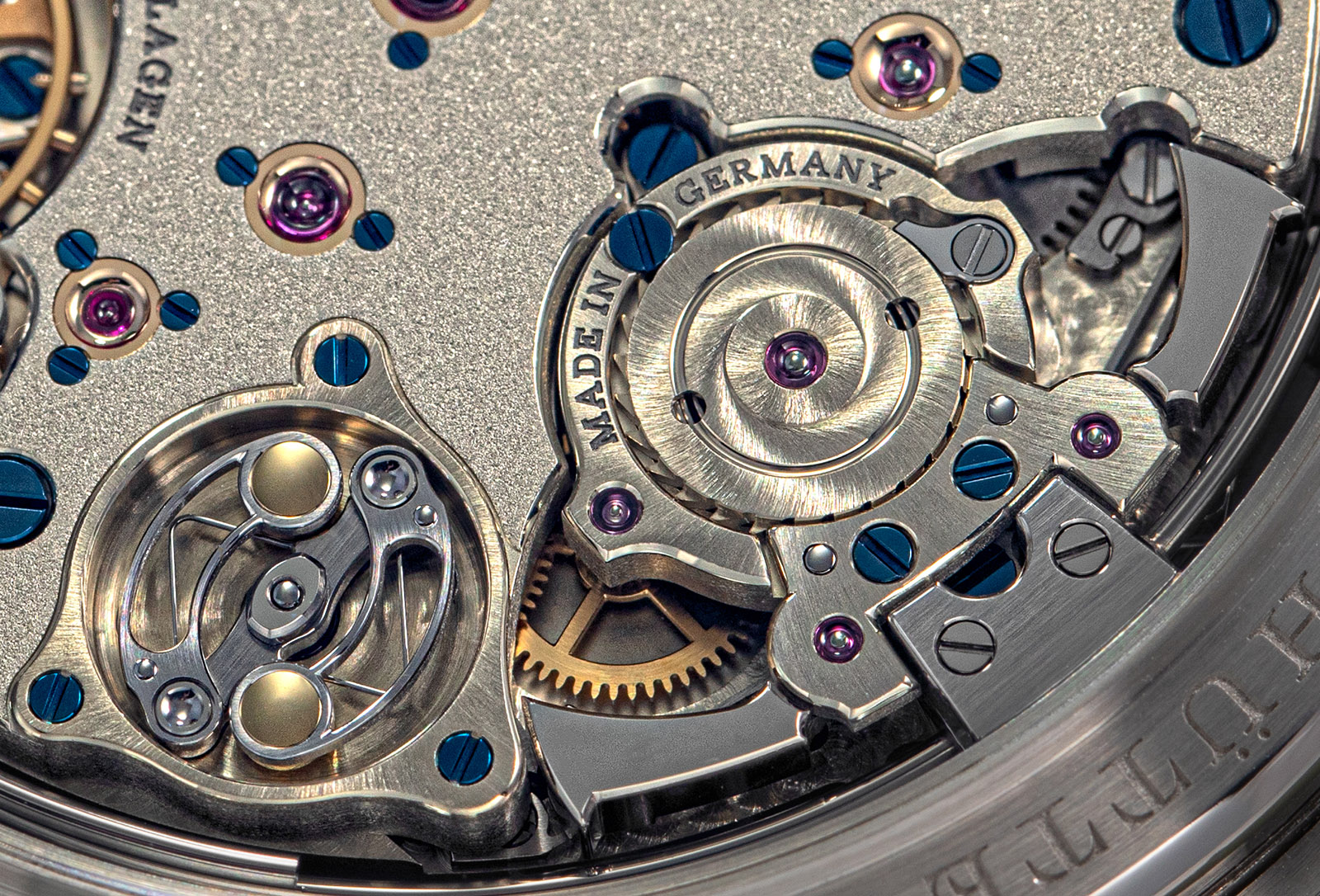
(Image: Revolution ©)
In all, the Minute Repeater Perpetual is exactly what one would expect from Lange at its uncompromising best. It is technically impressive, exceedingly beautiful and surprisingly compact for a high complication from Lange, with practical improvements where possible, such as water resistance while still retaining remarkable colour and clarity in its chimes.
Tech Specs: A. Lange & Söhne Minute Repeater Perpetual
Reference: Ref. 607.091FE
Movement: Manual-winding Lange manufacture calibre L122.2; 72-hour power reserve; 3Hz or 21,600 vph
Functions: Hours and minutes; small seconds with stop seconds; minute repeater striking mechanism; perpetual calendar displaying outsized date window, day, month, leap year, moon phases; 24-hour display
Case: 40.5mm x 12.1mm; 950 platinum case; water-resistant to 20m
Dial: 4-part 18K gold dial finished with black enamel
Strap: Hand-stitched black alligator strap with 950 platinum deployant clasp
Availability: Limited to 50 pieces
Price: €715,000
A. Lange & Söhne

You may also like
News
A. Lange & Söhne Launches Two New Saxonia Thin Special Editions
Oct 4, 2025
News
A. Lange & Söhne Launches Two New Saxonia Thin Special Editions
Oct 4, 2025
News
A. Lange & Söhne Unveils Richard Lange Jumping Seconds And 1815 Tourbillon At Hampton Court Palace
Sep 5, 2025
News
A. Lange & Söhne Unveils Richard Lange Jumping Seconds And 1815 Tourbillon At Hampton Court Palace
Sep 5, 2025
Reviews
A Closer Look: A. Lange & Söhne Zeitwerk Date in Pink Gold
Jul 25, 2025
Reviews
A Closer Look: A. Lange & Söhne Zeitwerk Date in Pink Gold
Jul 25, 2025