



Inside The Bovet Récital 22 Grand Récital And Récital 28 Prowess 1
Technical
Inside The Bovet Récital 22 Grand Récital And Récital 28 Prowess 1

Even within the realm of independent watchmaking, where individual visions of horology are the rule rather than the exception, Bovet is a watchmaker apart. Pascal Raffy is not only the owner of Bovet but is also deeply involved in both the creative and technical direction of the brand. While many independent brands are led by watchmakers, it’s far less common for a non-watchmaker to play such an active role in the development of complications. The fact that numerous patents are filed in his name is especially impressive, which shows his direct hand in shaping Bovet’s innovations.
The two principal collections, the Bovet Fleurier and Dimier, reflect two distinct expressions of the brand’s identity and are dramatically different from anything any other company or watchmaker produces. The Fleurier watches are the spiritual descendants of Bovet’s 19th-century pocket watches. They are characterized by the brand’s signature bow and crown at 12 o’clock, echoing the pocket watches that defined Bovet’s early history. Many of them incorporate the patented Amadeo system, which allows the timepiece to be transformed from wristwatch to pocket watch or table clock without the need for any tools. In general, they tend to favor symmetry, but there are also highly ornate pieces with skeletonization and hand engraving.

Mr. Pascal Raffy, CEO of Bovet
In contrast, the Dimier-cased Récital collection is Bovet at its most mechanically theatrical. The defining feature is the sloped case, inspired by an antique writing desk — thicker at the top and thinner at the bottom — designed to enhance legibility and to present the movement like a stage. This format allows complications to be executed in three dimensions, giving the Récital watches a distinctive sense of depth. This is where Bovet explores the grandest ideas. They are wrist-worn theater, each one conceived as a “recital” in the literal sense where complications are the “actors,” the incline is the stage and the wearer, the audience. They are a reminder that mechanics, when taken seriously enough, can become art.
This philosophy finds its fullest expression in the Récital 22 Grand Récital and the Récital 28 Prowess 1 — two towering achievements that demonstrate the breadth of Bovet’s technical ambition and singular vision of what haute horlogerie can be. They seem to not only solve very complex problems, but also invite new ways of thinking about what mechanics can articulate. One is rooted in celestial order, the other confronts terrestrial complexity.
Récital 22 Grand Récital
The Bovet Récital 22 Grand Récital is one of the most ambitious watches the brand has ever created, combining a retrograde perpetual calendar, a tellurium and a double-sided flying tourbillon. The watch was launched in 2018 and swiftly took home the Aiguille d’Or at the Grand Prix d’Horlogerie de Genève (GPHG) that year.

Bovet Récital 22 Grand Récital (Image: Revolution ©)
The case measures 46.3mm in diameter and 19.6mm at its highest point. This is by no means a small watch, but as with Bovet watches in general, size tends to be a feature rather than a flaw. Thanks to the sheer size of the watch, a lengthy power reserve of nine days can be achieved using a single large barrel.
How does the tellurium display Earth, Moon, and Sun?
While there is a general tendency for enthusiasts to describe movements as being miniature cities, with the Récital 22 Grand Récital, this is less of a metaphor. The movement is unapologetically three dimensional. At the heart of the watch is a tellurium, a type of orrery which displays the relative positions of the Earth, Moon and Sun. The Earth takes center stage in the watch, represented by a hand-painted hemispherical dome that rotates once every 24 hours. Depicting a top-down view of the Northern Hemisphere, the hand-painted dome presents the continents encircling the Arctic, rendered in soft gradients of green, ochre and pale yellow. The oceans are rendered in deep blue, veiled with fine white strokes that suggest drifting cloud cover. Though entirely pictorial, the treatment evokes the impression of a living planet suspended in motion. Super-LumiNova is mixed into the pigments used for the land masses, creating one of the most mesmerizing nighttime displays ever seen on a wristwatch.

Luminous pigments are mixed into the paint, allowing the entire scene to glow in the dark. In a nod to celestial realism, only the side of the Moon facing the Sun is treated with lume, while a cam-guided compensation system ensures that this illuminated face constantly shifts to remain oriented toward the Sun (Image: Revolution ©)
Around the dome is a spherical Moon that completes one revolution around the Earth every synodic month (29.53 days) while the Sun is represented by a flying tourbillon. The spherical Moon has a light half and dark half to simulate the illuminated and shadowed sides. The light side is also painted with Super-LumiNova. Notably — and this is where the ingenuity of the tellurium lies — it produces a faithful simulation of the Moon’s apparent behavior as seen from Earth.
Because the Moon is tidally locked to the Earth, it rotates on its own axis at the same rate that it orbits the Earth. As a result, the same hemisphere of the Moon always faces the Earth. At the same time, the Sun continuously illuminates half of the Moon — whichever half is facing the Sun at any given time — while the other half remains in darkness. The boundary between light and dark on the Moon is called the terminator. As the Moon orbits the Earth, the angle between the Earth, Moon and Sun changes, and so does the portion of the illuminated half that is visible from Earth. This changing view of the sunlit portion is what creates the lunar phases.

The cam-guided system pivots the Moon sphere to faithfully replicate lunar phases as seen from Earth
To replicate this natural phenomenon, the Moon sphere in the watch is guided by a compensation system that subtly pivots it as it orbits the Earth, ensuring that the dark hemisphere consistently faces the Earth dome, while the light hemisphere faces the Sun, symbolized by the tourbillon. Interestingly, this compensation system is not a differential but a cam-guided mechanism.
The Moon is mounted on a shaft, which passes through a rotating ring that completes one revolution in 29.53 days. Affixed to the opposite end of this shaft is a plate carrying two eccentric fingers. These fingers are offset from the central axis of the shaft and are designed to track within closed grooves cut into a plate, which is secured to the movement. As the Moon rotating ring completes its orbit around the Earth cap over the course of 29.53 days, the motion of the fingers along the shaped grooves causes the shaft and, therefore, the Moon to pivot gradually. The geometry of the grooves ensures that the Moon’s orientation remains fixed relative to the Sun.

At the heart of the watch is a tellurium, featuring a hand-painted hemisphere of the Earth as its centerpiece (Image: Revolution ©)
The position of the spherical Moon relative to the Earth and the fixed Sun represented by the flying tourbillon provides an intuitive sense of the current lunar phase. For added clarity, a printed scale encircling the Earth provides labeled markers for each phase. The hour is indicated by a 24-hour rotating ring positioned around the Earth cap, with a fixed luminous pointer showing the current hour against the numerals printed on the ring. A retrograde minute display sits to the left and a power reserve indicator to the right.
How does Bovet’s double-sided flying tourbillon work?
At 6 o’clock is Bovet’s signature double-sided flying tourbillon. Unlike a conventional flying tourbillon that is cantilevered from below and typically supports both the escapement and balance on a single platform, Bovet’s construction is both structurally and visually distinct. The escapement is mounted on the underside of the rotating cage, while the balance wheel is located on the upper side, facing the dial. These are joined by a long balance staff running through the hollow central axis of the cage, which in turn rotates around a central ball bearing positioned between the two platforms. This ball bearing supports the entire cage assembly and enables smooth rotation with minimal friction, replacing the traditional lower pivot or peripheral roller supports altogether. Additionally, the tourbillon cage is made of titanium for lightness and gold plated to represent the Sun. Its rays are beautifully rounded and polished, while a diamond end stone at its center adds a brilliant focal point.
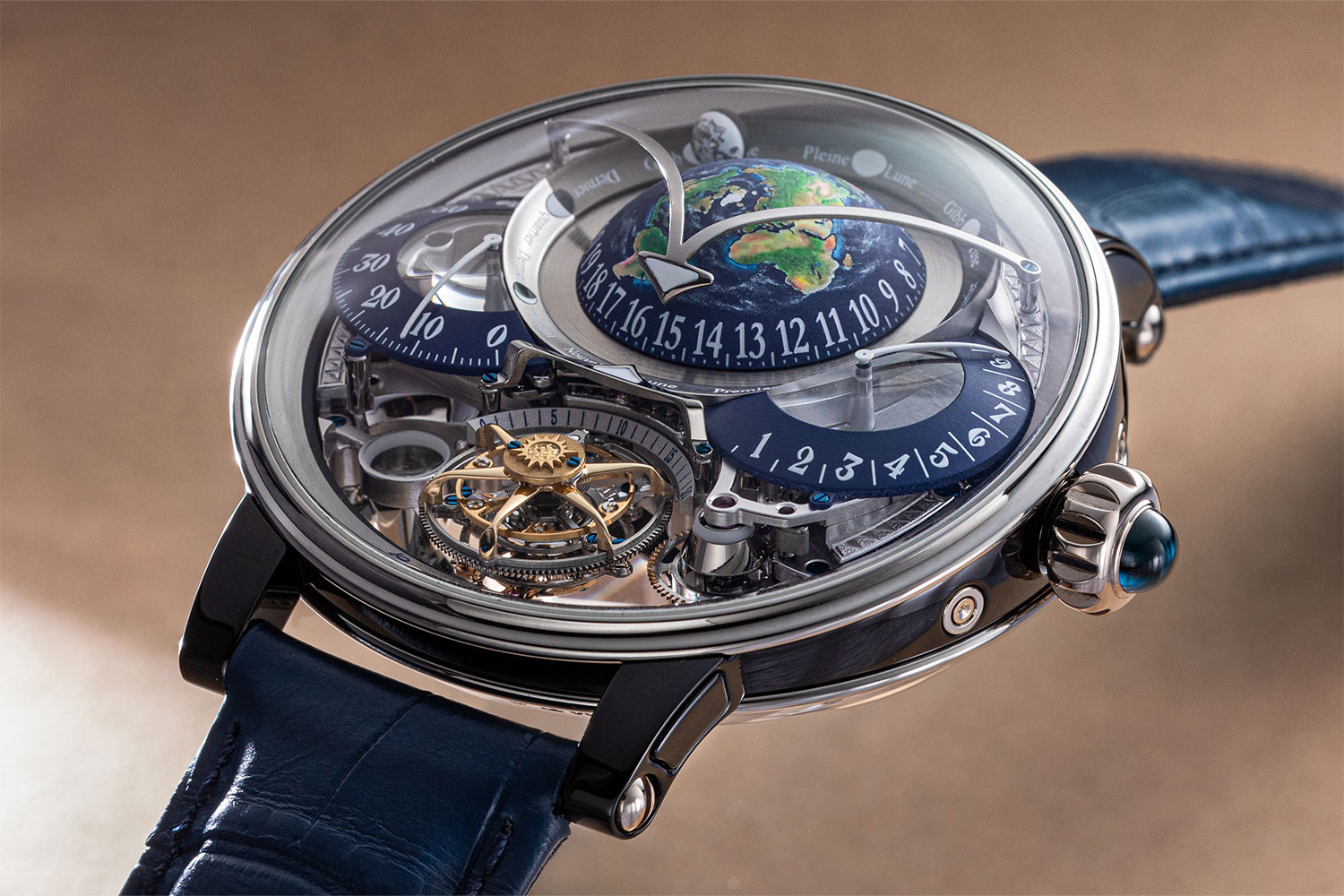
A titanium, gold-plated cage with no upper or lower bridge showcases both escapement and balance in dramatic 3D (Image: Revolution ©)
With no upper or lower bridge obscuring the view, both the escapement and the balance are fully exposed, visible through separate sapphire crystals on the front and back of the case. At the same time, the tourbillon cage is driven on its periphery by the last wheel in the going train rather than a pinion beneath the cage. The result is a visually dramatic tourbillon that appears to float on both sides while remaining robust.
On the right of the tourbillon is a differential screw for the power reserve indicator. Power reserve differentials are usually planar and visually underwhelming. Bovet, however, has chosen a more traditional and three-dimensional cone-and-feeler system instead of a planetary gearset. Here, the mechanism takes the form of a threaded cone that is traced by a feeler arm. As the barrel winds and unwinds, the cone is driven up and down the threads of a vertical screw, moving the feeler through its slope. This vertical travel is translated into the arc of the power reserve hand. While conceptually simple, the three-dimensional execution is striking and in keeping with Bovet’s philosophy of turning even auxiliary functions into mechanical theater.

The far left is a retrograde minute display, balanced on the right by a power reserve indicator, while Bovet’s signature double-sided flying tourbillon, which doubles as the Sun, occupies the six o’clock position (Image: Revolution ©)
On the left of the tourbillon is a date window with a magnifying lens. The date disk carries numbers from 1 to 31 on both sides so that the date display can be shown on both the front and back of the watch. These numbers are not mirrored or superimposed but offset on the disk. The disk is mounted centrally and driven in one direction — counterclockwise on the dial side, which when seen from the back, appears as clockwise. This allows a single rotation mechanism to serve both displays. The drive system is retrograde, meaning the disk snaps back to “1” after reaching “31.” Because the disk is located closer to the back of the movement, a magnifying glass is mounted over a viewing window to make the date readable from the front.
What is special about the power reserve and calendar system?
The perpetual calendar is of a traditional design, relying on a grand lever and a 12-month program wheel with Maltese cross satellite to manage the month of February. However, it has been reengineered for both spatial efficiency and user convenience. The calendar indications — date, day, month, leap year and moonphase — are arranged across both faces of the watch, but driven from a unified gear train linked to a 24-hour wheel. Correction is handled through a sophisticated system of quick-setting levers. Each indication has its own recessed pusher, allowing for independent adjustment. However, the corrector for the date is linked to the day of the week, so the two advance together. A central correction pusher activates an extended control lever that simultaneously advances the date, day of the week and moonphase — the three indications that follow a daily cycle. The month is adjusted separately via its own corrector, preserving flexibility while streamlining the most frequent calendar corrections.
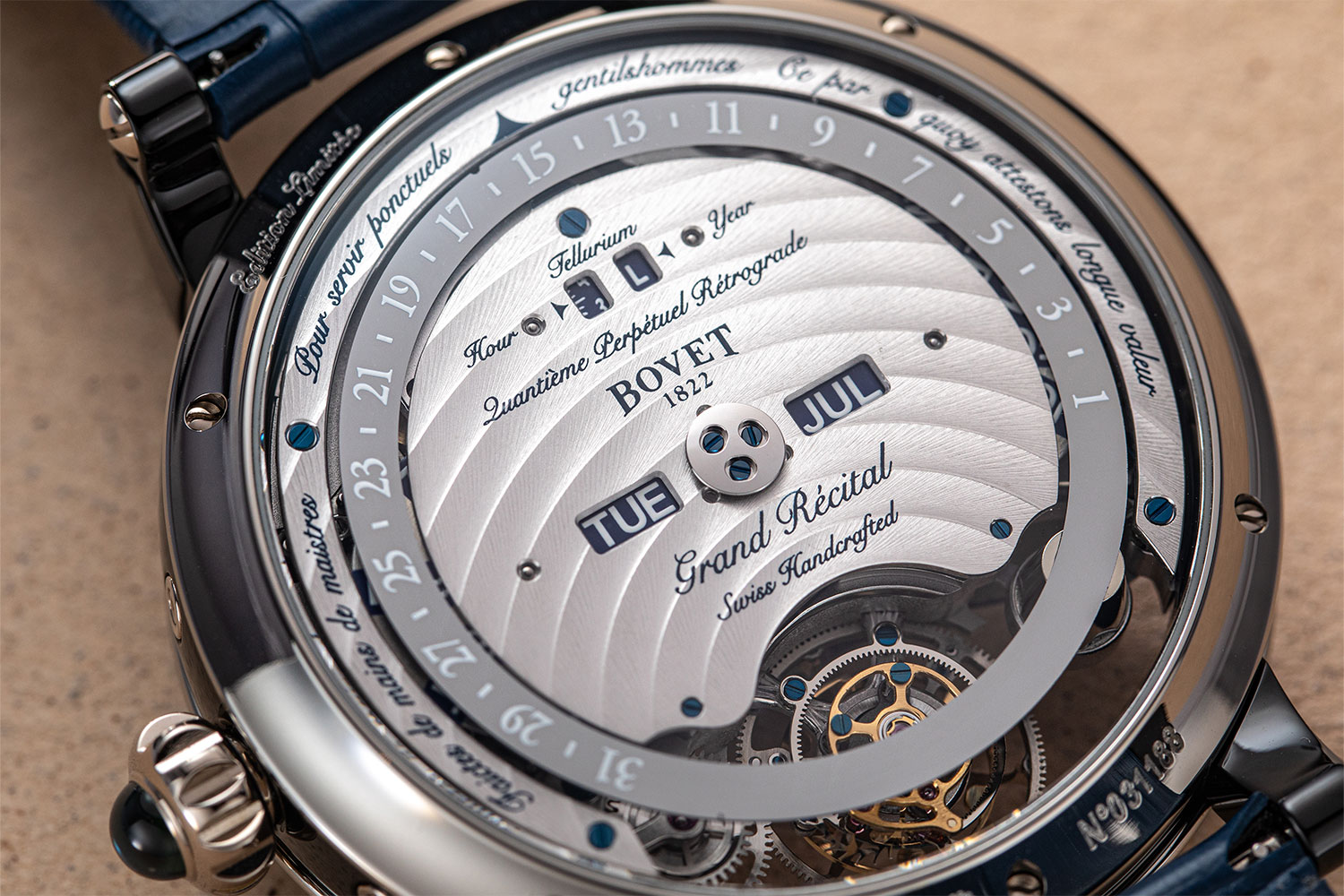
(Image: Revolution ©)
At its core, the Bovet Récital 22 Grand Récital is the celebration of the movement as both a visual and technical tour de force. In an era where complexity is often pursued for its own sake, this is a watch that uses complication to convey beauty, structure and meaning. It rewards curiosity and attention and, in that sense, it comes across not just as a feat of watchmaking but as an argument for why such feats still matter.
Tech Specs: Bovet Récital 22 Grand Récital
Movement: Manual winding Caliber 17DM03-TEL; nine-day power reserve
Functions: Hours (24H); retrograde minutes; seconds on flying tourbillon; tellurium (orrery) functions with the Sun (symbolized by tourbillon); hemispherical Earth and spherical moonphase; perpetual calendar with retrograde date (both sides), day, month and leap year indicators; reversed hours indicator
Case: 46.3mm × 19.6mm; Grade 5 titanium, 950 platinum or 18K red gold; water resistant to 30m
Dial: Blue lacquered with hand-painted miniature scenes and luminescent coating
Strap: Double-face full skin alligator with pin buckle in matching metal
Price: CHF 520,000 for titanium, CHF 561,600 for 18K red gold and CHF 591,600 for platinum (excl. VAT)
Availability: 60 pieces in total
Récital 28 Prowess 1
If the Grand Récital is Bovet’s most expansive and poetic expression of time, the Récital 28 Prowess 1 is its most focused and uncompromising. It confronts a problem that horology has, for the most part, politely sidestepped — a global fully mechanical reckoning with Daylight Saving Time (DST). It is the first watch that displays DST around the world simultaneously. It is an extraordinary breakthrough, a feat of horological stubbornness in the best possible sense, which rightfully earned it the Mechanical Exception award at the GPHG last year.
What makes Daylight Saving Time such a challenge for watchmakers?
Daylight Saving Time was introduced during the First World War as a way to extend daylight hours and reduce reliance on artificial lighting. Though conceived as a practical adjustment to human schedules, it introduced a layer of artificiality into global timekeeping that has proven troublesome ever since. Not all countries observe DST, and among those that do, the rules vary. Even within regions that do observe it, such as Europe and North America, the transition dates are not synchronized. Some begin in March, others at the end of March; some end in October, others in November. As a result, the time difference between cities can shift seasonally, depending on the specific DST rules in effect.

Bovet Récital 28 Prowess 1 (Image: Revolution ©)
This inconsistency is particularly vexing for world time watches, which traditionally display 24 time zones using a rotating 24-hour ring against a disk of printed reference cities. This design, derived from the classic Louis Cottier system of the 1930s, assume static offsets but DST renders those offsets dynamic. For nearly half a year, many of the cities on a world time dial are effectively displaying the wrong time. A simple workaround is to print the names of cities affected by DST in a different color, but such compromises highlight the problem more than they resolve it.
One notable solution comes from the Glashütte Original Senator Cosmopolite, a dual time watch that allows selection from all 37 time zones, including those with non-standard offsets. It accounts for Daylight Saving Time by displaying the airport code of a selected city in either a DST or Standard Time window. The change is handled mechanically when adjusting the time zone. Though clever, it is not a world timer and offers a DST solution only for the selected zone.
How does Bovet’s roller system redefine the world time complication?
The Récital 28 Prowess 1 is unusual in that it meets the problem in a world time watch directly. Rather than simplifying it away, it builds a mechanism complex enough to match it. It supports four main time systems — Co-ordinated Universal Time (UTC), American Summer Time (AST), European and American Summer Time (EAS) or European Winter Time (EWT). These modes allow the mechanism to account for the fact that some cities are affected by DST, while others aren’t, and how daylight saving transitions occur at different times in different regions. Crucially, this mechanism ensures that the reference cities on the dial are always aligned with their real-world time status, something no other mechanical world timer has achieved.

The time system is displayed on a small roller at 8 o’clock. Pressing the crown cycles through four time systems, prompting all 24 city rollers to rotate 90 degrees in unison to reveal the correct cities for that setting, making this the first world time watch to account for DST across the globe mechanically (Image: Revolution ©)
It replaces the city disk of a traditional world timer with 24 rotating rollers, each representing a major city in a different time zone. Each roller has four faces and can be rotated in 90-degree increments to present one of four city names, depending on the selected DST system. For instance, when switching from Standard Time to American Summer Time in March, Las Vegas rotates off its initial roller at 6:00 and is replaced by Anchorage. Simultaneously, Las Vegas reappears on the next roller at 7:00 to reflect its new effective offset under DST. At the same time, Halifax, which occupies 10:00 in the Standard Time configuration, for instance, disappears entirely when the watch transitions to American Summer Time. Meanwhile, Gambier appears for the first time at 5:00, a position previously occupied by Anchorage. Because only 24 cities are shown at any given moment, the system dynamically substitutes cities to occupy a given position as needed.
At any given moment, the user can press the crown to cycle between the four time systems displayed on a small roller at 8 o’clock. When the time system is changed, all 24 rollers rotate simultaneously by 90 degrees to reveal the correct city names for the selected system. The rollers themselves remain stationary during normal timekeeping; it is the 24-hour disk that rotates continuously to indicate local time. The rollers only advance when the pusher is pressed to select a new time system, at which point all 24 rotate simultaneously to reveal the appropriate city names for the new configuration. Allowing the 24-hour disk to rotate while the rollers remain static until a DST system change results in a more stable and energy-efficient mechanism. By sparing the rollers from constant movement, legibility is maintained and unnecessary wear can be avoided.

Twenty-four city rollers rotate in sync to always display correct local times under different DST regimes (Image: Revolution ©)
The underlying mechanism involves a huge central gear with two sets of teeth — radial toothing at the lower periphery and a conical toothing angled upward from it. The two toothing are contiguous, forming a continuous three-dimensional set of teeth. The conical teeth enable it to drive a ring of horizontal pinions, each of which is connected to a roller. As the gear rotates, it advances all 24 rollers simultaneously by 90 degrees, shifting them to display the appropriate set of cities according to the selected time system. At the same time, the radial teeth enable the wheel to be driven by the selector train.
How does the perpetual calendar in the Prowess 1 work?
More than that, the Récital 28 Prowess 1 is also a perpetual calendar with a date and month displayed on rollers located on either side of the flying tourbillon at 12 o’clock. The leap year cycle is indicated on a smaller roller above the month display. Notably, the date is a retrograde display which snaps back to its starting position at the end of each cycle. Because it is a roller drum rather than a lightweight hand or disk, the retrograde motion must overcome far greater inertia. Accelerating and halting such a mass with precision requires not only a strong return force but also careful control to prevent rebound or shock.

The roller-based system extends to the perpetual calendar, with the date, month, and leap year shown on rollers flanking the flying tourbillon at 12 o’clock (Image: Revolution ©)
In a traditional rack sector and spring setup, the return force is applied through a rotational pivot, which can struggle to accelerate and stop a large, heavy display element cleanly. To manage this, Bovet developed a rectilinear rack mechanism with a helical spring, visible at 12 o’clock on the movement side. This achieves not only a more compact footprint but also provides a more consistent and forceful return stroke.
The rack is progressively driven forward along a rectilinear guide path as the date advances day by day, loading the helical spring in the process. At the end of the month, the date mechanism disengages, allowing the spring to release its energy and rapidly drive the rack back to its starting position. To ensure a controlled return, the system includes a dampening mechanism that gently arrests the roller, avoiding any jarring impact.

A single oversized mainspring barrel powers all complications, from the world timer to perpetual calendar (Image: Revolution ©)
Crucially, the rack also carries a retractable actuating finger, which interacts with the month star. As the rack moves forward over the course of the month, the finger encounters the pointed tips of the 12-toothed month star. Rather than catching on them, it pivots backward against the force of a return spring, allowing it to ride smoothly over each tooth without advancing the wheel. When the rack snaps back during the retrograde return, the finger is held in its extended position by the spring and it pushes the tooth forward by one step, which drives the month roller forward by one increment.
All perpetual calendar indications are adjusted individually through pushers recessed into the caseband. A safety device was developed so that the perpetual calendar cannot be corrected during the dead zone when the indications are in the process of changing.

(Image: Revolution ©)
The rest of the perpetual calendar mechanism is also visible on the reverse, where the movement is extensively openworked. The bridges are hand engraved and finished to a high standard, with numerous sharp internal angles, particularly across the barrel bridge. A power reserve indicator at 9 o’clock tracks the countdown of its impressive 10-day autonomy. Remarkably, this is achieved with a single oversized mainspring barrel, which drives all of the energy-intensive complications, including the double-sided flying tourbillon. In this scenario, due to the calendar mechanism on the top plate, the tourbillon is only visible on the dial side, which draws greater focus to its unusual construction. As the escape wheel is located on the lower platform of the cage, the balance appears to be oscillating freely under a blued three-arm upper cage.

(Image: Revolution ©)
Due to its roller-based indications, the Récital 28 Prowess 1 has a kind of engineered brutality, a machine-celebratory beauty that’s the result of a problem taken seriously and pursued to an unapologetically mechanical conclusion. It simply does what no watch has done before and does so with the logic and relentlessness of pure mechanics.
Taken together, both watches demonstrate Bovet’s capacity to engineer solutions to meet very different demands of time in the heavens and on earth. One enchants through its evocation of cosmic order, and the other is sobering in its confrontation with the complexities of human timekeeping. Between them lies a philosophical tension and an argument for the continued relevance of mechanical watchmaking in making sense of both.
Tech Specs: Bovet Récital 28 Prowess 1
Movement: Manual winding Caliber R28-70-00X; 10-day power reserve
Functions: Hours and minutes; seconds on flying tourbillon; world time on rollers with UTC, American Summer Time, European and American Summer Time and European Winter Time; perpetual calendar with rollers for date (retrograde), month, and leap year, disk for the day
Case: 46.3mm × 17.85mm; Grade 5 titanium, 950 platinum or 18K red gold; water resistant to 30m
Dial: Inner and outer ring in aventurine; rollers in black PVD
Strap: Double-face full skin alligator with folding buckle in matching metal
Availability: 60 pieces in total
Price: CHF 650,000 for titanium, CHF 686,000 for 18K red gold; CHF 716,000 for platinum (excluding VAT)
Bovet

You may also like

News
Introducing the Bovet Récital 12 with Malachite and Tiger’s Eye Dials
Aug 22, 2025
News
Introducing the Bovet Récital 12 with Malachite and Tiger’s Eye Dials
Aug 22, 2025

News
Bovet Celebrates 10 Years of the 19Thirty with Three Stripped Back Dials
Jun 16, 2025
News
Bovet Celebrates 10 Years of the 19Thirty with Three Stripped Back Dials
Jun 16, 2025

News
Introducing The Bovet 1822 Range
Aug 31, 2021
News
Introducing The Bovet 1822 Range
Aug 31, 2021