


This May Be the Best Audemars Piguet Royal Oak Perpetual Calendar Yet
News
This May Be the Best Audemars Piguet Royal Oak Perpetual Calendar Yet

At the risk of sounding emotionally fragile … OK, who am I kidding? Anyone that’s ever sat next to me on a plane knows that as soon as I start watching any movie featuring a dog, I start crying uncontrollably … The truth is that I can’t stand good-byes. I’ve always hated them. That’s why at farewell parties I always enact my signature “French exit,” meaning that I head straight for the door. No hugging. No kissing. No bumping of fists. No adieu. Not even a backward glance, lest I become overwhelmed with emotion. Because, while I might not be the most popular guy in the world, I take my friendships very seriously. It was for this reason I turned down Audemars Piguet’s invite to the launch of its Travis Scott watch in late 2023. Because how was I supposed to attend the final soaring, totemic, La Bohème-like exit aria for François-Henry Bennahmias — one of our industry’s greatest leaders and an even greater friend — and not end up an emotional wreck?
Yet this was precisely the scenario I found myself confronted by one year ago at the AP Social House event in Milan. I recall muttering to myself as I held back my tears, “Goddamn it, AP, why didn’t you prepare me for this?” Even as we celebrated Audemars Piguet’s collaboration with its newly anointed Creative Conduit, John Mayer, I realized that actually the brand was throwing a farewell party for one my best friends, the Caliber 5134. Yes, John Mayer’s watch with its colossal “Crystal Sky” dial is — as William Miller described Russell Hammond’s guitar sound in the film Almost Famous — “incendiary.” But I found myself later in my hotel room with my eyes tearing and my hands shaking as I experienced what Marcel Proust describes as an “involuntary flood of memories” that had me weeping worse than watching Hachiko for the first time.

Audemars Piguet Royal Oak Perpetual Calendar "John Mayer"
The Era-Defining AP Perpetual Calendars
Is it normal for a grown man to get so emotional about a watch caliber? Well, the Caliber 5134 was much more than a caliber. Introduced in 2015, it was the engine featured inside THE timepiece that introduced contemporary culture to the complicated watch. It was the movement inside the most sought-after modern timepieces of the last decade — the black ceramic Reference 26579CE, the black ceramic openworked Ref. 26585CE, the white ceramic Ref. 26579CB and the blue ceramic Ref. 26579CS. That’s right, the Audemars Piguet Royal Oak Perpetual Calendar with its signature week indicator was the timepiece that seduced a whole new generation of watch collectors and made complications relevant to an all-new demographic of celebrity clientele, including Jay-Z, Kevin Hart, Ed Sheeran and Travis Scott, who selected the Caliber 5134 as the base for his “Cactus Jack” collaboration with Audemars Piguet. And of course, there is the Creative Conduit himself, Mister John Mayer.
Says Audemars Piguet’s CEO, Ilaria Resta, “Many new clients are entering our brand because of the perpetual calendar and its popularity, which makes us unique in the world of high watchmaking.” She’s right.

Audemars Piguet Caliber 5134

From left: Audemars Piguet Royal Oak Perpetual Calendar Black Ceramic Ref. 26579CE; Black Ceramic Openworked Ref. 26585CE; White Ceramic Ref. 26579CB and Blue Ceramic Ref. 26579CS

The Royal Oak Perpetual Calendar Openworked “Cactus Jack” Limited Edition is crafted in brown ceramic
But more than that, the cultural significance and technical authenticity of AP’s perpetual calendar is massive. To paraphrase the great American poet Walt Whitman, it is large and it contains multitudes … The Audemars Piguet perpetual calendar began its revolutionary run conquering popular culture a full 47 years ago when the Caliber 2120/2800 was conceived as a project to rescue AP from the ravages of the Quartz Crisis that had decimated the Swiss watch industry and wiped out two thirds of its workforce.
Operating like a unit of resistance fighters within the manufacture, three watchmakers named Michel Rochat, Jean-Daniel Golay and Wilfred Berney worked in secret to create the world’s thinnest automatic perpetual calendar movement amid the onslaught of inexpensive electronic timepieces. The resulting watch, the magnificent Ref. 5548, was the first significant counteroffensive for mechanical watchmaking and single-handedly paved the way for the resurgence of Swiss haute horlogerie.
Says Michael Friedman, former historian and head of complications at Audemars Piguet, “Think about it. In the context of 1978, no one was making complicated watches, let alone perpetual calendars. In fact, the only other brand that had made a serially produced perpetual calendar wristwatch up until this point was Patek Philippe. Their watch at the time was the Reference 3448 (launched in 1961), a round ‘Disco Volante’ shaped watch that was 37 mm in diameter and 11 mm in thickness. Then we unveiled the Reference 5548, that was significantly thinner at 7 mm. It was such an audacious watch. Because it was saying to the world that was being swept up by the quartz craze, ‘Hang on, look what we are capable of with mechanical watchmaking.’ In the size of a quartz watch, we placed a mechanical supercomputer. And because of the lean elegant dimensions of the 5548, it became a symbol of modernity like the Royal Oak before it.”
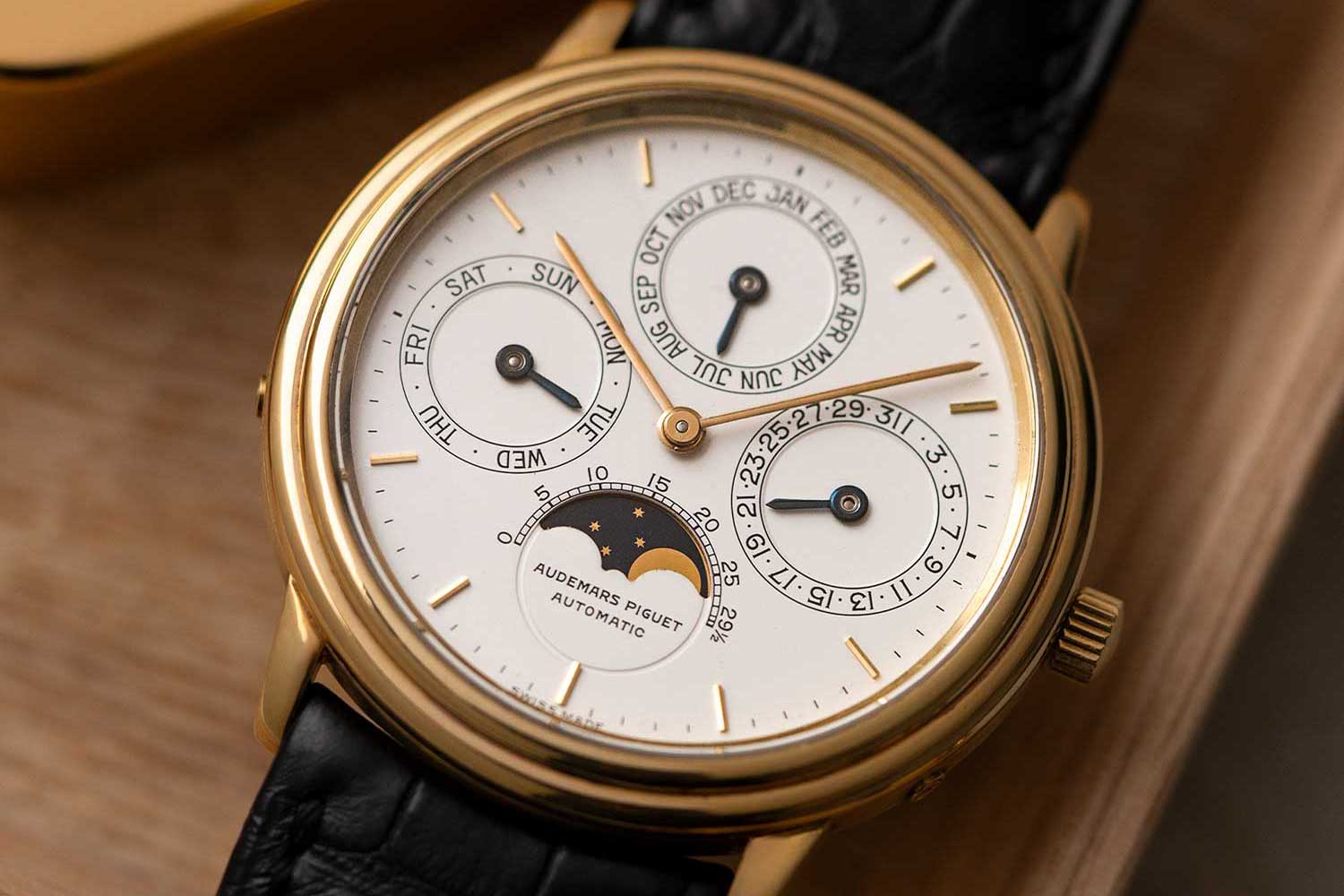
The Audemars Piguet Perpetual Calendar ref. 5548 was unveiled in the midst of the quartz maelstrom. It is clear that Dimier and the trio of Rochat, Golay and Berney wanted their watch to be a statement of what mechanical watchmaking was capable of. Here in a case the size of its quartz competition was a mechanical masterpiece that would never age, become obsolete or require a battery change, capable of telling all calendar information in perpetuity.; the watch seen here is presently the property of the Pygmalion Gallery's private collection (Image: Photo and watch, property of Pygmalion Gallery)
Read: The Complete History of the Audemars Piguet Royal Oak Perpetual Calendar
In 1984, that watch movement found its perfect home in the ravishing formed art shape of the Royal Oak case and, for the first time, a perpetual calendar became the epicenter of all that was thrilling and modern in contemporary culture. The Royal Oak Perpetual Calendar became an instant icon. It represented the union of the two most revolutionary watchmaking acts of Audemars Piguet — the iconoclastic Royal Oak and the world’s thinnest automatic perpetual calendar movement, the 2120/2800.

The ultra-thin cal. 2120/2800 was first made in 1967, measuring in at an unimaginable 28mm diameter and 3.95mm thickness
In 2015, the Reference 26574 featuring the Caliber 5134 marked the first major advancement of the legendary Audemars Piguet Perpetual Calendar housed inside an all-new case that measured 41mm in diameter as opposed to the traditional 39mm. Rather than 3.95mm, the movement is now 4.31mm thick. Why? Because of the addition of a week indicator. AP, however, did a great job in ensuring that the case of this watch was only marginally thicker at 9.5 mm as opposed to the 9.3mm of its predecessor. 2017 marked the year when the manufacture unveiled the all-ceramic perpetual calendar Reference 26579CE.

The Royal Oak Perpetual Calendar Ref. 26574ST in steel with a blue dial (left) and Royal Oak Perpetual Calendar in black ceramic Ref. 26579CE
Incredibly, every single part of the watch was brushed and polished to the high standards of AP, making it remarkably distinct from the majority of ceramic tool watches on the market. This was the watch that, for the first time, fixed the normally cerebral perpetual calendar permanently in the epicenter of all that was cool. It also attracted a whole new clientele — collectors who liked the fresh injection of modernity to the watch. At the same time, it managed to strike a chord with serious horophiles — yes, including one Creative Conduit, Mister John Mayer — and, as a result, the limited production timepiece became one of the hottest commodities in the world. Which brings us back to Milan last year, with me softly sobbing in the corner of AP Social House at the departure of one of my all-time favorite watch movements.
Alone in my hotel room, I bellowed at the heavens whilst rending my chest, “Why, dear Lord, had AP decided to stop making my beloved Caliber 5134? It’s just not fair!” Following the event in Milan, the world suddenly became cold and dark. All food, no matter how rich, gastronomic and inundated with goose fat, tasted like gruel from a Charles Dickens novel. I felt the onset of what the French existentialists described as an excruciating discomfort with humanity, or malaise.
Introducing the New AP Caliber 7138
Incredibly, AP allowed me to suffer for one full year. It was not until very recently that I was given the opportunity to meet the successor to the Caliber 5134, the all-new Caliber 7138, and just like that, light came flooding back into my life. The laughter of children suddenly resumed its melodic appeal. I could once again smell the life-giving power of the ocean. Because this caliber that fires the first celebratory salute to Audemars Piguet’s 150th anniversary represents one of the greatest achievements in Swiss watchmaking. It is to me the easiest and most intuitive-to-use perpetual calendar movement ever made. First, let me establish that we are talking about a full perpetual calendar display incorporating day, date, month, leap year and moonphase.
Says Ilaria Resta, “The perpetual calendar complication is deeply in touch with nature as it connects us to the universe and the Earth’s rotation around the Sun and, as such, is at the heart of our Le Brassus identity.”
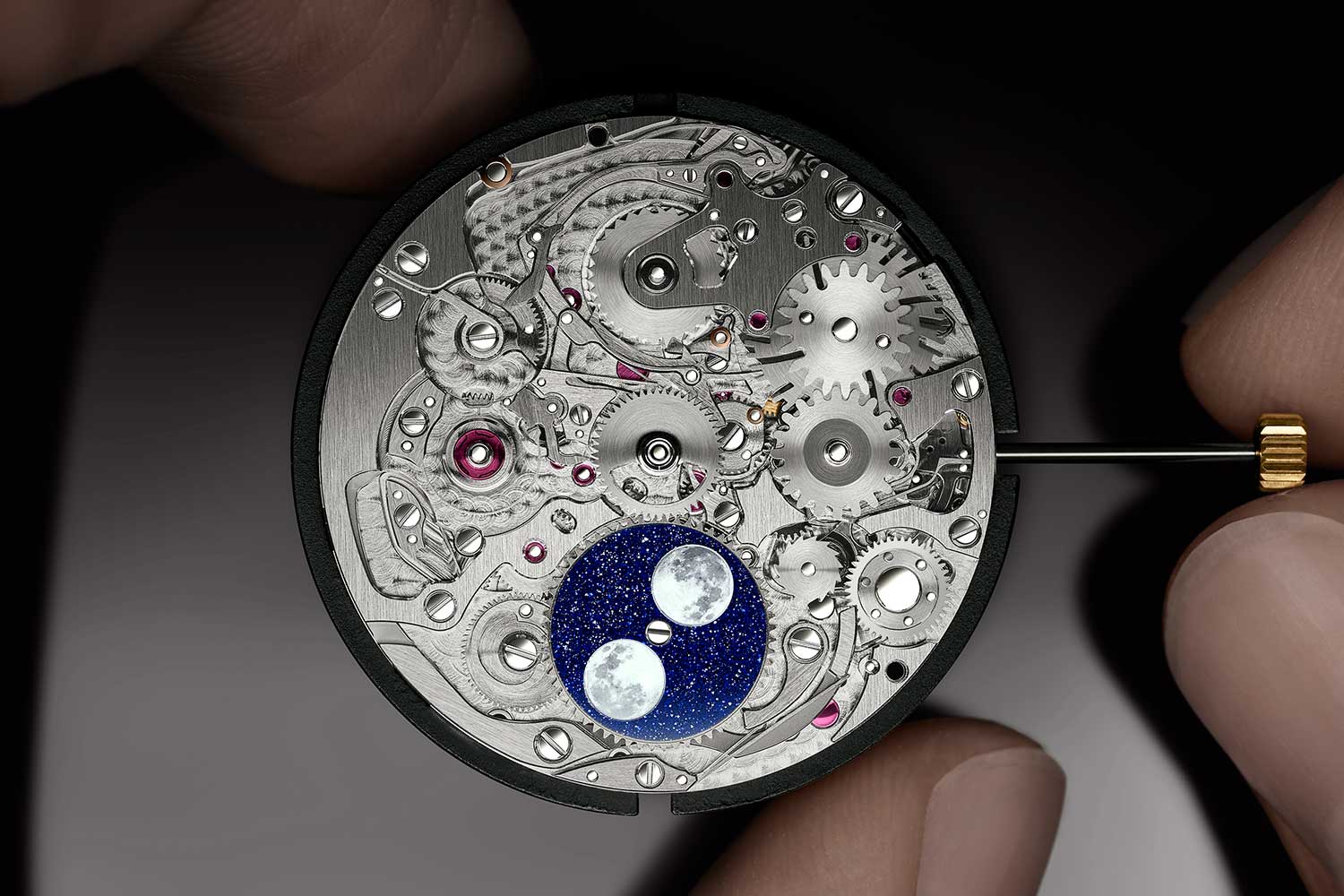
The all-new Audemars Piguet caliber 7138
Second, let’s acknowledge that perpetual calendars, which act as mechanical supercomputers capable of correctly displaying all this information while accurately correcting for the shifting rhythms of the 30- and 31-day months, and even knowing when to add an extra day for the leap year, are fragile and notoriously difficult to adjust. The reason is that they use a series of “correctors” embedded in the side of the case that have to be operated during specific hours and in a particular sequence in order not to damage the movement. But that all changed in 2023 when Audemars Piguet introduced the incredible RD#4, or Ultra-Complication Universelle, a grande complication that made operating the perpetual calendar so effortless that a client could simply pick it up and start using it without fear of damage.
Read: Why Audemars Piguet’s Code 11.59 by Audemars Piguet Universelle RD#4 Is So Good
Says Ilaria Resta, “The RD#4 was a milestone achievement that showed us we had to adapt our complicated watches to be the easiest to use to truly broaden the audience for our complications. Today even a supercar client simply gets in and drives, and that is the idea for the new Caliber 7138. An owner can pick up the watch and after a few minutes they instinctively know how to use it with total confidence.”
What you need to know about this new movement is that it is a direct evolution of the amazing Caliber 5133, which allowed Audemars Piguet to break the record for the world’s thinnest perpetual calendar in 2018 with its amazing RD#2 watch. Specifically, the Caliber 7138 takes the end-of-the-month cam integrated into the date wheel and month cam integrated into the month wheel from that movement.

The new Royal Oak perpetual calendar models (also presents in the new Code 11.59 by Audemars Piguet model) feature new self-winding perpetual calendar models powered by the multi-patented Calibre 7138. Image: Revolution ©

The new crown correction system has enabled the Audemars Piguet teams to eliminate the correctors on the side of the case and streamline the design of the new perpetual calendar models. Image: Revolution ©
But it brings one major new improvement in that every single indicator is operated using the crown. Also, each indicator is individually selected, which is important because there are synchronized perpetual calendars on the market where all information can be adjusted with the crown. But their Achilles’ heel is that if they are adjusted too far forward, there’s nothing you can do but send it to the manufacture or wait agonizingly for time to catch up. In contrast, with the 7138, every indication is individually adjusted, so that if you accidentally set any of them too far forward, you just keep turning the crown to get back to the right point. Even better, Caliber 7138 at 4.09mm is thinner than the outgoing Caliber 5134 at 4.31mm.
Intuitive Setting of the Watch
How does it work? OK, first let’s look at the layout of the all-new dial. What I love about the new Royal Oak Perpetual Calendar watches powered by Caliber 7138 is that the changes to the exterior of the watch are so subtle that you might not notice them at a casual glance. The first clue is the change in layout of the information. Compared to a watch powered by the Caliber 5134, the new watch shifts the date to 12 o’clock, month and leap year to 3 o’clock, moonphase indicator to 6 o’clock, and day and 24-hour time to 9 o’clock. The week indicator stays on the perimeter of the dial. Importantly, all indications now have the first unit of measure oriented at 12 o’clock, meaning 1 for the date, 1 for the week, January for the month and Monday for the day of the week. Previously, it was the last unit of each scale that was oriented at 12.

The subdials have been rearranged and optimised to improve legibility and to display the date in the European format (day, date, month) when reading the dial from left to right. Image: Revolution ©
Personally I love the new displays because having the beginning of each week, month and year positioned in this way as a starting point reflects the way human beings perceive time. Another design element that creates the ultimate visual harmony are the patented progressive steps of the date display, which adapt to the width of the digits.
Says Ilaria Resta, “The subdials of the watch enhance visual clarity, legibility, aesthetic harmony and even reflect the way we order time in our minds.”
Now comes the truly miraculous part of the new Caliber 7138 watches. They feature a four-position crown which you operate in the following way. In its default or first position, pushing the crown winds the watch. However, the power reserve of the movement has increased to 55 hours from the 40-hour reserve of its predecessor. So you probably won’t be winding it much. Pull the crown out once to position 2 and turn it clockwise to adjust the date at 12 o’clock and counterclockwise to adjust the month and leap year indicator at 3 o’clock. Pull the crown out once more to position 3 and you can set the time backwards or forwards.

The new Calibre 7138 perpetual calendar movement puts ergonomics at the forefront by making the corrections of all functions possible via its “all-in-one” crown. Image: Revolution ©
Now here is where the movement really demonstrates its true genius. To operate the day of the week and moonphase indicators, you push the crown back to position 2 and turn the crown clockwise for the day of the week and counterclockwise for the moonphase. This effectively adds a fourth operating position to the crown but by cleverly integrating this into a fixed sequence of out (position 2), out (position 3) and back (position 4), the use of the crown becomes incredibly intuitive. Featured in the 9 o’clock subdial is the 24-hour indicator with a “no correction zone” clearly demarcated in red. What is brilliant about the Caliber 7138 is even if someone tries to change their indicators during this “no go” zone from 9 p.m. to 3 a.m., the watch will not allow it. This means that AP has totally eliminated risk of accidental breakage. The Caliber 7138 and its ingenious mechanism was the result of five years of development and has resulted in three new patents for AP.
A New Epoch: The Royal Oak Perpetual Calendars and Code 11.59 by Audemars Piguet Perpetual Calendar
The marvelous Caliber 7138 is introduced across three different models this year, celebrating Audemars Piguet’s 150th anniversary. Two of these are Royal Oak models, one in stainless steel paying tribute to the origins of the Royal Oak, and one in AP’s proprietary sand gold, a stunning alloy launched last year with the chameleon-like ability to change colors according to light. The third reference is a Code 11.59 by Audemars Piguet 18K white gold model. All three watches feature a special logo in a font based on historical documents provided by the brand’s Heritage Team. All models also feature “1 of 150” engraved on the caseback.
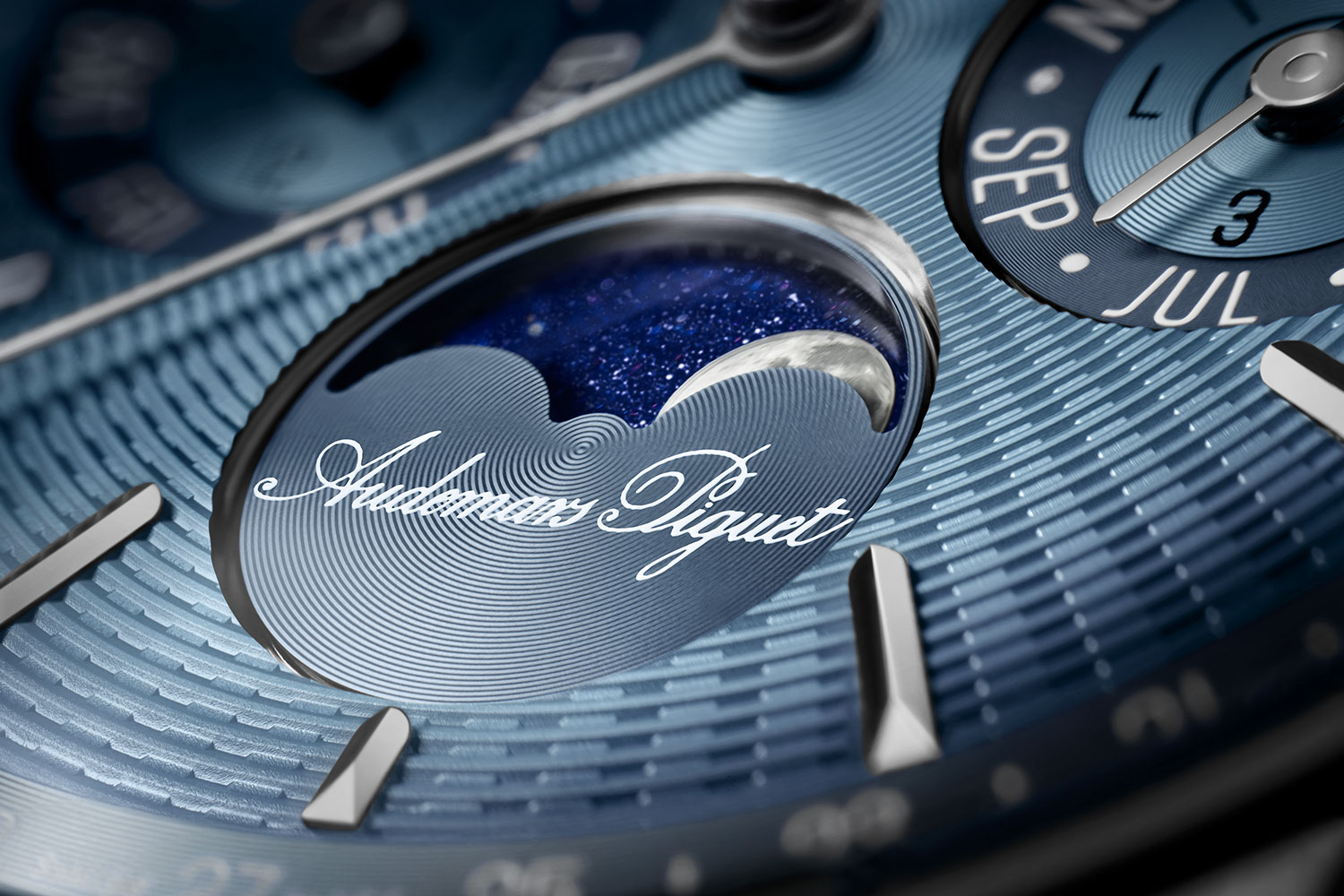
To celebrate Audemars Piguet’s 150th anniversary, special “anniversary” limited editions of the 41mm Code 11.59 by Audemars Piguet and Royal Oak Selfwinding Perpetual Calendar has been created

The limited “anniversary” editions present a vintage “Audemars Piguet” signature inspired by historical documents
The stunning 41 mm by 10.6 mm white gold Code 11.59 by Audemars Piguet Reference 26494BC features a dial that is a masterpiece of nuanced detail. It is color graduated or “fumé” starting with an icy blue in the center and ending with a deep azure at the perimeter. It features a hyper complex guilloché pattern designed by Master Yann von Kaenel of Neuchâtel that begins with micro-concentric circular ripples at the center and explodes into a dynamic basic weave pattern toward the edge of the dial. Together the use of colors and engraving creates a dial that vibrates with dynamic energy.

As worn on me: The new Code 11.59 by Audemars Piguet model presents a refined two-tone aesthetic with its 18-carat white gold case, smoked blue dial and matching rubber-coated strap. Image: Revolution ©
The steel Royal Oak Perpetual Calendar Reference 26674ST measures the same 41mm in diameter and svelte 9.5mm of its predecessor. But it’s the dial of the watch that is transformed. A cruel joke played on me was that by the time I could afford a perpetual calendar, my eyesight had gotten so bad that I couldn’t read it. But this Royal Oak is an exception as the placement of the date display at 12 o’clock, coupled with the patented progressive step that adjusts for the width of the date digits, creates remarkable clarity. The dial features AP’s iconic blue-gray color rendered just a touch lighter to create a wonderful luminous effect and, of course, its iconic grande tappiserie motif.

Royal Oak Selfwinding Perpetual Calendar 41mm Ref. 26674ST. Image: Revolution ©

Royal Oak Selfwinding Perpetual Calendar 41mm Ref. 26674SG. Image: Revolution ©
This model is joined by the ravishing Royal Oak Perpetual Calendar Reference 26674SG in sand gold. This unique and patented alloy “hovers” between white and pink gold; the change in hue depending on how light hits it is dramatic. In certain light, it can appear almost monochrome, and in different conditions, it explodes with a warm radiance. What I love about this and all of AP’s considerable efforts in material innovation is that an AP can be recognized across the room not only for its unmistakable shape, as in the case of the eight-sided Royal Oak bezel, but now also because of its signature color. All watches feature three patents — two for the innovative new crown and one for the progressive step of the date indicator.
Considering how enamored I am with the new Caliber 7138, I’m pleased to report the dissipation of any residual existential angst at the departure of my beloved Caliber 5134. Because of the technical brilliance in this first act in Audemars Piguet’s 150th anniversary celebrations, life itself has been restored to me and my confidence in the universe now resumes unshaken. For this, Audemars Piguet, I thank you.

Tech Specs: Audemars Piguet Code 11.59 by Audemars Piguet Selfwinding Perpetual Calendar 41mm
Reference: 2649BC.OO.D350KB.01
Movement: Self-winding Caliber 7138; 55-hour power reserve
Functions: Hours and minutes; central seconds; perpetual calendar with week indication; day; date; astronomical moon; month; leap year
Case: 41mm × 10.6mm; 18K white gold; water-resistant to 30m
Dial: Smoked blue Code 11.59 by Audemars Piguet embossed signature dial
Strap: Blue textured rubber with calfskin lining and 18K white gold three-blade folding clasp
Availability: Includes a special “Anniversary” limited edition made in 150 pieces

Tech Specs: Audemars Piguet Royal Oak Selfwinding Perpetual Calendar 41mm
Reference: 26674ST.OO.1320ST.01; 26674SG.OO.1320SG.01
Movement: Self-winding Caliber 7138; 55-hour power reserve
Functions: Hours and minutes; central seconds; perpetual calendar with week indication; day; date; astronomical moon; month; leap year
Case: 41mm × 9.5mm; stainless steel or 18K sand gold; water-resistant to 50m
Dial: Grand Tapisserie pattern in blue or sand gold
Strap: Stainless steel or 18K sand gold bracelet; both with AP folding clasp
Availability: Includes a special “Anniversary” limited edition made in 150 pieces each
Audemars Piguet

You may also like

News
Audemars Piguet Concludes RD Series With Royal Oak “Jumbo” Extra-Thin Flying Tourbillon Chronograph RD#5
Oct 30, 2025
News
Audemars Piguet Concludes RD Series With Royal Oak “Jumbo” Extra-Thin Flying Tourbillon Chronograph RD#5
Oct 30, 2025

Reference
Five Chapters of Innovation in Complications: The Audemars Piguet RD Series
Oct 22, 2025
Reference
Five Chapters of Innovation in Complications: The Audemars Piguet RD Series
Oct 22, 2025

News
Audemars Piguet Brings The Perpetual Calendar To 38mm For The First Time And Introduces A Trio Of Vibrant Stone Dials
Sep 10, 2025
News
Audemars Piguet Brings The Perpetual Calendar To 38mm For The First Time And Introduces A Trio Of Vibrant Stone Dials
Sep 10, 2025