


Trump, Tariffs, And Sydney Sweeney: Does Woke Culture Belong In The Swiss Watch Industry?
Opinion
Trump, Tariffs, And Sydney Sweeney: Does Woke Culture Belong In The Swiss Watch Industry?

You have to admit Donald Trump has a flair for the dramatic, as his big, beautiful “Trump tariff” amounting to a 39-percent tax on Swiss imports to the U.S. was not so much announced but blasted across the proverbial bow of my favorite Alpine nation on no less than the Swiss National Day. I could imagine innumerable glasses of delicious ice-cold Petite Arvine and Chasselas wine frozen in mid-air as a rictus of fear washed through Swiss President Karin Keller-Sutter before passing through a multitude of watch brand owners. After all, the United States has grown rapidly from importing 3 billion Swiss francs of luxury watches in 2021 to an impressive 4.4 billion Swiss francs last year.
That is, for context, more than double that of China’s 2 billion Swiss francs of watch imports with its floundering luxury market. Having said that, Singapore which ranks sixth, imported 1.6 billion Swiss francs’ worth of watches in 2024, and it did so with a population of just 6 million people, which is 57 times smaller than that of the U.S. and 233 times smaller than that of China.

President of the Swiss Confederation, Karin Keller-Sutter (Image: Fabrice Coffrini/AFP/Getty Images)
To make it clear, Keller-Sutter has expressed her intention to continue negotiations, and I hope for the best. Without the United States contributing the heavy-lifting in Swiss luxury watch consumption, our industry will face a serious challenge. One common belief is that Trump’s 39-percent tariff is a tactic to compel Keller-Sutter, who had thought that Switzerland would receive at most a 10-percent tariff, to return to the bargaining table. The White House has stated that, “Switzerland, being one of the wealthiest, highest income countries in the world, cannot expect the United States to tolerate a one-sided trade relationship.”
Keller-Sutter, in a statement to Reuters, stated that her government would keep negotiating with Washington, but there were only limited concessions it could offer, as U.S. imports already enjoyed 99.3-percent free market access. She explained, “We have companies that have made very important direct investments (in the U.S.). It’s really difficult to give more.”
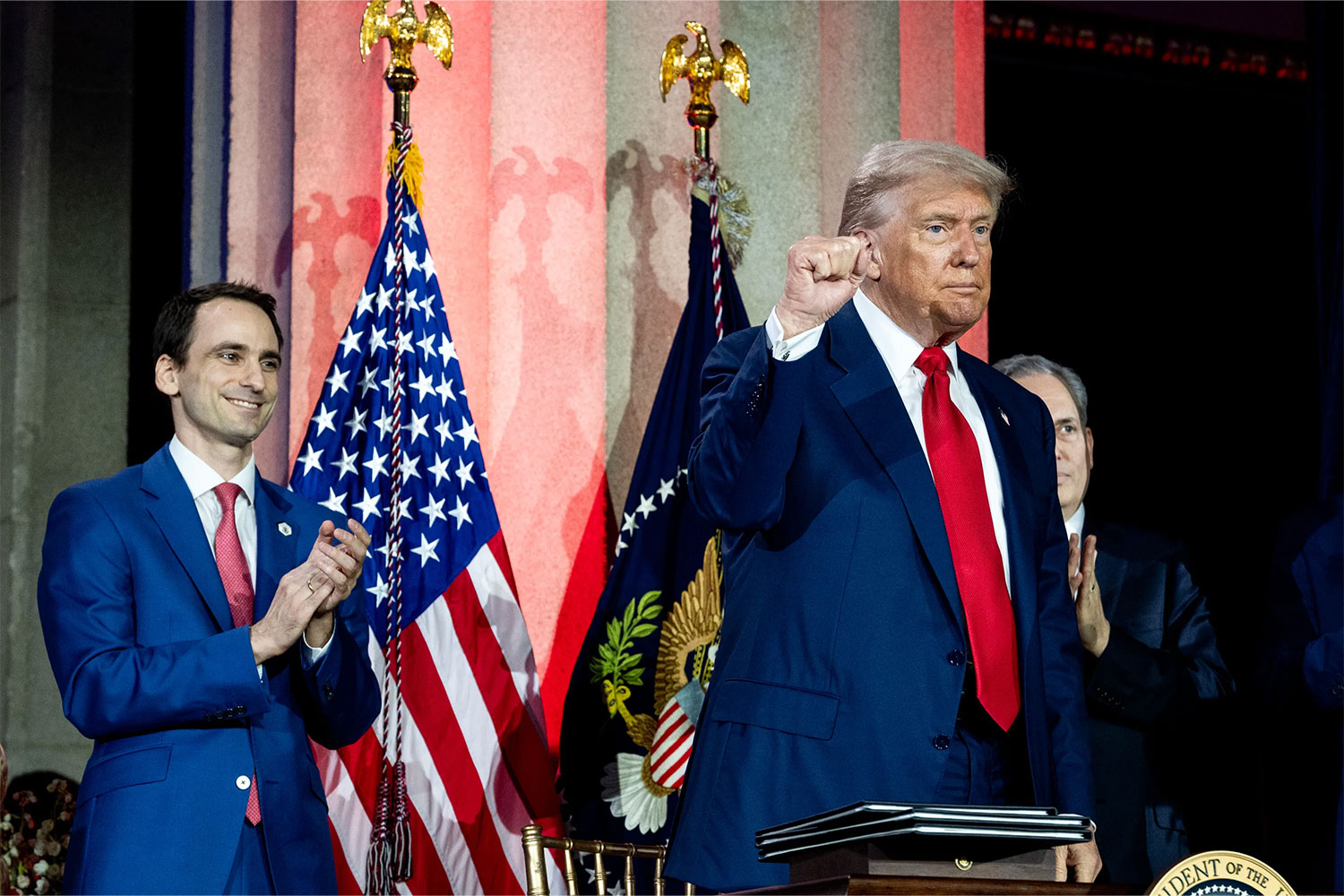
President Donald Trump delivers remarks at the White House AI Summit at Andrew W. Mellon Auditorium in Washington, D.C. (Image: The White House)
Trump’s target may not be the Swiss watch industry, but Switzerland’s pharmaceutical business, which is the country’s largest exporting industry, accounting for 40 percent of total Swiss exports. Over half of Swiss pharmaceutical exports go to the U.S., with a total value of 35.5 billion U.S. dollars. On August 1, 2025, Trump sent 17 letters to major pharmaceutical companies demanding that they reduce drug prices in the United States. Amongst these is the Swiss giant Novartis. Already in April, in response to the earlier announced 31-percent tariff, Novartis pledged 23 billion U.S. dollars to build 10 plants in the U.S., with another 27 billion U.S. dollars in further investments by 2030. Another Swiss company, Roche, the second largest pharmaceutical manufacturer in the world, generates 50 percent of its sales in the U.S., where medicines are on average three to four times higher than the cost of medicines in other high-income, developed countries. So, there may be some underlying method to the seeming madness. Unfortunately, it appears that the Swiss watch industry is, for now, collateral damage in this trade war.
Why Sydney Sweeney’s American Eagle ad sparked outrage — and what it says about the culture war
I am by no means pro-Trump, or pro-anyone in American politics, as I am a Singaporean. And no, Senator Cotton, I am not a member of the Chinese Communist Party. Incidentally, please don’t paint me as supportive of TikTok’s Chew Shou Zi either, as I’m of the opinion that this platform and all forms of social media are responsible for the global deracination of literateness and critical thought, and a massive exacerbator of sowing divisiveness across the world — more on this later. But I thought this would be an apt moment to, as objectively as possible, from the perspective of a non-American, understand why Donald Trump got elected to his second term.
It’s simple — at least to an outsider like me. The Woke Left just went too far. I can condense this down to, of all things, Sydney Sweeney’s American Eagle campaign, which now finds itself at the epicenter of controversy. As someone who can recall the ’80s and ’90s, when Brooke Shields’ and later Kate Moss and Marky Mark’s “Nothing comes in between me and my Calvins” commercials appeared on TV, I was a little baffled by the uproar.
While I try to limit my time on social media, as I can genuinely feel my remaining brain cells dying each time I spiral into a death scroll, what I can ascertain is the following: Firstly, people are upset because Sydney Sweeney is too attractive and, in an age of inclusivity, they feel that advertisements should instead be portraying a variety of body types as beautiful.
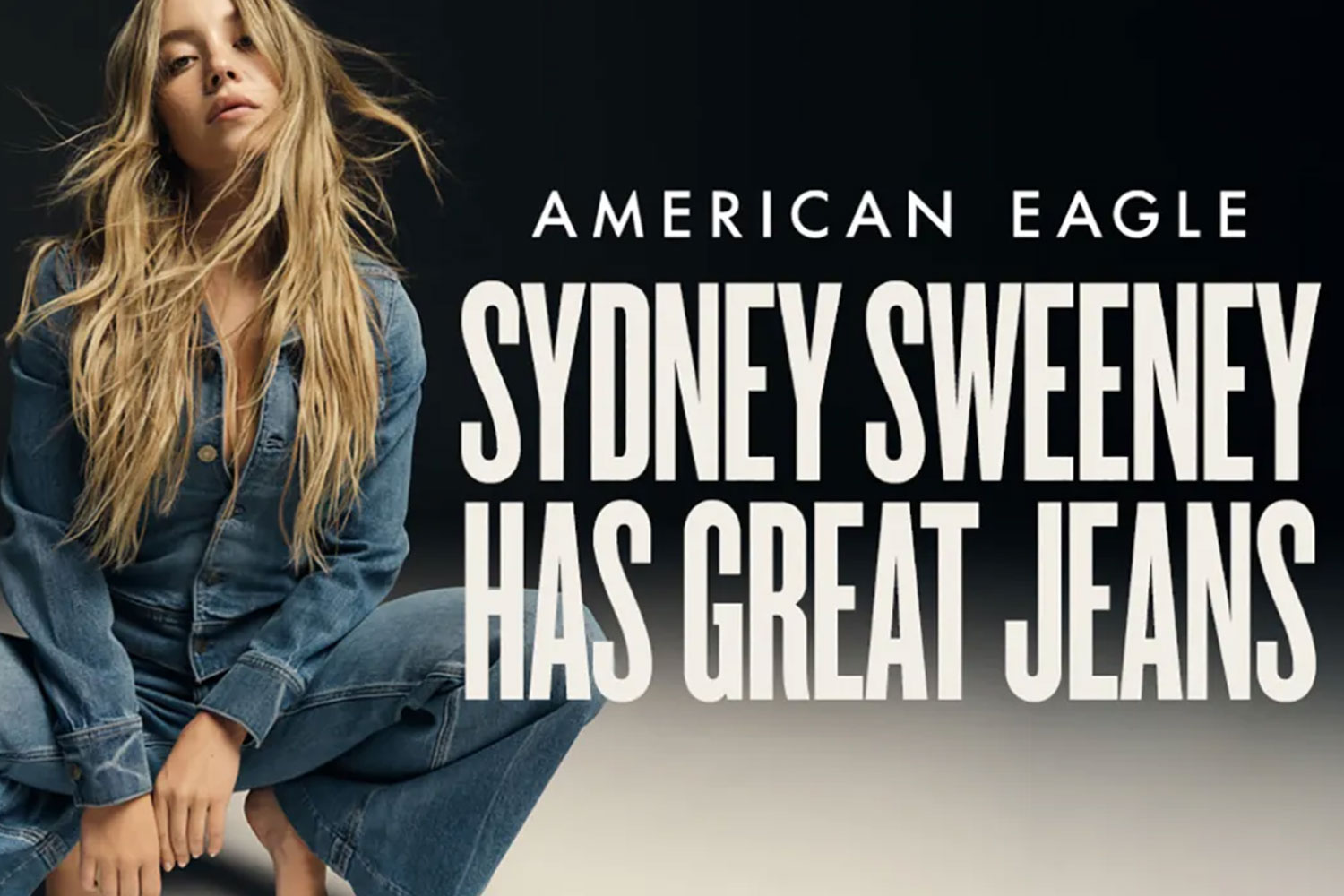
The latest American Eagle campaign featuring Sydney Sweeney
Secondly, the ad uses the term “jeans” interchangeably and pun-tastically with “genes,” and because she has blonde hair and blue eyes, it is believed she is pushing some kind of Nietzschean Übermensch, “master race” narrative. One influencer on social media claimed to feel victimized because she felt excluded by Sweeney’s attractiveness. I’m sorry, but have we become so ridiculous as a society that a reasonably attractive young woman with what is objectively a very cool car — a Shelby Mustang GT350 — can’t do an ad for jeans without people feeling victimized?
The far more pertinent question is: did Sweeney actually perform the GT350’s burnout and donut inside the studio herself. If so, she deserves some serious respect. To watch that impressive stunt, check out the video:
And yes, I said “reasonably attractive” because I honestly can’t say that Sweeney is the hottest woman I’ve ever seen. That person, for me, is and will always be my wife, who, in terms of physical attractiveness and in every hotness metric, is on another level to any other woman on the planet.
Wokeness and the Swiss Watch Industry
Has wokeness become a factor in the Swiss watchmaking industry, too? Actually, from what I can see, it hasn’t. Maybe there is just too much common sense in our industry. What has happened is a very nice sense of inclusivity today, which is a great thing. Collectors, journalists, influencers and brand management, owners and founders are richly varied in every way. What I like about the watch industry is that it is genuinely a meritocracy. If you’re good, you’ll succeed; if you suck, you won’t. Enough said.
But the recent Sydney Sweeney/American Eagle controversy reminded me of a moment three Geneva Watch Days ago. I had organized a symposium about how watches were becoming a new asset class for investors, and I had made what was meant to be a joke that watches, in the long run, would be far more transportable and would cost you far less money than yachts, racehorses, your art collection or your mistress. (Something that I think Andy Byron, the former CEO of Astronomer, who was caught on a Coldplay concert kiss cam embracing his “Chief People Officer,” Kristin Cabot, can attest to).
In Geneva, later that evening, during a charity backgammon tournament I was hosting, an American woman with flaming red hair approached me. She appeared bleary-eyed and was clutching a large glass of the free-to-her champagne that I was paying for. As she saw me, she launched immediately into a tirade, bellowing, “Wei Koh, I accuse you of being a sexist and objectifying women. You grouped them together with yachts and paintings implying that they are objects. How dare you? I demand an apology.”

I was, of course, taken aback, when thus confronted by an apoplectic and seemingly inebriated, uninvited guest to my own event. But anyway, I thought it would be best to apologize to her. I replied, “Madam, that was not my intention, but if you take umbrage at my words, I deeply and profoundly apologize.”
Somewhat appeased and noticing that her glass of free-to-her champagne was empty, she trundled over to the bar counter, leaving her male companion behind. He was a slim fellow with a similar shock of red hair. Also clutching a glass of free-to-him champagne, he decided it was his turn and started ranting while spraying saliva over me, “I also demand an apology. In one of your videos, you said that anyone that flips an Omega Ultraman is an asshole. And I bought this watch but I didn’t like it. It didn’t please me. So I sold it. I, too, demand an apology for your words.”
I thought about it and decided best to appease him as well. I looked him in the eyes and said, “Sir, I am very sorry you are such an asshole.” It was at the moment I also decided to stop supplying alcohol to strangers and, as such, there have been no more Revolution-sponsored parties as of this year. I’ve grown tired of financing the very inebriation that emboldens people to act like jackasses.
Amusingly, about a week after those incidents, a friend of mine forwarded a screenshot from an “empowerment chat group,” which I presume to be the WhatsApp equivalent of the Little Rascals’ “He-Man Woman Haters Club,” where that very same woman claimed to have “sent me scurrying like a frightened mouse” after confronting me, or something along those lines. Another individual, herself a well-known subject of controversy for her alleged receptivity to gifting in return for watch allocation, replied, “You go, gurl!” And it dawned on me that wokeism has, to a large extent, become about sowing division.
But why has it resonated so powerfully with certain people — and why has it not taken hold of the Swiss watch industry?
The four keys to happiness
I think it comes down to this. I recently read that for a human being to be happy, he or she needs four things: Friendship, Purpose, Family and Faith. Friendship is a pretty straightforward thing. It is the people we choose to surround ourselves with. Now what I love about the Swiss watch industry is that the people in our industry don’t form close friendships easily, but when they do, it really means something. I feel this is better than in certain cultures where everyone is your buddy, everyone loves you, but these relationships are, in my opinion, a bit superficial. In Switzerland, when someone says they are your friend, they go to bat for you. They will go the hard route for you, they will make that extra effort — and that is something I’m always impressed by and one of the reasons I love being in this industry.
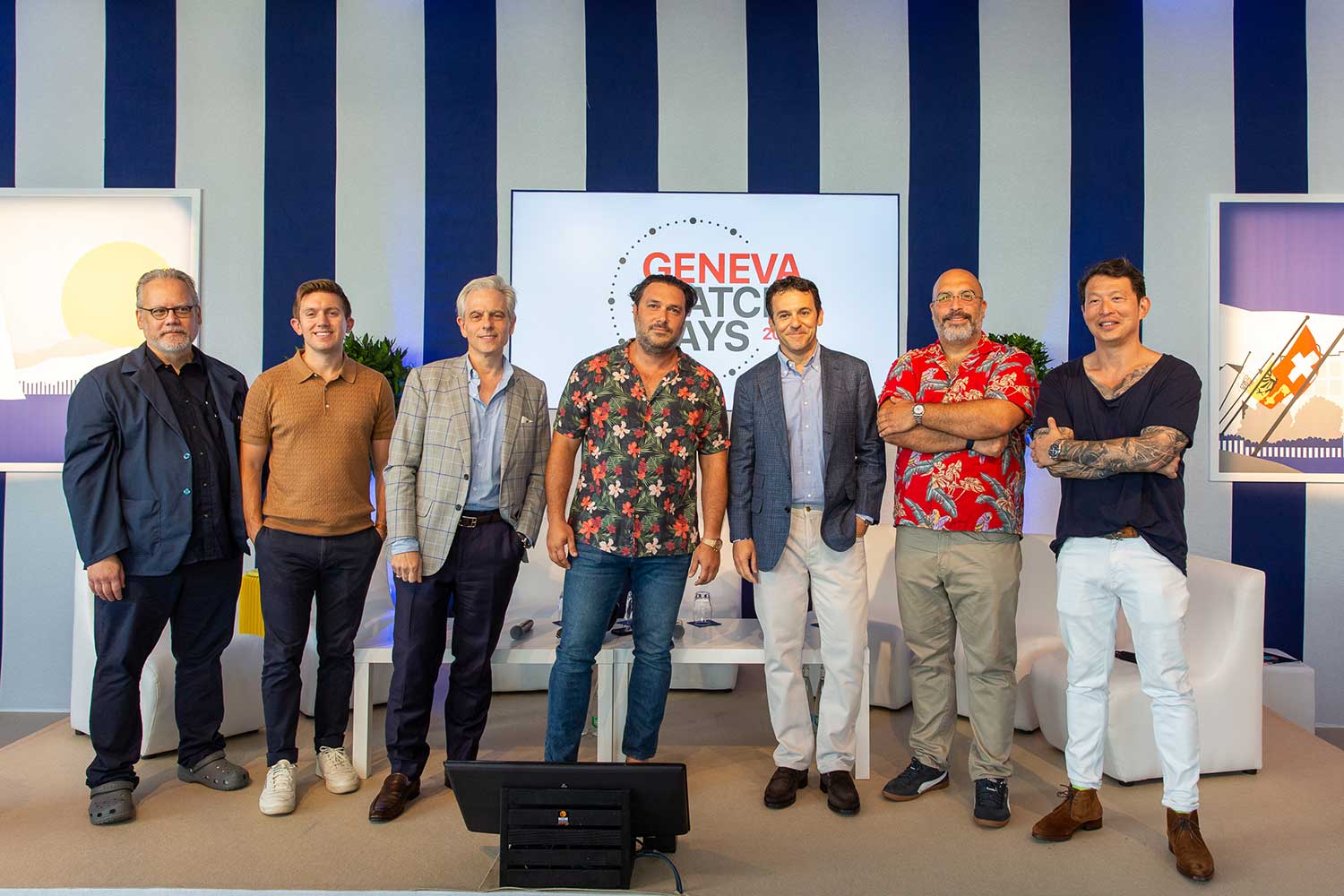
Participating panelists from one of the Horological Symposiums at Geneva Watch Days 2024
Purpose is something that I’ve found professionally through watches. But I also like that in our business, purpose is synonymous with the achievement of excellence. What I love about the watch industry is the expectation that you don’t just go one extra step. You always go two steps further. Take, for example, the tremendous effort that Catherine Eberlé-Devaux and Françoise Bezzola have put into organizing the upcoming Geneva Watch Days, which takes place from September 4 to 7, 2025.
When it comes to Family, this is sacrosanct in Switzerland. It’s funny, I used to get a little irritated when people in the industry went on their holidays in August and no one would answer a text or email. But as someone who is very happily married and hopes to have a family one day, I can understand how important it is to have this time to enjoy with your loved ones.
Finally, there is Faith. For context, the entire Swiss watch industry was built on faith by the Huguenots, who were fleeing religious persecution in France and wanted to build a better life with the freedom to worship God as they chose. As I get older, I appreciate more the importance of faith, because it makes you understand there is far greater meaning to the world beyond yourself and your own little ego.
I am of the belief that wokeism has grabbed so many people, because it fills the gaps when any of these four key things are missing in our lives. And because of the addiction-inducing algorithms underlying social media platforms that feed you incessant content that confirms your bias, no matter how warped, you are made to feel constantly vindicated and empowered so long as there’s battery power in your phone.
Social cohesiveness in the Woke era
Someone with a perspective on woke culture that I agree with is Singapore’s former Prime Minister Lee Hsien Loong, where he explains that it makes life rather burdensome. You can watch that video here:
Wokeness certainly does not, as Lee states, make us a more cohesive, resilient society with a strong sense of solidarity. One of the things that I am proud of as a Singaporean is that we are united as a nation, despite the fact that we are comprised of multiple ethnic and religious groups.
Perhaps the most appalling extension of wokeism is how in the West, the rights of criminals seem to be prioritized over the rights of their victims. Zero fear of repercussions for violent watch crimes is the reason why it’s utterly unsafe to wear any luxury watch in the majority of Europe’s capital cities, including Paris, Rome, Madrid and London. Quite honestly, Milan, Barcelona, New York and Los Angeles are not significantly better. California has become particularly ludicrous, thanks to Penal Code 459.5, where shoplifting is considered a misdemeanor. It is only charged as a felony, or as “grand theft,” if the value of the stolen items is greater than 950 U.S. dollars. A thief might even get the charges reduced if he or she claims that they only decided to steal after entering the store, in which case the worst that can happen is a conviction for petty theft, and if they are a first timer, it means they usually serve community service.
But I know one state where watch crime is probably as low as it gets in the U.S. And that is Montana, where I had the pleasure of working for a year as a hand on the N-Bar Ranch. In Montana, there are repercussions to bad behavior. If you insult someone, you will most likely be punched in the face — and I’ve witnessed this quite a few times. If you threaten someone by trying to violently rob them, you will be shot.
Similarly, it is the fear of repercussions for crimes — enforced through robust legal systems — that makes it perfectly safe in both Singapore and Dubai, where you could leave your Patek Philippe Grandmaster Chime at a Starbucks to hold your table.
A word on inclusivity in the watch world
All things considered, perhaps the best reason wokeness has proven unnecessary in the watch industry is that watches transcend race, religion, age, gender and sexual orientation effortlessly. They are a universal language that is completely transversal. Why do we love them so much? I believe that as human beings, we are innately drawn to mechanical systems, because they remind us of ourselves. But of all the marvels of engineering, it is the mechanical watch we are drawn to and love the most, because it is the only mechanical system with a heartbeat that is as enduring, as everlasting and as universal as our own. When we look at a watch, we see ourselves reflected back — maybe the very best idealistic versions of ourselves, and that is perhaps why we always smile when confronted by such universally appealing beauty.
You may also like

Editorial
After F1’s Luxury Boom, Are Cycling and Sailing Next?
Aug 12, 2025
Editorial
After F1’s Luxury Boom, Are Cycling and Sailing Next?
Aug 12, 2025
People
Farewell To My Friend And Hero, Angelo Bonati
May 16, 2025
People
Farewell To My Friend And Hero, Angelo Bonati
May 16, 2025

Opinion
Was the 1920s the Most Influential Decade in Wristwatch History?
May 7, 2025
Opinion
Was the 1920s the Most Influential Decade in Wristwatch History?
May 7, 2025